


College of Foreign Language, Inner Mongolia University of Technology, Hohhot, 010050, China
Received: January 5, 2026
Accepted: March 22, 2026
Publication Date: May 21, 2026
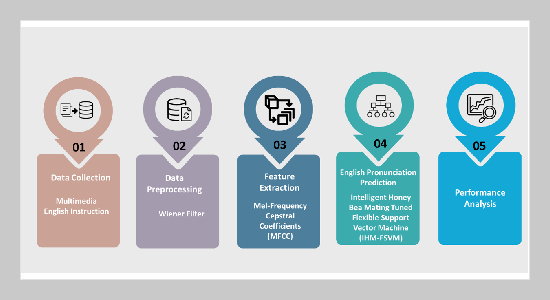
Methodology Flow Diagram
Copyright The Author(s). This is an open access article distributed under the terms of the Creative Commons Attribution License (CC BY 4.0), which permits unrestricted use, distribution, and reproduction in any medium, provided the original author and source are cited.
Download Citation: BibTeX | http://dx.doi.org/10.6180/jase.202609_32.049
Integrating digital media and interactive learning has transformed English instruction, enhancing teaching and learner engagement. Limited resources hinder spoken proficiency, but advances in digital media and ML provide solutions. This study proposes an ML-based pronunciation model using Intelligent Honeybee Mating tuned FSVM (IHM-FSVM) in an online interactive framework. Students used multimedia instruction via apps, videos, and gamified exercises. Speech data were preprocessed with Wiener filtering and features extracted with MFCC. IHM-FSVM outperformed conventional methods, achieving 97.9% accuracy, 95.9% recall, 96.2% precision, and 96.5% F1-score, demonstrating its effectiveness in improving interactive English learning and pronunciation.
Keywords: English Teaching; Digital Media; Interactive Learning; Intelligent Honeybee Mating tuned Flexible Support Vector Machine (IHM-FSVM)
- [1] L. Ma, (2021) “An immersive context teaching method for college English based on artificial intelligence and machine learning in virtual reality technology” Mobile Information Systems 2021(1): 2637439. DOI: 10.1155/2021/2637439.
- [2] W. Pranawengtias, (2022) “Undergraduate students’ motivation on English language learning at Universitas Teknokrat Indonesia” Journal of English Language Teaching and Learning 3(2): 27–32. DOI: 10.33365/jeltl.v3i2.1956.
- [3] B. B. Dash, (2022) “Digital tools for teaching and learning English language in 21st century” International Journal of English and Studies 4(2): 8–13. DOI: 10.47311/IJOES.2022.4202.
- [4] N. R. Putri and F. M. Sari, (2021) “Investigating English teaching strategies to reduce online teaching obstacles in the secondary school” Journal of English Language Teaching and Learning 2(1): 23–31. DOI: 10.33365/jeltl.v2i1.780.
- [5] B. Mandasari and D. Aminatun, (2022) “Investigating teachers’ belief and practices toward digital media of English learning during COVID-19 pandemic” English Review: Journal of English Education 10(2): 475–484. DOI: 10.25134/erjee.v10i2.6248.
- [6] C. Rwodzi, L. De Jager, and N. Mpofu, (2020) “The innovative use of social media for teaching English as a second language” Theological Studies 16(1): DOI: 10.4102/td.v16i1.702.
- [7] T. Eli, (2021) “Students’ perspectives on the use of innovative and interactive teaching methods at the University of Nouakchott Al Aasriya, Mauritania: English department as a case study” International Journal of Technology, Innovation and Management 1(2): 90–104. DOI: 10.54489/ijtim.v1i2.26.
- [8] K. R. N. Malikovna, S. Z. Mirsharapovna, S. M. Shadjalilovna, and A. A. Kakhramonovich, (2022) “Types of interactive methods in teaching English to students” Texas Journal of Multidisciplinary Studies 14: 1–4.
- [9] W. Simpol, P. Paulina, P. Sinthong, and P. Praraksa, (2022) “Research and development an online training course to enhance teacher competency in creating digital media for teaching English” UMGESHIC Conference Proceedings 1(2): 965–978. DOI: 10.30587/umgeshic.v1i2.3505.
- [10] M. Anis, (2023) “Leveraging artificial intelligence for inclusive English language teaching: Strategies and implications for learner diversity” Journal of Multidisciplinary Educational Research 12(6): 54–70.
- [11] Z. Sun, M. Anbarasan, and D. J. C. I. Praveen Kumar, (2021) “Design of online intelligent English teaching platform based on artificial intelligence techniques” Computational Intelligence 37(3): 1166–1180. DOI: 10.1111/coin.12351.
- [12] W. Villegas-Ch, M. Román-Cañizares, and X. Palacios-Pacheco, (2020) “Improvement of an online education model with the integration of machine learning and data analysis in an LMS” Applied Sciences 10(15): 5371. DOI: 10.3390/app10155371.
- [13] A. S. G. Samosir, (2023) “The meaning of well-being for undergraduate medical students: Perspectives from Indonesia” PhD Thesis, University of Glasgow: DOI: 10.5525/gla.thesis.83604.
- [14] F. Wirawan, (2020) “A study on the teaching media used by the English teacher at SMP Muhammadiyah 2 Malang” Jurnal Ilmiah Profesi Pendidikan 5(2): 89–95. DOI: 10.29303/jipp.v5i2.115.
- [15] A. Almufarreh and M. Arshad, (2023) “Promising emerging technologies for teaching and learning: Recent developments and future challenges” Sustainability 15(8): 6917. DOI: 10.3390/su15086917.
- [16] M. Ayu and Z. F. Pratiwi, (2021) “The implementation of online learning in English language teaching during pandemic: The teachers’ voice” Journal of Research on Language Education 2(2): 93–99. DOI: 10.33365/jorle.v2i2.1316.
- [17] H. Guo and W. Gao, (2022) “Metaverse-powered experiential situational English-teaching design: An emotion-based analysis method” Frontiers in Psychology 13: 859159. DOI: 10.3389/fpsyg.2022.859159.
- [18] W. Lu, G. N. Vivekananda, and A. Shanthini, (2023) “Supervision system of English online teaching based on machine learning” Progress in Artificial Intelligence 12(2): 187–198. DOI: 10.1007/s13748-021-00274-y.
- [19] P. Zhang, (2023) “Cloud computing English teaching application platform based on machine learning algorithm” Soft Computing: 1–13. DOI: 10.1007/s00500-023-08589-9.
- [20] Q. Yang, (2022) “Analysis of English cultural teaching model based on machine learning” Computational Intelligence and Neuroscience 2022(1): 7126758. DOI: 10.1155/2022/7126758.
- [21] Y. Chen, (2024) “Application of multimedia technology in teaching English in colleges and universities” International Journal of Maritime Engineering 1(1): 333–346. DOI: 10.5750/ijme.v1i1.1365. [22] L. Qian, (2022) “Research on college English teaching and quality evaluation based on data mining technology” Journal of Applied Science and Engineering 26(4): 547–556. DOI: 10.6180/jase.202304_26(4).0011.