




1School of Engineering Management, Zhengzhou University of Economics and Business, He’nan Zhengzhou, 451191, China
2School of Civil Engineering, Chongqing Jiaotong University, Chongqing, 400074, China
Received: February 3, 2026
Accepted: April 23, 2026
Publication Date: May 21, 2026
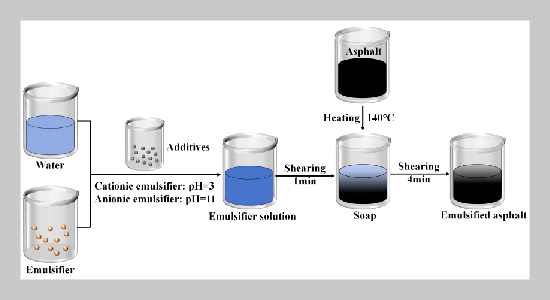
The preparation process of emulsified asphalt
Copyright The Author(s). This is an open access article distributed under the terms of the Creative Commons Attribution License (CC BY 4.0), which permits unrestricted use, distribution, and reproduction in any medium, provided the original author and source are cited.
Download Citation: BibTeX | http://dx.doi.org/10.6180/jase.202609_32.048
This study investigates the interfacial characteristics and stabilization mechanisms of anionic emulsifiers (KDS and SDBS) and cationic emulsifiers (STAC and STAB) in asphalt emulsions through interfacial tension analysis, storage stability testing, and molecular dynamics (MD) simulations. The results demonstrate that cationic systems exhibit superior performance; STAC and STAB reduced interfacial tension by 63.6% and 62.6%, respectively, significantly outperforming the anionic systems (50.8% and 47.3% ). Furthermore, cationic systems maintained 5-day storage separation rates below 5%, whereas anionic systems exceeded 13%. MD simulations elucidated that cationic emulsifiers form dense interfacial monolayers through robust electrostatic interactions, characterized by an interfacial energy of −85kcal/mol and an aggregation peak of 13.26. Notably, electrostatic forces accounted for more than 65% of the total interaction energy in cationic systems. In contrast, anionic emulsifiers exhibited loose adsorption patterns due to electrostatic repulsion, resulting in a higher interfacial energy of −70kcal/mol. Hydrophilic-lipophilic balance (HLB) analysis further confirmed optimal values for cationic surfactants, whereas KDS exhibited excessive hydrophilicity. All experiments were conducted under standard conditions (60◦C for interfacial tension measurement, 25◦C for storage stability testing, and pH 7.0 ). These findings provide fundamental molecular-level insights for the design of high-performance emulsified
asphalt.
Keywords: Emulsified asphalt; Emulsifier; Oil-water interface; Molecular dynamics; Stability
- [1] Z. Yingyong, H. Sen, Z. Congcong, L. Youdong, and M. Changpeng, (2024) “Preparation and application of rubber modified emulsified asphalt” Construction and Building Materials 411: 134540. DOI: 10.1016/J.CONBUILDMAT.2023.134540.
- [2] T. Wei, Z. Songxiang, K. Lingyun, P. Yi, X. Lei, and F. Yaoguo, (2022) “Influence of aggregate chemical composition on the demulsification rate of emulsified asphalt” Frontiers in Materials 9: 1079431. DOI: 10.3389/FMATS.2022.1079431.
- [3] C. Hu, J. Zhao, Z. Leng, M. N. Partl, and R. Li, (2019) “Laboratory evaluation of waterborne epoxy bitumen emulsion for pavement preventative maintenance application” Construction and Building Materials 197: 220–227. DOI: 10.1016/j.conbuildmat.2018.11.214.
- [4] X. Yifeng, J. Jie, and C. Qian, (2022) “Road Performance Comprehensive Evaluation of Polymer Modified Emulsified Asphalt Fiber Microsurfacing” Advances in Materials Science and Engineering 2022: 8179137. DOI: 10.1155/2022/8179137.
- [5] J. Nazim, KamranFarshad, B. MoghaddamTaher, and HashemianLeila, (2024) “Evaluation of Mechanical Performance of Asphalt Emulsion Stabilized Base Course Composed of Reclaimed Asphalt Pavement and Asphaltenes” Department of Civil and Environmental Engineering, Faculty of Engineering, University of Alberta, Edmonton, Alberta, Canada;Department of Civil and Environmental Engineering, 7-370 Donadeo Innovation Centre for Engineering, Edmonton, Alberta, Canada;Department of Civil and Environmental Engineering, 7-255 Donadeo Innovation Centre for Engineering, Edmonton, Alberta, Canada 52(1): 268–289. DOI: 10.1520/JTE20230205.
- [6] Y. Wang, Y. Gao, Q. Zhang, and Q. Meng, (2018) “A novel cationic emulsifier used for preparing slow-cracking and rapid-setting asphalt: Synthesis, surface activity, and emulsification ability” Journal of Dispersion Science and Technology 39(4): 478–483. DOI: 10.1080/01932691.2017.1326122.
- [7] L. Xiujun, W. Ningning, Z. Heng, Q. Xiangying, and S. Fangzhi, (2025) “Molecular simulation on influence of modifier on emulsified asphalt oil-water interfacial stability” Journal of highway and transportation research and development 42(01): 44–53. DOI: 10.3969/j.issn.
- [8] Y. Xiaoguang, T. Lingzhi, and X. Tao, (2022) “Preparation, properties and compound modification mechanism of waterborne epoxy resin/styrene butadiene rubber latex modified emulsified asphalt” Construction and Building Materials 318: 126178. DOI: 10.1016/J.CONBUILDMAT.2021.126178.
- [9] L. Yanan, Z. Yuzhen, and H. Shucai, (2022) “A High Proportion Reuse of RAP in Plant-Mixed Cold Recycling Technology and Its Benefits Analysis” Coatings 12(9): 1283. DOI: 10.3390/COATINGS12091283.
- [10] Z. Yang, C. Jiang, Q. Xiang, J. Wu, J. Li, Z. Cao, and F. Xiao, (2025) “Probing the stability of emulsified asphalts: A dual analysis of zeta potential and particle size” Fuel 396: 135266. DOI: 10.1016/J.FUEL.2025.135266.
- [11] S. Liu, (2008) “Emulsified asphalt and its application in road and construction engineering” China Building Materials Press: Beijing, China:
- [12] H. Daniel, S. Wen, and D. Hugh, (2021) “Examining the role of salinity on the dynamic stability of Pickering emulsions.” Journal of colloid and interface science 608(P3): 2321–2329. DOI: 10.1016/J.JCIS.2021.10.176.
- [13] Z. X, B. Y, Q. Y, G. R, W. Z, S. X, and J. W, (2012) “Influence of inorganic salts on emulsion stability and phase inversion” Inorganic Chemicals Industry 44(09): 25–28+31. DOI: 10.1016/j.colsurfa.2013.03.03.
- [14] S. Shuang, Q. Xiujie, C. Conglin, W. Xing, M. Tao, and K. Lingyun, (2023) “Stability of dodecyl sulfate emulsified asphalt: The overlook effect of dissociated counterions” Journal of Molecular Liquids 392(P1): 123462. DOI: 10.1016/J.MOLLIQ.2023.123462.
- [15] C. Xing, Z. Han, M. Li, B. Zhu, Z. Sun, Y. Wang, and S. Wang, (2026) “Thermal history-induced nanoscale surface characteristics of bitumen: implications of sample preparation on accurate characterization” Applied Surface Science 730: 166309. DOI: 10.1016/J.APSUSC.2026.166309.
- [16] S. Zhu, L. Kong, Y. Peng, Q. Zeng, B. Feng, O. Jian, P. Zhao, W. Zhang, and Z. Li, (2024) “Long-chain alkyl emulsifiers induced asphalt particle dispersion: Lipophilicity-enhancement effect” Construction and Building Materials 449: 138275. DOI: 10.1016/J.CONBUILDMAT.2024.138275.
- [17] S. Zhu, L. Kong, P. Zhao, Y. Peng, B. Feng, Q. Zeng, M. Yang, and H. Zhang, (2024) “Effect of alkyl chain length on the demulsification process of cationic emulsified asphalt on a CaCO3 surface” Construction and Building Materials 417: 135154–. DOI: 10.1016/J.CONBUILDMAT.2024.135154.
- [18] K. Lingyun, Z. Songxiang, Q. Xiujie, and P. Yi, (2022) “Effect of phenyl functional group on the demulsification process of dodecyl anion emulsified asphalt” Construction and Building Materials 354: 129196. DOI: 10.1016/J.CONBUILDMAT.2022.129196.
- [19] W. Shuhui, C. Xuanlai, Z. Xiao, L. Fang, G. Yang, and L. Fan, (2022) “Effect of ionic emulsifiers on the properties of emulsified asphalts: An experimental and simulation study” Construction and Building Materials 347: 128503. DOI: 10.1016/J.CONBUILDMAT.2022.128503.
- [20] C. Bingyan, W. Hao, G. Xingyu, and H. Dongliang, (2022) “Study of the inter-diffusion characteristics and cracking resistance of virgin-aged asphalt binders using molecular dynamics simulation” Construction and Building Materials 351: 128968. DOI: 10.1016/J.CONBUILDMAT.2022.128968.
- [21] Y. Bo, L. Gan-zhan, F. Zhi-hong, C. Zheng, and Y. LuFeng, (2021) “Numerical modelling and experimental validation of two-dimensional chloride concentration distribution within concrete” Construction and Building Materials 298: 123804. DOI: 10.1016/J.CONBUILDMAT.2021.123804.
- [22] M. J. F., P. Terry, and C. Peter, (2001) “Dynamics of Bitumen Fractions by Thin-Layer Chromatography/Flame Ionization Detection” Energy Fuels 15(4): 955–960. DOI: 10.1021/ef010032n.
- [23] M. Ronald and F. P. Luis, (2016) “Asphalt emulsions formulation: State-of-the-art and dependency of formulation on emulsions properties” Construction and Building Materials 123: 162–173. DOI: 10.1016/j.conbuildmat.2016.06.129.
- [24] S. Shuang, L. Lanqin, G. Linhao, C. Conglin, and M. Tao, (2023) “Study on the optimal biomass oil content of biomass oil emulsified asphalt based on permeation performance” Case Studies in Construction Materials 19: DOI: 10.1016/j.cscm.2023.e02597.
- [25] X. Jia-yun, M. Biao, M. Wei-jie, S. Wei, and W. Xiaoqing, (2023) “Review of interfacial adhesion between asphalt and aggregate based on molecular dynamics” Construction and Building Materials 362: DOI: 10.1016/j.conbuildmat.2022.129642.
- [26] D. D. Li and M. L. Greenfield, (2014) “Chemical compositions of improved model asphalt systems for molecular simulations” Fuel 115: 347–356. DOI: 10.1016/j.fuel.2013.07.012.
- [27] L. You, T. Spyriouni, Q. Dai, Z. You, and A. Khanal, (2020) “Experimental and molecular dynamics simulation study on thermal, transport, and rheological properties of asphalt” Construction and Building Materials 265: 120358–. DOI: 10.1016/j.conbuildmat.2020.120358.
- [28] X. M. Y. J. F. D. H. Yudong, (2019) “Diffusion characteristics of asphalt rejuvenators based on molecular dynamics simulation” International Journal of Pavement Engineering 20(5): 615–627. DOI: 10.1080/10298436.2017.1321412.
- [29] S. Zhu, L. Kong, Y. Fu, Y. Peng, Y. Chen, H. Wang, O. Jian, P. Zhao, and W. Zhang, (2024) “Effect of hydrophilic group substituent position on adhesion at the emulsified asphalt/aggregate interface” Construction and Building Materials 444: 137783–137783. DOI: 10.1016/J.CONBUILDMAT.2024.137783.