





Muhammad Hassan Yaqoob and Huang Hai
Hangzhou International Innovation Institute, Regional Centre for Space Science and Technology Education in Asia and the Pacific,
School of Astronautics, Beihang University, Beijing, 100191, China
Received: March 1, 2026
Accepted: April 6, 2026
Publication Date: May 17, 2026
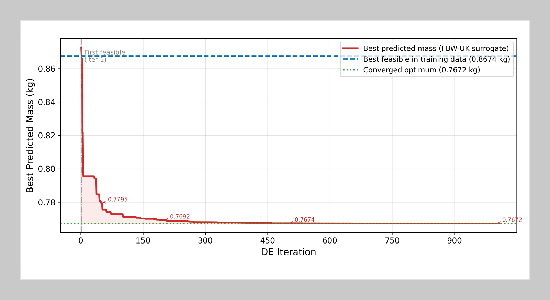
Mass convergence history during Differential Evolution.
Copyright The Author(s). This is an open access article distributed under the terms of the Creative Commons Attribution License (CC BY 4.0), which permits unrestricted use, distribution, and reproduction in any medium, provided the original author and source are cited.
Download Citation: BibTeX | http://dx.doi.org/10.6180/jase.202609_32.046
Surrogate modelling is essential for simulation-based engineering optimization when high-fidelity simulations are computationally expensive. This paper presents Fuzzy-Based Weighted Universal Kriging (FBW-UK), a surrogate modelling framework designed to improve Kriging performance by explicitly incorporating variable importance information into the modelling pipeline. FBW-UK integrates three components: a data-driven fuzzy weighting mechanism based on Pearson-correlation importance scores, which amplifies influential variables and suppresses weakly informative ones through a sigmoidal membership function; a universal linear trend that captures global drift before Gaussian process regression; and an ARD Matérnkernel that provides per-dimension length-scale adaptation for residual modelling. The framework is validated on a CubeSat structural optimization problem using high-fidelity finite element simulations, with separate surrogates constructed for mass, stress, and deflection. Comparative results against Response Surface Methodology and Simple Kriging show that FBW-UKdelivers consistently better predictive performance across responses and evaluation metrics, with thelargest gains observed for the non-linear, constraint-critical stress response. The method also demonstrates stronger data efficiency, achieving competitive accuracy under limited-sample conditions and reducing the number of expensive simulations required for reliable surrogate construction. When integrated into a surrogate based optimization workflow, FBW-UK yields a lighter feasible structural design while satisfying stress and deflection constraints. The resulting optimum is physically interpretable, and the learned fuzzy weights align
with engineering intuition by identifying the most influential design variables. Overall, the study shows that importance-informed input-space rescaling can improve surrogate accuracy, robustness, and optimization effectiveness in computationally intensive engineering design.
Keywords: Fuzzy-Based Weighted Universal Kriging (FBW-UK); Surrogate modeling; Gaussian process regression; Structural optimization; CubeSat; Finite element analysis; Differential Evolution
- [1] R. Yondo, E. Andrés, and E. Valero, (2018) “A review on design of experiments and surrogate models in aircraft real-time and many-query aerodynamic analyses” Progress in Aerospace Sciences 96: 23–61. DOI: 10.1016/j.paerosci.2017.11.003.
- [2] S. G. Kontogiannis and M. A. Savill, (2020) “A generalized methodology for multidisciplinary design optimization using surrogate modelling and multifidelity analysis” Optimization and Engineering 21: 723–759. DOI: 10.1007/s11081-020-09504-z.
- [3] A. J. Keane and I. I. Voutchkov, (2020) “Robust design optimization using surrogate models” Journal of Computational Design and Engineering 7(1): 44–55. DOI: 10.1093/jcde/qwaa005.
- [4] U. Kizhakkinan, P. L. T. Duong, R. Laskowski, G. Vastola, D. W. Rosen, et al., (2023) “Development of a surrogate model for high-fidelity laser powder-bed fusion using tensor train and gaussian process regression” Journal of Intelligent Manufacturing 34: 369–385. DOI: 10.1007/s10845-022-02038-4.
- [5] D. Zhan and H. Xing, (2020) “Expected improvement for expensive optimization: A review” Journal of Global Optimization 78(3): 507–544. DOI: 10.1007/s10898-020-00923-x.
- [6] B. Lei, T. Q. Kirk, A. Bhattacharya, D. Pati, X. Qian, R. Arroyave, B. K. Mallick, et al., (2021) “Bayesian optimization with adaptive surrogate models for automated experimental design” npj Computational Materials 7: 194. DOI: 10.1038/s41524-021-00662-x.
- [7] H. Røstum, S. Gros, and K. Aas-Jakobsen, (2025) “Constrained Bayesian optimization for engineering bridge design” Structural and Multidisciplinary Optimization 68: 20. DOI: 10.1007/s00158-024-03951-3.
- [8] A. Keane and I. I. Voutchkov, (2020) “Surrogate approaches for aerodynamic section performance modelling” AIAA Journal 58(1): 16–24. DOI: 10.2514/1.J058687.
- [9] J. Ollar, C. Mortished, R. Jones, J. Sienz, and V. Toropov, (2017) “Gradient based hyper-parameter optimisation for well conditioned kriging metamodels” Structural and Multidisciplinary Optimization 55: 2029–2044. DOI: 10.1007/s00158-016-1262-8.
- [10] M. A. Bouhlel, N. Bartoli, A. Otsmane, and J. Morlier, (2016) “Improving Kriging surrogates of high-dimensional design models by partial least squares dimension reduction” Structural and Multidisciplinary Optimization 53(5): 935–952. DOI: 10.1007/s00158-015-1395-9.
- [11] M. A. Bouhlel, N. Bartoli, R. G. Regis, A. Otsmane, and J. Morlier, (2018) “Efficient global optimization for high-dimensional constrained problems by using the Kriging models combined with the partial least squares method” Engineering Optimization 50(12): 2038–2053. DOI: 10.1080/0305215X.2017.1419344.
- [12] Y. Ge, J. Shi, Y. Li, and J. Shen, (2022) “An efficient Kriging modeling method based on multidimensional scaling for high-dimensional problems” Algorithms 15(1): 3. DOI: 10.3390/a15010003.
- [13] Y. He and J. Luo, (2024) “Efficient Hierarchical Kriging Modeling Method for High-dimension Multi-fidelity Problems” Chinese Journal of Mechanical Engineering 37: 151. DOI: 10.1186/s10033-024-01136-z.
- [14] Y. Deng, M. R. Eden, and S. Cremaschi, (2024) “A Gaussian process embedded feature selection method based on automatic relevance determination” Computers & Chemical Engineering 191: 108852. DOI: 10.1016/j.compchemeng.2024.108852.
- [15] I. Cruz-Vega, A. Reyes-García, H. J. Escalante, J. d. J. Rangel-Magdaleno, and J. M. Ramírez-Cortés, (2018) “Surrogate modeling based on granular models and fuzzy aptitude functions” Applied Soft Computing 65: 21–32. DOI: 10.1016/j.asoc.2017.12.016.
- [16] S. Li, S. Yuan, S. Liu, J. Wen, and Q. Huang, (2022) “Research on an Accuracy Optimization Algorithm of Kriging Model Based on a Multipoint Filling Criterion” Mathematics 10(9): 1548. DOI: 10.3390/math10091548.
- [17] T. Villela, C. A. Costa, A. M. Brandão, F. T. Bueno, and R. Leonardi, (2019) “Towards the thousandth CubeSat: A statistical overview” International Journal of Aerospace Engineering 2019: 5063145. DOI: 10.1155/2019/5063145.
- [18] C. Girardello, M. Tajmar, and C. Scharlemann, (2024) “GREATCube+: conceptual design tool for CubeSat’s design” CEAS Space Journal 16: 375–392. DOI: 10.1007/s12567-023-00509-9.
- [19] F. T. Al-Maliky and M. J. AlBermani, (2018) “Structural Analysis of Kufasat Using Ansys Program” Artificial Satellites 53(1): 29–35. DOI: 10.2478/arsa-2018-0003.
- [20] A. N. Alhammadi, F. Jarrar, M. Al-Shaibah, A. Almesmari, T. Vu, A. Tsoupos, and P. Marpu, (2021) “Effect of finite element model details in structural analysis of CubeSats” CEAS Space Journal 13(2): 231–246. DOI: 10.1007/s12567-020-00339-z.
- [21] Y.-K. Park, G.-N. Kim, and S.-Y. Park, (2021) “Novel Structure and Thermal Design and Analysis for CubeSats in Formation Flying” Aerospace 8(6): 150. DOI: 10.3390/aerospace8060150.
- [22] A. Elshaal, M. Okasha, E. Sulaeman, A. H. Jallad, W. F. Aizat, and A. B. Alzubaidi, (2024) “Structural Analysis of AlAinSat-1 CubeSat” The Egyptian Journal of Remote Sensing and Space Sciences 27(3): 532–546. DOI: 10.1016/j.ejrs.2024.06.006.
- [23] G. Capovilla, E. Cestino, and L. Reyneri, (2023) “Modular Multifunctional Composite Structure for CubeSat Applications: Embedded Battery Prototype Modal Analysis” Aerospace 10(12): 1009. DOI: 10.3390/aerospace10121009.
- [24] B. Gaspar, A. P. Teixeira, and C. Guedes Soares, (2014) “Assessment of the efficiency of Kriging surrogate models for structural reliability analysis” Probabilistic Engineering Mechanics 37: 24–34. DOI: 10.1016/j.probengmech.2014.03.011.