



Li Qiang1,2, Zhang Ting3, Lei Jun4, Yang QingYi1, and Xia Quan1
1Meteorology School, Lanzhou Resources & Environment Voc-Tech University, Lanzhou, 730021, China
2Key Laboratory of Arid Climate Resource and Environment of Gansu Province (ACRE), Lanzhou, 730000, China
3Gansu Fengyun Meteorological Equipment Co., Ltd., Gansu, 730030, China
4Dingxi Meteorological Bureau, Dingxi 743000, China
Received: February 24, 2026
Accepted: April 26, 2026
Publication Date: May 17, 2026
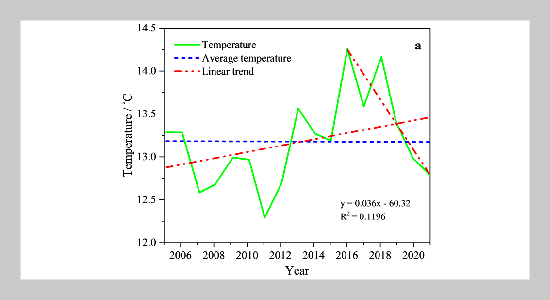
Variation trends of temperature and Mann-Kendall statistics during the growing period of Angelica sinensis.
Copyright The Author(s). This is an open access article distributed under the terms of the Creative Commons Attribution License (CC BY 4.0), which permits unrestricted use, distribution, and reproduction in any medium, provided the original author and source are cited.
Download Citation: BibTeX | http://dx.doi.org/10.6180/jase.202609_32.045
The increasing challenges posed by climate change have significant implications for agricultural productivity, particularly for crops like Angelica sinensis, a valuable medicinal plant. Understanding how climatic variables such as temperature and precipitation affect the yield of Angelica sinensis is critical for developing adaptive strategies to sustain its cultivation. research to determine impacts climatic variables on yields of Angelica sinensis in Northwestern Cool Semi-Humid Region of China seventeen years of agricultural meteorological data from 2005 to 2021. Linear trend estimation, Mann-Kendall mutation test, correlation analysis, and path analysis methods have been utilized to examine the relationships among temperature, precipitation, and yields of Angelica sinensis during the different growth stages from transplanting to harvest. The temperature during the growth period presents a fluctuating increasing trend of 0.37°C decade-1 with a mutation in 2013 and a prominent decreasing trend of-2.89°C decade-1 since 2016. Precipitation increases by 41.6 mm decade-1, and a mutation from low to high precipitation occurred in 2018. Yield has a strongly significant positive correlation with precipitation (correlation coefficient = 0.581). Path analysis results show that the precipitation during
Three-leaves-to-six-leaves growth stage has the strongest direct influence on the yields of Angelica sinensis (path coefficient = 0.550), while the precipitation during Seven-leaves-to-harvest stage has a considerable direct influence (path coefficient = 0.521) despite the negligible simple correlation. Annual yields of Angelica sinensis significantly increase by 44.9 g/m² decade-1. This study valuable insights into optimizing the irrigation schedule and selecting suitable cultivation sites for Angelica sinensis, particularly under changing climatic conditions.
Keywords: Climate change; Angelica sinensis; Temperature; Precipitation; Yield
- [1] X. Xu, T. Zhu, T. Shi, J. Chen, and L. Jin, (2020) “Quality suitability regionalization analysis of Angelica sinensis in Gansu, China” PLoS One 15(12): e0243750. DOI: 10.1371/journal.pone.0243750.
- [2] P. Yu, X. Yan, S. Wang, Y. Zhang, F. Xiong, R. Bai, J. Hong, J. Yang, and L. Guo, (2025) “Unveiling the origin and quality traits of Angelica sinensis: Hyperspectral imaging combined with chemometrics and information fusion strategies” Journal of Food Composition and Analysis: 108089. DOI: 10.1016/j.jfca.2025.108089.
- [3] X. Han, M. Li, Q. Yuan, S. Lee, C. Li, Y. Ren, M. Garth, and L. Wang, (2023) “Advances in molecular biological research of Angelica sinensis” Medicinal Plant Biology 2(1): DOI: 10.48130/MPB-2023-0016.
- [4] L. Yang, J. Li, Y. Xiao, and G. Zhou, (2022) “Early bolting, yield, and quality of angelica sinensis (oliv.) diels responses to intercropping patterns” Plants 11(21): 2950. DOI: 10.3390/plants11212950.
- [5] Y. Hua, W. Yao, P. Ji, and Y. Wei, (2017) “Integrated metabonomic–proteomic studies on blood enrichment effects of Angelica sinensis on a blood deficiency mice model” Pharmaceutical Biology 55(1): 853–863. DOI: 10.1080/13880209.2017.1281969.
- [6] Y. Niu, V. Abdullayev, A. V. Alyar, and A. T. Kamran, (2023) “Green technologies and their role in mitigating climate change: a comparative study across developing nations” estidamaa 2023: 27–35. DOI: 10.70470/ESTIDAMAA/2023/004.
- [7] T. P. Dawson, S. T. Jackson, J. I. House, I. C. Prentice, and G. M. Mace, (2011) “Beyond predictions: biodiversity conservation in a changing climate” science 332(6025): 53–58. DOI: 10.1126/science.1200303.
- [8] X. Liu, M. Luo, M. Li, and J. Wei, (2022) “Depicting precise temperature and duration of vernalization and inhibiting early bolting and flowering of Angelica sinensis by freezing storage” Frontiers in Plant Science 13: 85344. DOI: 10.3390/fpls.2022.85344.
- [9] H. Y. Zhang, W. G. Bi, Y. Yu, and W. B. Liao, (2012) “Angelica sinensis (Oliv.) Diels in China: Distribution, cultivation, utilization and variation” Genetic Resources and Crop Evolution 59(4): 607–613. DOI: 10.1007/s10722-012-9795-9.
- [10] Z. Tan, Y. Yuan, S. Huang, Y. Ma, Z. Hong, Y. Wang, X. Wu, Z. Li, J. Ye, and L. Zhang, (2023) “Geographical distribution and predict potential distribution of Angelica L. genus” Environmental Science and Pollution Research 30(16): 46562–46573. DOI: 10.1007/s11356-023-25490-y.
- [11] F.-G. Zhang, F. Liang, K. Wu, L. Xie, G. Zhao, and Y. Wang, (2024) “The potential habitat of Angelica dahurica in China under climate change scenario predicted by Maxent model” Frontiers in plant science 15: 1388099. DOI: 10.3389/fpls.2024.1388099.
- [12] Z. Yan, H. Jin, X. Yang, D. Min, X. Xu, C. Hua, and B. Qin, (2025) “Effect of rhizosphere soil microbial communities and environmental factors on growth and the active ingredients of Angelica sinensis in Gansu Province, China” Folia Microbiologica 70(3): 673–687. DOI: 10.1007/s12223-024-01210-y.
- [13] X. Gong, B. Chen, L. Yang, Y. Zhang, S. Chang, T. Yang, Y. Chen, Y. Zhu, Z. Wang, X. He, et al., (2026) “Location and growth period influence the bioactive compounds of Angelica sinensis (Oliv.) diels: multi-omics insights” BMC Plant Biology: DOI: 10.1186/s12870-026-08135-3.
- [14] H. Dong, M. Li, L. Jin, X. Xie, M. Li, and J. Wei, (2022) “Cool temperature enhances growth, ferulic acid and flavonoid biosynthesis while inhibiting polysaccharide biosynthesis in Angelica sinensis” Molecules 27(1): 320. DOI: 10.3390/molecules27010320.
- [15] Y.-W. Mi, C.-W. Gong, W.-P. Shao, and Y.-X. Peng, (2022) “Effects of plastic film mulching on soil moisture, soil temperature and root growth of Angelica sinensis in cold and humid areas.” DOI: 10.1168/cyxb2022052.
- [16] X. Zhang, D. Lang, E. Zhang, C. Bai, and H. Wang, (2013) “Diurnal changes in photosynthesis and antioxidants of Angelica sinensis as influenced by cropping systems” Photosynthetica 51(2): 252–258. DOI: 10.1007/s11099-013-0013-6.
- [17] Q.-J. Zhang, D.-L. Wu, Y.-C. Zhu, C. Liu, and D.-S. Yang, (2025) “A long-term dataset of maize phenology observations from agrometeorological stations in Northeast China (1891–2024)” Scientific Data: DOI: 10.1038/s41597-025-06330-9.
- [18] P. Zhao and Z. He, (2022) “Temperature change characteristics in Gansu Province of China” Atmosphere 13(5): 728. DOI: 10.3390/atmos13050728.
- [19] M. Waqas, U. W. Humphries, and P. T. Hlaing, (2024) “Time series trend analysis and forecasting of climate variability using deep learning in Thailand” Results in Engineering 24: 102997. DOI: 10.1016/j.rineng.2024.102997.
- [20] G. I. Cotlier and J. C. Jimenez, (2025) “Seasonal Regime Shifts and Warming Trends in the Universal Thermal Climate Index over the Italian and Iberian Peninsulas (1940–2024)” Climate 13(9): 184. DOI: 10.3390/cli13090184.
- [21] G. T. Mekonnen, A. B. Berlie, S. A. Legesse, and M. A. Wubie, (2023) “The implication of climate change in causing urban heat island in Gondar City, Ethiopia: an analysis made using Mann–Kendall’s trend test and homogeneity test” Arabian Journal of Geosciences 16(12): 638. DOI: 10.1007/s12517-023-11739-w.
- [22] M. Şan, (2025) “Combined innovative trend analysis methods for seasonal trend testing” Journal of Hydrology 649: 132418. DOI: 10.1016/j.jhydrol.2024.132418.
- [23] S. He and C. Hao, (2024) “Analysis on spatial-temporal variation characteristics of climate in Qinling-Huaihe demarcation zone since 1961” Ecological Indicators 158: 111345. DOI: 10.1016/j.ecolind.2023.111345.