




Shanshan Wang1, Ruitong Zhao2, Guoming Hao3 and Yechen Cui4
1School of Grassrooted Education of Two Committees, Shandong Open University, Jinan 250014, China
2School of Economics and Management, Shihezi University, Shihezi 832003, China
3Inspur Intelligent Terminal Co., Ltd., Jinan 250101, China
4School of Agriculture and Rural Development, Henan University of Economics and Law, Zhengzhou 450000, China
Received: March 16, 2026
Accepted: April 8, 2026
Publication Date: May 17, 2026
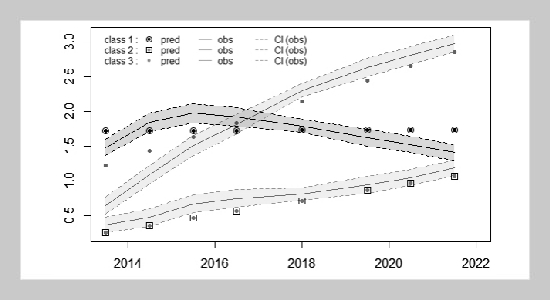
Digital Transformation Trajectory Class of SMEs
Copyright The Author(s). This is an open access article distributed under the terms of the Creative Commons Attribution License (CC BY 4.0), which permits unrestricted use, distribution, and reproduction in any medium, provided the original author and source are cited.
Download Citation: BibTeX | http://dx.doi.org/10.6180/jase.202609_32.044
From the perspective of digital transformation trajectory, the Latent Class Linear Mixed Model (LCLMM) was first applied in the field of enterprise management. Based on panel data of 790 small and medium-sized enterprises (SMEs) in China from 2013 to 2022, the internal mechanism of how digital transformation of SMEs affects total factor productivity (TFP) was explored. The research results show: (1) There are three trajectories of digital transformation for SMEs: speed adjustment, steady growth, and rapid growth. (2) Regarding the impact of digital transformation on total factor productivity, the speed adjustment enterprises will suppress its improvement effect, the uniform growth enterprises will exhibit an inverted “U”-shaped relationship, and the rapid growth enterprises can strengthen this promoting effect. (3) The digital transformation of SMEs improves their production efficiency by reducing R&D investment, improving innovation efficiency and shifting the resource structure to non-strategic resources; among them, the differences in R&D investment among different trajectories of SMEs are significant, while there are no differences in the adjustment of the resource structure. The marginal contribution of this study is mainly reflected in three aspects: first, explaining the paradox of digital productivity from the perspective of dynamic trajectories; second, revealing the differential mechanism of innovation capability and resource allocation under different transformation trajectories; third, for the first time, applying the Latent Class Linear Mixed Model to the field of enterprise digital transformation.
Keywords: Computer Network; Digital Transformation Trajectory; Total Factor Productivity; Latent Class Linear Mixed Model; Strategic Resource Structure
- [1] A. Jamwal, N. Palit, S. Kumari, R. Agrawal, and M. Sharma, (2025) “A decision framework for SMEs to address sustainability issues with Industry 4.0 technologies” Annals of Operations Research 359: 1–29. DOI: 10.1007/s10479-025-06560-5.
- [2] R. Dragana and P. Saša, (2023) “Impact of digitalization on technological innovations in small and medium-sized enterprises (SMEs)” Technological Forecasting & Social Change 191: 122474. DOI: 10.1016/j.techfore.2023.122474.
- [3] W. S. Hwang and H. S. Kim, (2021) “Does the adoption of emerging technologies improve technical efficiency? Evidence from Korean manufacturing SMEs” Small Business Economics 59: 1–17. DOI: 10.1007/s11187-021-00554-w.
- [4] S. Hafeez, K. Shahzad, P. Helo, and M. F. Mubarak, (2025) “Knowledge management and SMEs’ digital transformation: A systematic literature review and future research agenda” Journal of Innovation & Knowledge 10: 100728. DOI: 10.1016/j.jik.2025.100728.
- [5] S. Liu, (2025) “Digital transformation–productivity nexus: Platform integration and enterprise performance” Finance Research Letters 81: 107420. DOI: 10.1016/j.frl.2025.107420.
- [6] G. Xiaochuan, L. Mengmeng, W. Yanlin, and M. Abbas, (2023) “Does digital transformation improve the firm’s performance? From the perspective of digitalization paradox and managerial myopia” Journal of Business Research 163: 113868. DOI: 10.1016/j.jbusres.2023.113868.
- [7] Z. Xu, L. Xiwa, L. Yao, and W. Ziqi, (2024) “The impact of digital transformation on firm performance” Industrial Management & Data Systems 124: 2567–2587. DOI: 10.1108/IMDS-09-2023-0661.
- [8] G. Swapan, H. Mat, H. Ian, and H. Paul, (2022) “Digital transformation of industrial businesses: A dynamic capability approach” Technovation 113: 102414. DOI: 10.1016/j.technovation.2021.102414.
- [9] de Lucas Ancillo Antonio and G. G. Sorin, (2023) “The Impact of Research and Development on Entrepreneurship, Innovation, Digitization and Digital transformation” Journal of Business Research 157: 113566. DOI: 10.1016/j.jbusres.2022.113566.
- [10] P. D. Wibbens, (2020) “A formal framework for the RBV: Resource dynamics as a Markov process” Strategic Management Journal 41: 1–23. DOI: 10.1002/smj.3165.
- [11] J. J. Ferreira, C. I. Fernandes, and F. A. Ferreira, (2019) “To be or not to be digital, that is the question: Firm innovation and performance” Journal of Business Research 101: 583–590. DOI: 10.1016/j.jbusres.2018.11.013.
- [12] G. Vial, (2019) “Understanding digital transformation: A review and a research agenda” Journal of Strategic Information Systems 28: 118–144. DOI: 10.1016/j.jsis.2019.01.003.
- [13] S. F. Wamba, A. Gunasekaran, S. Akter, S. J.-f. Ren, R. Dubey, and S. J. Childe, (2017) “Big data analytics and firm performance: Effects of dynamic capabilities” Journal of Business Research 70: 356–365. DOI: 10.1016/j.jbusres.2016.08.009.
- [14] T.-S. Joan, D.-C. Ángel, M.-P. Albert-Pol, and S. Jorge, (2022) “Towards the Tyrell corporation? Digitisation, firm-size and productivity divergence in Spain” Journal of Innovation & Knowledge 7: 100185. DOI: 10.1016/j.jik.2022.100185.
- [15] G. Cheng and R. Vincent, (2020) “Developing a unified definition of digital transformation” Technovation 96-97: 102217. DOI: 10.1016/j.technovation.2020.102217.
- [16] C. Giovanna, M. Arianna, and N. Alessandro, (2022) “Breakthrough innovations and where to find them” Research Policy 51: 104376. DOI: 10.1016/j.respol.2021.104376.
- [17] J. Q. Dong, K. J. McCarthy, and W. W. M. E. Schoenmakers, (2017) “How Central Is Too Central? Organizing Interorganizational Collaboration Networks for Breakthrough Innovation” Journal of Product Innovation Management 34: 526–542. DOI: 10.1111/jpim.12384.
- [18] A. B. K., K. S. Sanjay, R. Shuang, B. Pawan, and V. Dmitriy, (2022) “Mastering digital transformation: The nexus between leadership, agility, and digital strategy” Journal of Business Research 145: 636–648. DOI: 10.1016/j.jbusres.2022.03.038.
- [19] K. Hudson and R. E. Morgan, (2024) “Industry Exposure to Artificial Intelligence, Board Network Heterogeneity, and Firm Idiosyncratic Risk” Journal of Management Studies 63: 596–630. DOI: 10.1111/joms.13127.
- [20] D. J. Teece, (2018) “Profiting from innovation in the digital economy: Enabling technologies, standards, and licensing models in the wireless world” Research Policy 47: 1367–1387. DOI: 10.1016/j.respol.2017.01.015.
- [21] U. A., F. F., M. P. A., P. P., F. B. M., and O. B., (2021) “Unveiling the impact of the adoption of digital technologies on firms’ innovation performance” Journal of Business Research 133: 327–336. DOI: 10.1016/j.jbusres.2021.04.035.
- [22] W. Linfei, S. Liwen, C. Qing, Z. Die, and Q. Peixiao, (2022) “How do digitalization capabilities enable open innovation in manufacturing enterprises? A multiple case study based on resource integration perspective” Technological Forecasting & Social Change 184: 122019. DOI: 10.1016/j.techfore.2022.122019.
- [23] B. Wernerfelt, (1984) “A resource-based view of the firm” Strategic Management Journal 5: 171–180. DOI: 10.1002/smj.4250050207.
- [24] A. Raphael and H. Xu, (2017) “Value Creation through Novel Resource Configurations in a Digitally Enabled World: Novel Resource Configurations in a Digitally Enabled World” Strategic Entrepreneurship Journal 11: 228–242. DOI: 10.1002/sej.1256.
- [25] N. Franke, M. Huber, F. T. Piller, and G. Reischauer, (2020) “Strategies for Digitalization in Manufacturing Firms” California Management Review 62: 17–36. DOI: 10.1177/0008125620920349.
- [26] G. Ahuja and R. Katila, (2004) “Where Do Resources Come From? The Role of Idiosyncratic Situations” Strategic Management Journal 25: 887–907. DOI: 10.1002/smj.392.
- [27] J. Barney, M. Wright, and D. J. Ketchen, (2001) “The resource-based view of the firm: Ten years after 1991” Journal of Management 27: 625–641. DOI: 10.1016/S0149-2063(01)00114-3.
- [28] X. Ding, Z. Sheng, A. Appolloni, M. Shahzad, and S. Han, (2024) “Digital transformation, ESG practice, and total factor productivity” Business Strategy and the Environment 33: 4547–4561. DOI: 10.1002/bse.3718.
- [29] S. S. Muhammad, B. L. Dey, M. M. Kamal, L. Samuel, and E. A. Alzeiby, (2025) “Digital transformation or digital divide? Smes’ use of AI during global crisis” Technological Forecasting & Social Change 217: 124184. DOI: 10.1016/j.techfore.2025.124184.
- [30] B. Anandhi, E. S. O. A., P. P. A., and V. N., (2013) “Digital Business Strategy: Toward a Next Generation of Insights” MIS Quarterly 37: 471–482. DOI: 10.2307/23522684.
- [31] P. C. Verhoef, T. Broekhuizen, Y. Bart, A. Bhattacharya, J. Q. Dong, N. Fabian, and M. Haenlein, (2021) “Digital Transformation: A Multidisciplinary Reflection and Research Agenda” Journal of Business Research 122: 890–902. DOI: 10.1016/j.jbusres.2020.10.005.
- [32] H. André, B. René, M. David, and A. M. Cláudia, (2020) “A Systematic Review of the Literature on Digital Transformation: Insights and Implications for Strategy and Organizational Change” Journal of Management Studies 58: 1159–1197. DOI: 10.1111/joms.12639.
- [33] J. B. Barney, (1991) “Firm Resources and Sustained Competitive Advantage” Advances in Strategic Management 17: 3–10. DOI: 10.1016/S0742-3322(05)23017-1.
- [34] C. P. Lima, V. Philipps, and B. Liquet, (2017) “Estimation of Extended Mixed Models Using Latent Classes and Latent Processes: The R Package lcmm” Journal of Statistical Software 78: 1–56. DOI: 10.18637/jss.v078.i02.
- [35] S. S. Mirza, F. J. Wolters, S. A. Swanson, P. J. Koudstaal, A. Hofman, H. Tiemeier, and M. A. Ikram, (2016) “10-year trajectories of depressive symptoms and risk of dementia: a population-based study” The Lancet Psychiatry 3: 628–635. DOI: 10.1016/S2215-0366(16)00097-3.
- [36] L. Hannah, K. Scott, S. Matthew, B. Iain, C. A. J., L. Michael, C. M. B., and R. A. G., (2018) “Framework to construct and interpret latent class trajectory modelling.” BMJ Open 8: e020683. DOI: 10.1136/bmjopen-2017-020683.
- [37] A. M. Pettigrew, R. W. Woodman, and K. S. Cameron, (2001) “Studying Organizational Change and Development: Challenges for Future Research” The Academy of Management Journal 44: 697–713. DOI: 10.2307/3069367.
- [38] K. Lewin, (1951) “Field Theory in Social Science” American Catholic Sociological Review 12: 103. DOI: 10.2307/3707263.
- [39] C. Crossland, D. C. Hambrick, and M.-J. Chen, (2014) “CEO CAREER VARIETY: EFFECTS ON FIRM-LEVEL STRATEGIC AND SOCIAL NOVELTY” The Academy of Management Journal 57: 652–674. DOI: 10.5465/amj.2012.0695.