




Received: February 14, 2026
Accepted: March 30, 2026
Publication Date: May 17, 2026
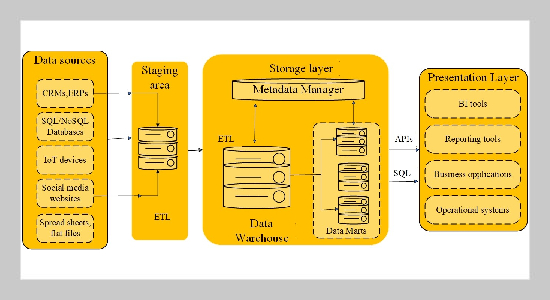
Layered Big Data Architecture for Data Integration and Analytics
Copyright The Author(s). This is an open access article distributed under the terms of the Creative Commons Attribution License (CC BY 4.0), which permits unrestricted use, distribution, and reproduction in any medium, provided the original author and source are cited.
Download Citation: BibTeX | http://dx.doi.org/10.6180/jase.202609_32.042
Accurate monitoring and prediction of carbon emissions has become a key need by industries across the globe due to the growing need for sustainable development. Industrial activities generate large volumes of energy consumption data, creating opportunities for real-time monitoring and predictive analytics using big data technologies. A carbon emission monitoring and prediction systems is developed that integrates real-time electricity consumption data with external variables such as industry type, energy mix, and economic indicators. Big data platforms including Apache Hadoop and Apache Spark support large-scale data ingestion, storage, and processing. Carbon emission prediction is performed using a hybrid model that combines Long Short Term Memory(LSTM)networks for temporal pattern learning with Extreme Gradient Boosting (XGBoost) to capture feature-based relationships. Data preprocessing techniques such as normalization, feature engineering, and missing value imputation improve data quality and model reliability. The dataset consists of large-scale industrial energy consumption and carbon emission records collected at an hourly resolution, comprising approximately 10,000 samples. The data is divided into training and testing sets using an 80:20 split. The LSTM model is configured with two layers and 128 hidden units, using a learning rate of 0.001 with the Adamoptimizer. The XGBoost model employs 100 estimators with a maximum depth of 6 and regularization parameters ( λ = 1.0, γ = 0.1 ). Experimental evaluation shows that the hybrid LSTM-XGBoost model outperforms alternative approaches including CNN-LSTM-BERT and AdaBoost, achieving MAE = 0.0234, MSE= 0.00086, and R2 = 0.963. The framework supports real-time carbon emission monitoring and forecasting, providing a reliable tool for data-driven industrial emission management and sustainable decision-making.
Keywords: Carbon Emission Monitoring, Big Data, LSTM, XGBoost, Sustainability
- [1] G. Demirdöğen, Z. Işık, and Y. Arayici, (2020) “Lean Management Framework for Healthcare Facilities Integrating BIM, BEPS and Big Data Analytics” Sustainability 12(17): 7061. DOI: 10.3390/su12177061.
- [2] A. H. A. AL-Jumaili, Y. I. A. Mashhadany, R. Sulaiman, and Z. A. A. Alyasseri, (2021) “A Conceptual and Systematics for Intelligent Power Management System-Based Cloud Computing: Prospects, and Challenges” Applied Sciences 11(21): 9820. DOI: 10.3390/app11219820.
- [3] S. P. R. Asaithambi, R. Venkatraman, and S. Venkatraman, (2020) “MOBDA: Microservice-Oriented Big Data Architecture for Smart City Transport Systems” Big Data and Cognitive Computing 4(3): 17. DOI: 10.3390/bdcc4030017.
- [4] P. Fraga-Lamas, S. I. Lopes, and T. M. Fernández-Caramés, (2021) “Green IoT and Edge AI as Key Technological Enablers for a Sustainable Digital Transition towards a Smart Circular Economy: An Industry 5.0 Use Case” Sensors 21(17): 5745. DOI: 10.3390/s21175745.
- [5] X. Tao, L. Cheng, R. Zhang, W. K. Chan, H. Chao, and J. Qin, (2024) “Towards Green Innovation in Smart Cities: Leveraging Traffic Flow Prediction with Machine Learning Algorithms for Sustainable Transportation Systems” Sustainability 16(1): 251. DOI: 10.3390/su16010251.
- [6] R. Singh, S. V. Akram, A. Gehlot, D. Buddhi, N. Priyadarshi, and B. Twala, (2022) “Energy System 4.0: Digitalization of the Energy Sector with Inclination towards Sustainability” Sensors 22(17): 6619. DOI: 10.3390/s22176619.
- [7] X. Dai, Y. Chen, C. Zhang, Y. He, and J. Li, (2023) “Technological Revolution in the Field: Green Development of Chinese Agriculture Driven by Digital Information Technology (DIT)” Agriculture 13(1): 199. DOI: 10.3390/agriculture13010199.
- [8] E. Badidi, Z. Mahrez, and E. Sabir, (2020) “Fog Computing for Smart Cities’ Big Data Management and Analytics: A Review” Future Internet 12(11): 190. DOI: 10.3390/fi12110190.
- [9] N. L. H. Hien and A.-L. Kor, (2022) “Analysis and Prediction Model of Fuel Consumption and Carbon Dioxide Emissions of Light-Duty Vehicles” Applied Sciences 12(2): 803. DOI: 10.3390/app12020803.
- [10] J. Gusc, P. Bosma, S. Jarka, and A. Biernat-Jarka, (2022) “The Big Data, Artificial Intelligence, and Blockchain in True Cost Accounting for Energy Transition in Europe” Energies 15(3): 1089. DOI: 10.3390/en15031089.
- [11] H. Huang, X. Wu, and X. Cheng, (2021) “The Prediction of Carbon Emission Information in Yangtze River Economic Zone by Deep Learning” Land 10(12): 1380. DOI: 10.3390/land10121380.
- [12] P. V. Thayyil et al., (2023) “State-of-the-Art of Artificial Intelligence and Big Data Analytics Reviews in Five Different Domains: A Bibliometric Summary” Sustainability 15(5): 4026. DOI: 10.3390/su15054026.
- [13] H. Zheng, T. Zhang, C. Fang, J. Zeng, and X. Yang, (2021) “Design and Implementation of Poultry Farming Information Management System Based on Cloud Database” Animals 11(3): 900. DOI: 10.3390/ani11030900.
- 14] K. N. Shivaprakash and et al., (2022) “Potential for Artificial Intelligence (AI) and Machine Learning (ML) Applications in Biodiversity Conservation, Managing Forests, and Related Services in India” Sustainability 14(12): 7154. DOI: 10.3390/su14127154.
- [15] D. Zhou and et al., (2022) “Intelligent Manufacturing Technology in the Steel Industry of China: A Review” Sensors 22(21): 8194. DOI: 10.3390/s22218194.
- [16] C. Zhou, X. Lin, R. Wang, and B. Song, (2023) “Real-Time Carbon Emissions Monitoring of High-Energy-Consumption Enterprises in Guangxi Based on Electricity Big Data” Energies 16(13): 5124. DOI: 10.3390/en16135124.
- [17] S. Almanasra, (2024) “Applications of integrating artificial intelligence and big data: A comprehensive analysis” Journal of Intelligent Systems 33(1): DOI: 10.1515/jisys-2024-0237.
- [18] T. Peng, X. Yang, Z. Xu, and Y. Liang, (2020) “Constructing an Environmental Friendly Low-Carbon-Emission Intelligent Transportation System Based on Big Data and Machine Learning Methods” Sustainability 12(19): 8118. DOI: 10.3390/su12198118.
- [19] F. Xu and et al., (2025) “Geospatial Big Data-Driven Fine-Scale Carbon Emission Modeling” Remote Sensing 17(18): 3185. DOI: 10.3390/rs17183185.
- [20] J. Rubio-Loyola and W. R. S. Paul-Fils, (2022) “Applied Machine Learning in Industry 4.0: Case-Study Research in Predictive Models for Black Carbon Emissions” Sensors 22(10): 3947. DOI: 10.3390/s22103947.
- [21] J. Udoh, J. Lu, and Q. Xu, (2024) “Application of Machine Learning to Predict CO2 Emissions in Light-Duty Vehicles” Sensors 24(24): 8219. DOI: 10.3390/s24248219.
- [22] C. Zhou, Y. Tang, D. Zhu, and Z. Cui, (2024) “Tracking the Carbon Emissions Using Electricity Big Data: A Case Study of the Metal Smelting Industry” Energies 17(3): 652. DOI: 10.3390/en17030652.
- [23] C. D. Fay, B. Corcoran, and D. Diamond, (2024) “Green IoT Event Detection for Carbon-Emission Monitoring in Sensor Networks” Sensors 24(1): 162. DOI: 10.3390/s24010162.
- [24] K. U. Khan, G. Ali, N. Murtaza, Y. Pan, and V. Kysucky, (2025) “Toward Net-Zero Emissions: The Role of Smart City Technologies in Reducing Carbon Emissions in China” Urban Science 9(9): 374. DOI: 10.3390/urbansci909090374.
- [25] L. Wang and et al., (2024) “The Design and Implementation of an Intelligent Carbon Data Management Platform for Digital Twin Industrial Parks” Energies 17(23): 5972. DOI: 10.3390/en17235972.
- [26] E. Bicamumakuba, M. N. Reza, H. Jin, Samsuzzaman, K.-H. Lee, and S.-O. Chung, (2025) “Multi-Sensor Monitoring, Intelligent Control, and Data Processing for Smart Greenhouse Environment Management” Sensors 25(19): 6134. DOI: 10.3390/s25196134.
- [27] A. A. Alhussan and M. Metwally, (2025) “Enhanced CO2 Emissions Prediction Using Temporal Fusion Transformer Optimized by Football Optimization Algorithm” Mathematics 13(10): 1627. DOI: 10.3390/math13101627.
- [28] NOAA Global Monitoring Laboratory. Data Finder – NOAA Global Monitoring Laboratory.
- [29] K. Liu, H. Ren, S. Lu, X. Shang, Z. Liu, and B. Yu, (2026) “Analysis and Prediction Evaluation of Provincial Carbon Emissions Under Multi-Model Fusion” Sustainability 18(5): 2545. DOI: 10.3390/su18052545.
- [30] R. Ji, (2024) “Research on Factors Influencing Global Carbon Emissions and Forecasting Models” Sustainability 16(23): 10782. DOI: 10.3390/su162310782.