




Department of Mechanical and Information Engineering, Sichuan University of Architectural Technology, Jingyang District, Deyang City 618000, China
Received: March 13, 2026
Accepted: April 17, 2026
Publication Date: May 17, 2026
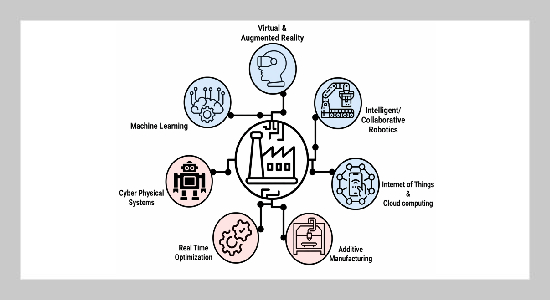
Construction diagram supporting performance evaluation in Intelligent Manufacturing using Computer Simulation Optimization.
Copyright The Author(s). This is an open access article distributed under the terms of the Creative Commons Attribution License (CC BY 4.0), which permits unrestricted use, distribution, and reproduction in any medium, provided the original author and source are cited.
Download Citation: BibTeX | http://dx.doi.org/10.6180/jase.202609_32.041
Intelligent Manufacturing, based on computer simulation optimization, promotes the mechanical manufacturing design greatly. The technology allows to test and optimize mechanical products virtually, and deliver more effective and economical manufacturing processes and advanced software applications with complex algorithms the design is faster, requires less physical prototyping, and is more accurate. In addition, simulation based on optimization can assess a number of design alternatives or operating scenarios to find the best solutions. This method improves the intelligence level of manufacturing systems, enables the mass customization and the rapid innovation of mechanical products. In an intelligent manufacturing environment, Computer Simulation Optimization synthesizes the features of design efficiency, cost reduction and effective utilization of resources and contributes to elevating design efficiency of manufactures and curbing down design cost, ultimately leading to high productivity and high-quality design
Keywords: Accurate; Dramatically; Mechanical; Optimization; Efficiency
- [1] A. K. Adeleke, E. C. Ani, K. A. Olu-lawal, O. K. Olajiga, and D. J. P. Montero, (2024) “Future of precision manufacturing: Integrating advanced metrology and intelligent monitoring for process optimization” International Journal of Scientific Research Archive 11: 2346–2355. DOI: 10.30574/ijsra.2024.11.1.0335.
- [2] Y. Wang and Y. Liu, (2024) “Construction of a virtual simulation practical teaching system for intelligent manufacturing under the background of new engineering” Computer Applications in Engineering Education: e22768. DOI: 10.1002/cae.22768.
- [3] G. Zhang, M. Peng, W. Zhang, M. Pan, Z. Xu, and J. Zheng, (2025) “Advances in monitoring system and application in precision/ultra-precision machining processes” International Journal of Advanced Manufacturing Technology 140: 5823–5868. DOI: 10.1007/s00170-025-16583-8.
- [4] S. Hu, C. Li, B. Li, M. Yang, X. Wang, T. Gao, and P. Xu, (2024) “Digital twins enabling intelligent manufacturing: From methodology to application” Intelligent and Sustainable Manufacturing 1: 10007. DOI: 10.35534/ism.2024.10007.
- [5] X. Cao, M. Yao, Y. Zhang, X. Hu, and C. Wu, (2024) “Digital twin modeling and simulation optimization of transmission front and middle case assembly line” CMES – Computer Modeling in Engineering and Sciences 139: 3. DOI: 10.3260/cmes.2023.030773.
- [6] G. Lazaroiu, T. Gedeon, E. Rogalska, K. Valaskova, M. Nagy, H. Musa, and V. Braga, (2024) “Digital twin-based cyber-physical manufacturing systems, extended reality metaverse enterprise and production management algorithms, and Internet of Things financial and labor market technologies in generative artificial intelligence economics” Oeconomia Copernicana 15: 837–870.
- [7] P. Zheng, J. Yang, J. Lou, and B. Wang, (2024) “Design and application of virtual simulation teaching platform for intelligent manufacturing” Scientific Reports 14: 12895. DOI: 10.1038/s41598-024-62072-5.
- [8] Y. Hu, Q. Jia, Y. Yao, Y. Lee, M. Lee, C. Wang, and F. Yu, (2024) “Industrial Internet of Things intelligence empowering smart manufacturing: A literature review” IEEE Internet of Things Journal: DOI: 10.1109/JIOT.2024.3367692.
- [9] E. Mahmoodi, M. Fathi, M. Tavana, M. Ghobakhloo, and A. H. Ng, (2024) “Data-driven simulation-based decision support system for resource allocation in Industry 4.0 and smart manufacturing” Journal of Manufacturing Systems 72: 287–307. DOI: 10.1016/j.jmsy.2023.11.019.
- [10] G. Wu and Y. Liu, (2024) “Production automation and financial cost control based on intelligent control technology in sustainable manufacturing” International Journal of Advanced Manufacturing Technology: 1–10. DOI: 10.1007/s00170-024-13059-z.
- [11] M. Amini, K. Sharifani, and A. Rahmani, (2023) “Machine learning model towards evaluating data gathering methods in manufacturing and mechanical engineering” International Journal of Applied Science and Engineering Research 15: 349–362.
- [12] A. Ghasemi, F. Farajzadeh, C. Heavey, J. Fowler, and C. T. Papadopoulos, (2024) “Simulation optimization applied to production scheduling in the era of Industry 4.0: A review and future roadmap” Journal of Industrial Information Integration: 100599. DOI: 10.1016/j.jii.2024.100599.
- [13] J. Fernández-León, K. Keramati, L. Baumela, and C. González, (2024) “A digital twin for smart manufacturing of structural composites by liquid moulding” International Journal of Advanced Manufacturing Technology 130: 4679–4697. DOI: 10.1007/s00170-023-12637-x.
- [14] J. S. Lin and K. H. Chen, (2024) “A novel decision support system based on computational intelligence and machine learning: Towards zero-defect manufacturing in injection molding” Journal of Industrial Information Integration 40: 100621. DOI: 10.1016/j.jii.2024.100621.
- [15] M. Soori and F. K. G. Jough, (2024) “Artificial intelligence in optimization of steel moment frame structures: A review” International Journal of Structural and Construction Engineering:
- [16] G. Yuan, X. Liu, C. Zhu, C. Wang, M. Zhu, and Y. Sun, (2024) “Multi-objective coupling optimization of electrical cable intelligent production line driven by digital twin” Robotics and Computer-Integrated Manufacturing 86: 102682. DOI: 10.1016/j.rcim.2023.102682.
- [17] Y. Xiang, X. Lu, D. Cai, J. Chen, and C. Bao, (2024) “Multi-algorithm fusion-based intelligent decision-making method for robotic belt grinding process parameters” International Journal of Advanced Manufacturing Technology 132: 6053–6068. DOI: 10.1007/s00170-024-13734-1.
- [18] F. Psarommatis and G. May, (2024) “Optimization of zero defect manufacturing strategies: A comparative study on simplified modeling approaches for enhanced efficiency and accuracy” Computers and Industrial Engineering 187: 109783. DOI: 10.1016/j.cie.2023.109783.
- [19] E. C. Ani, K. A. Olu-lawal, O. K. Olajiga, D. J. P. Montero, and A. K. Adeleke, (2024) “Intelligent monitoring systems in manufacturing: Current state and future perspectives” Engineering Science and Technology Journal 5: 750–759. DOI: 10.51594/estj.v5i3.870.
- [20] M. Ghali, S. Elghali, and N. Aifaoui, (2024) “Genetic algorithm optimization based on manufacturing prediction for an efficient tolerance allocation approach” Journal of Intelligent Manufacturing 35: 1649–1670. DOI: 10.1007/s10845-023-02132-1.
- [21] W. Hou, X. Wang, J. Han, Z. Yao, and C. Wang, (2024) “An intelligent body frame structure modeling and optimization system based on conceptual design” Proceedings of the Institution of Mechanical Engineers, Part D: Journal of Automobile Engineering: 09544070231206878. DOI: 10.1177/09544070231206878.