


Yanli Zhu1, Hong He2, Dianguo Ma1, Haibo Liu1, Peimin Li1, and Lincai Zhang1
1School of Mechanical and Electrical Engineering, Zaozhuang University, Zaozhuang, 277160, China
2Tengzhou Wanbao Stroller Co., Ltd., Tengzhou, 277500, China
Received: March 4, 2026
Accepted: April 21, 2026
Publication Date: May 17, 2026
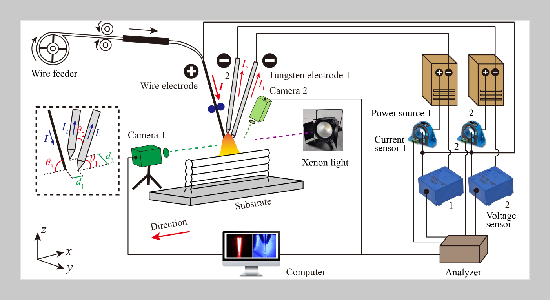
Schematic diagram of TTWIA additive manufacturing and signal and image acquisition system.
Copyright The Author(s). This is an open access article distributed under the terms of the Creative Commons Attribution License (CC BY 4.0), which permits unrestricted use, distribution, and reproduction in any medium, provided the original author and source are cited.
Download Citation: BibTeX | http://dx.doi.org/10.6180/jase.202609_32.040
In this paper, the effects of wire-tungsten ( d1 ) and tungsten-tungsten ( d2 ) spacing on the forming characteristic of twin tungsten electrode- wire electrode indirect arc (TTWIA) additive manufacturing were comprehensively studied. The arc shape, droplet transfer, and molten pool behavior were recorded respectively. Results showed that as d1 or d2 increased, the arc shape of TTWIA diverged and the coupling intensity was weakened. Besides,
the liquid stream became thick as well as the larger droplet diameter and lower transfer frequency, mainly attributed to the reduced arc current density and detachment forces acting on the droplet. Additionally, on account of the decreased arc pressure and droplet impingement force on the molten pool, the transverse flow tendency of liquid metal was diminished, and the molten pool width of TTWIA decreased, which was adverse to the spreading of the deposited layer. Moreover, the forming quality of the thin-walled part deteriorated, together with the increased surface roughness and reduced material utilization rate, which mainly attributed to the instability of the molten pool because of the lowered normal reaction acting on the molten pool of the present deposited layer.
Keywords: TTWIA; Wire and arc additive manufacturing; Forming characteristic; Process parameter; Arc shape
- [1] Z. Chen, L. Yuan, Z. Pan, H. Zhu, N. Ma, D. Ding, and H. Li, (2025) “A comprehensive review and future perspectives of simulation approaches in wire arc additive manufacturing (WAAM)” International Journal of Extreme Manufacturing 7: 022016. DOI: 10.1088/2631-7990/ada099.
- [2] M. Dekis, M. Tawfik, M. Egiza, and M. Dewidar, (2025) “Challenges and developments in wire arc additive manufacturing of steel: A review” Results in Engineering 26: 104657. DOI: 10.1016/j.rineng.2025.104657.
- [3] S. Gain and D. Veeman, (2025) “A review on advances and challenges in wire arc additive manufacturing: Process parameters, microstructural evolution and material performance across alloys” Journal of Alloys and Compounds 1029: 180735. DOI: https://doi.org/10.1016/j.jallcom.2025.180735.
- [4] J. Norrish, J. Polden, and I. Richardson, (2021) “A review of wire arc additive manufacturing: development, principles, process physics, implementation and current status” Journal of Physics D: Applied Physics 54: 473001. DOI: 10.1088/1361-6463/ac1e4a.
- [5] S. Huang, X. Zeng, X. Du, Z. Peng, J. Li, R. Wang, J. Liu, B. Yan, J. Liu, Z. Cai, H. Wang, and C. Liu, (2023) “Microstructure and mechanical properties of the Nb37.7Mo14.5Ta12.6Ni28.16Cr7.04 multi-principal alloys fabricated by gas tungsten wire arc welding additive manufacturing” Vacuum 210: 111900. DOI: https://doi.org/10.1016/j.vacuum.2023.111900.
- [6] Y. Ke and J. Xiong, (2020) “Microstructure and mechanical properties of double-wire feed GTA additive manufactured 308L stainless steel” Rapid Prototyping Journal 26: 1503–1513. DOI: 10.1108/RPJ-09-2019-0238.
- [7] P. Schilling, T. Ungethum, P. Sanderbrand, and H. C. Schmale, (2026) “Investigation of a multi-cathode TIG arc process for additive manufacturing applications” Welding in the World 64: 1329–1340. DOI: 10.1007/s40194-026-02414-1.
- [8] S. X. Lv, B. X. Tian, H. T. Wang, and S. Q. Yang, (2007) “Arc heating hot wire assisted arc welding technique for low resistance welding wire” Science and Technology of Welding and Joining 12: 431–435. DOI: 10.1179/174329307X213828.
- [9] A. L. Voigt, T. V. d. Cunha, and C. E. Niño, (2020) “Conception, implementation and evaluation of induction wire heating system applied to hot wire GTAW (IHW-GTAW)” Journal of Materials Processing Technology 281: 116615. DOI: https://doi.org/10.1016/j.jmatprotec.2020.116615.
- [10] Q. Han, X. Li, M. Dong, and G. Zhang, (2021) “Enhanced curve-fitting model of the bead section profile and the corresponding overlapping model for twin-electrode gas tungsten arc-based additive manufacturing” International Journal of Advanced Manufacturing Technology 116: 1151–1167. DOI: 10.1007/s00170-021-07501-9.
- [11] S.-C. Park, H.-S. Bang, and W.-J. Seong, (2020) “Effects of material properties on angular distortion in wire arc additive manufacturing: experimental and computational analyses” Materials 13: 1399. DOI: 10.3390/ma13061399.
- [12] T. Zhang, L. Wang, C. Xu, J. Cheng, and K. Wang, (2023) “Early-warning system for copper alloy abnormal molten pool in wire-arc additive manufacturing via convolutional neural network method” Journal of Materials Engineering and Performance 32: 11230–11239. DOI: 10.1007/s11665-023-07949-8.
- [13] X. Zhang, F. Martina, J. Ding, X. Wang, and S. W. Williams, (2017) “Fracture toughness and fatigue crack growth rate properties in wire + arc additive manufactured Ti-6Al-4V” Fatigue & Fracture of Engineering Materials & Structures 40: 790–803. DOI: 10.1111/ffe.12547.
- [14] T. Hauser, R. T. Reisch, P. P. Breese, B. S. Lutz, M. Pantano, Y. Nalam, K. Bela, T. Kamps, J. Volpp, and A. F. H. Kaplan, (2021) “Porosity in wire arc additive manufacturing of aluminium alloys” Additive Manufacturing 41: 101993. DOI: 10.1016/j.addma.2021.101993.
- [15] F. Wang, S. Williams, and M. Rush, (2011) “Morphology investigation on direct current pulsed gas tungsten arc welded additive manufactured Ti6Al4V alloy” International Journal of Advanced Manufacturing Technology 57: 597–603. DOI: 10.1007/s00170-011-3299-1.
- [16] S. Teng, S. Dehgahi, H. Henein, T. Wolfe, and A. J. Qureshi, (2025) “Sensor-fusion enabled inter-layer temperature control of nano-treated 7075 aluminum alloy produced through wire-arc directed energy deposition process” Progress in Additive Manufacturing 10: 1293–1314. DOI: 10.1007/s40964-024-00707-9.
- [17] J. A. Tröger, S. Hartmann, K. Treutler, A. Potschka, and V. Wesling, (2025) “Simulation-based process parameter optimization for wire arc additive manufacturing” Progress in Additive Manufacturing 10: 1–14. DOI: 10.1007/s40964-024-00597-x.
- [18] J. Long, M. Wang, W. Zhao, X. Zhang, Y. Wei, and W. Ou, (2022) “High-power wire are additive manufacturing of stainless steel with active heat management” Science and Technology of Welding and Joining 27: 256–264. DOI: 10.1080/13621718.2022.2045127.
- [19] C. Ma, C. Li, Y. Yan, Y. Liu, X. Wu, D. Li, Y. Han, H. Jin, and F. Zhang, (2021) “Investigation of the in-situ gas cooling of carbon steel during wire and arc additive manufacturing” Journal of Manufacturing Processes 67: 461–477. DOI: 10.1016/j.jmapro.2021.05.022.
- [20] J. Liu, Y. Miao, Z. Wang, Y. Zhao, Y. Wu, and C. Li, (2024) “Improved strength in nickel-aluminum bronze/steel bimetallic component fabricated using arcing-wire arc additive manufacturing with alternating deposition strategy” Journal of Manufacturing Processes 111: 89–103. DOI: 10.1016/j.jmapro.2024.01.027.
- [21] S. Chen, S. Zhang, N. Huang, P. Zhang, and J. Han, (2016) “Droplet transfer in arcing-wire GTAW” Journal of Manufacturing Processes 23: 149–156. DOI: 10.1016/j.jmapro.2016.05.014.
- [22] J. Wang, D. Wu, P. Liao, C. Y. Tian, M. Q. Li, and J. C. Feng, (2013) “Metal transfer and arc behaviour of novel consumable and non-consumable electrode indirect arc droplet welding” Science and Technology of Welding and Joining 18: 261–270. DOI: 10.1179/1362171812Y.0000000103.
- [23] Y. Zhu, Z. Wang, R. Liu, and L. Liu, (2022) “Study on arc behavior and droplet transfer in twin-electrode TIG-MIG indirect arc welding” International Journal of Advanced Manufacturing Technology 120: 6821–6831. DOI: 10.1007/s00170-022-09131-1.
- [24] Y. Zhu, R. Liu, and L. Liu, (2023) “A comparison of single and twin tungsten electrode – wire electrode IAW” Materials and Manufacturing Processes 38: 1436–1444. DOI: 10.1080/10426914.2022.2146715.
- [25] L. Liu, Y. Zhu, and R. Liu, (2023) “Study of twin tungsten electrode-wire electrode indirect arc welding assisted by alternating magnetic field” Journal of Manufacturing Processes 101: 171–180. DOI: 10.1016/j.jmapro.2023.06.007.
- [26] Y. Zhu, S. Gao, S. Yu, and D. Ma, (2025) “Forming characteristic analysis in twin tungsten electrode – Wire electrode indirect arc based additive manufacturing” Vacuum 232: 113902. DOI: 10.1016/j.vacuum.2024.113902.
- [27] L. Liu, S. Yu, G. Song, and C. Hu, (2019) “Analysis of arc stability and bead forming with high-speed TW-GIA welding” Journal of Manufacturing Processes 46: 67–76. DOI: 10.1016/j.jmapro.2019.08.023.
- [28] Y. Wu, Z. Li, X. Wang, Y. Feng, M. Wang, and J. Shan, (2022) “Narrow groove laser-arc hybrid welding of thick-sectioned HSLA steel using laser beam oscillation” Welding Journal 101: 181S–196S. DOI: 10.29391/2022.101.014.
- [29] K. Li, C. Jia, C. Fang, J. Hu, S. Xu, Y. Wang, and C. Wu, (2024) “Numerical simulation of the unique rotating arc behaviors during narrow-groove GTAW” Journal of Manufacturing Processes 131: 1611–1623. DOI: 10.1016/j.jmapro.2024.09.109.
- [30] R. Zong, J. Chen, C. S. Wu, and G. K. Padhy, (2017) “Influence of molten metal flow on undercutting formation in GMAW” Science and Technology of Welding and Joining 22: 198–207. DOI: 10.1080/13621718.2016.1214406.
- [31] K. C. Mills, B. J. Keene, R. F. Brooks, and A. Shirali, (1998) “Marangoni effects in welding” Philosophical Transactions of the Royal Society A: Mathematical, Physical and Engineering Sciences 356: 911–925. DOI: 10.1098/rsta.1998.0196.
- [32] C. Ma, Y. Yan, Z. Yan, Y. Liu, X. Wu, D. Li, M. Zhang, P. Liu, and H. Jin, (2023) “Efficient manufacturing of Al-Mg alloys using controlled low heat input wire and arc additive manufacturing” Journal of Materials Processing Technology 314: 117899. DOI: 10.1016/j.jmatprotec.2023.117899.
- [33] Y. Li, R. Zong, Y. Zhang, and B. Zhang, (2024) “Numerical simulation of molten pool behavior and bead formation in Al-alloy GMAW bead-on-plate welding” Welding in the World 68: 2293–2309. DOI: 10.1007/s40194-024-01754-0.