



Endang Tri Wahyuni1, Jeannina Cahyo Rani1, Fifi Aulia Yahya1, Early Zahwa Alharissa2, Suherman Suherman1, and Nur Farhana Jaafar3
1Department of Chemistry, Faculty of Mathematic and Natural Sciences, Universitas Gadjah Mada, Sekip Utara POB Bls 21
Yogyakarta, Indonesia
2Research Center for Nanoscience and Nanotechnology, Institut Teknologi Bandung, Indonesia
3School of Chemical Sciences, 11800 Universiti Sains Malaysia (USM) Pulau Pinang, Malaysia
Received: January 7, 2026
Accepted: March 23, 2026
Publication Date: May 17, 2026
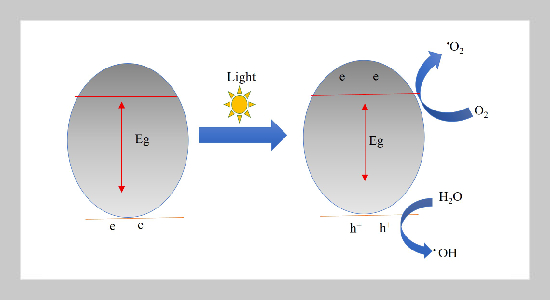
Schematic mechanism on semiconductor photocatalyst structure and hydroxyl radical formation
Copyright The Author(s). This is an open access article distributed under the terms of the Creative Commons Attribution License (CC BY 4.0), which permits unrestricted use, distribution, and reproduction in any medium, provided the original author and source are cited.
Download Citation: BibTeX | http://dx.doi.org/10.6180/jase.202609_32.038
Water pollution caused by linear alkylbenzene sulfonate (LAS) from laundry effluent has been increasingly detected, posing serious threats to both the environment and human health. Preventing this pollution requires a method that not only effectively reduces LAS concentration but also transforms it into smaller, safer molecules. This research aims to enhance the effectiveness of the photo-Fenton process at near-neutral pH for the removal
of LAS from laundry effluent by introducing rusted iron waste as a heterogeneous catalyst thermally treated at 100 ◦C and 450 ◦C. LAS photodegradation was conducted using a batch technique along with optimization of several process variables. The systematic characterization using XRD, DR-UV/Visible, SEM, and surface area analyzer techniques confirmed that increasing the calcination temperature of rusty waste results in the
formation of more crystalline and purer iron oxide (Fe2O3) exhibiting larger surface areas, wider pore diameters, and smaller band gap energies. Consistent with these properties, the iron oxide catalyst was able to remove LAS from laundry wastewater at an initial concentration of 119.18 mg/L, achieving up to 95% degradation efficiency, significantly higher than catalysts prepared at lower temperatures. The optimal degradation condition for 50 mL of wastewater was obtained by applying 6 g L−1 catalyst dose and 250 mmolL−1 of H2O2 at pH 6 , resulting in a 95% reduction of LAS within 60 minutes. These findings demonstrate that the heterogeneous photo-Fenton process, employing low-cost rust-derived iron oxide catalysts under near-neutral pH conditions, provides an effective and environmentally sustainable approach for treating laundry wastewater. Consequently, this method holds great potential in mitigating environmental pollution.
Keywords: laundry effluent; photo-Fenton; iron rust; solid catalyst; neutral pH
- [1] V. V. Patil, P. R. Gogate, A. P. Bhat, and P. K. Ghosh, (2020) “Treatment of laundry wastewater containing residual surfactants using combined approaches based on ozone, catalyst and cavitation” Separation and Purification Technology 239: 116594. DOI: https://doi.org/10.1016/j.seppur.2020.116594.
- [2] E. T. Wahyuni, I. Istiningsih, and A. Suratman, (2020) “Use of visible light for photo degradation of linear alkylbenzene sulfonate in laundry wastewater over Ag-doped TiO2.” 13: 124–130. DOI: 10.3923/jest.2020.124.130.
- [3] E. T. Wahyuni, A. Sabrina, and N. H. Aprilita, (2022) “Enhancement of Fenton Performance at Near-Neutral pH by Using Ethylene Diamine Tetra Acetic Acid for Anionic Surfactant Removal from a Laundry Wastewater” Key Engineering Materials 920: 57–62. DOI: 10.4028/p-665217.
- [4] E. Sugiharto, (2014) “Distribution of Detergent Waste in the Environment and the Removal by Using Photocatalytic Degradation and Coagulation Methods” American Chemical Science Journal 4: 715–725.
- [5] N. A. Affandi, C. G. Joseph, M. I. Nabeel, M. Hafiz, A. Majid, and K. Ghazali, (2025) “Photolytic and Photocatalytic Degradation of Detergent and Surfactant Solutions by Various Light Sources” Malaysian Journal of Chemistry 27: 41–63. DOI: https://doi.org/10.55373/mjchem.v27i6.41.
- [6] M. E.-D. R. Hassan, M. E. S. Barakat, and E. H. E. Yosef, (2024) “Synthesis and evaluation of core–shell nanocomposites for the photodegradation of liner alkylbenzene sulfonate water contaminations” International Journal of Environmental Science and Technology 21: 3185–3200. DOI: 10.1007/s13762-023-05181-4.
- [7] M. B. Miranzadeh, R. Zarjam, R. Dehghani, M. Haghighi, H. Z. Badi, M. A. Marzaleh, and A. M. Tehrani, (2016) “Comparison of fenton and photo-fenton processes for removal of linear alkyle benzene sulfonate (LAS) from aqueous solutions” Pol. J. Environ. Stud 25(4): 1639–1648. DOI: /10.15244/pjoes/61824.
- [8] E. T. Wahyuni, R. Roto, M. Sabrina, V. Anggraini, N. F. Leswana, and A. C. Vionita, (2016) “Photodegradation of Detergent Anionic Surfactant in Wastewater Using UV/TiO2/H2O2 and UV/Fe2+/H2O2 Processes” American Journal of Applied Chemistry 4(5): 174–180. DOI: 10.11648/j.ajac.20160405.13. eprint: https://article.sciencepublishinggroup.com/pdf/10.11648/j.ajac.20160405.13.
- [9] M. Bradai, J. Han, A. E. Omri, N. Funamizu, S. Sayadi, and H. Isoda, (2014) “Cytotoxic effect of linear alkylbenzene sulfonate on human intestinal Caco-2 cells: associated biomarkers for risk assessment” Environmental Science and Pollution Research 21: 10840–10851. DOI: 10.1007/s11356-014-3074-6.
- [10] K. Wysokowska, Z. Cupiał, M. Staszak, A. Zgoła-Grześkowiak, J. Koziołek, Ł. Ławniczak, M. Wysokowski, and B. Wyrwas, (2024) “Photocatalytic degradation of non-ionic, anionic, and cationic surfactants: from batch experiments through equilibrium/kinetic study to ecotoxicology analysis” Chemical Papers 78: 761–777. DOI: 10.1007/s11696-023-03117-3.
- [11] M.-h. Zhang, H. Dong, L. Zhao, D.-x. Wang, and D. Meng, (2019) “A review on Fenton process for organic wastewater treatment based on optimization perspective” Science of The Total Environment 670: 110–121. DOI: https://doi.org/10.1016/j.scitotenv.2019.03.180.
- [12] G. Papadopoulou, E. Evgenidou, and D. Lambropoulou, (2025) “Homogeneous and Heterogeneous Photo-Fenton-Based Photocatalytic Techniques for the Degradation of Nile Blue Dye” Applied Sciences 15(14): DOI: 10.3390/app15147917.
- [13] H. Befenzi, A. Ezzariai, T. Mechichi, L. Kouisni, M. Hafidi, E. Record, and L. EL Fels, (2025) “Degradation of antibiotics by homogeneous and heterogeneous Fenton processes: A review” Journal of Hazardous Materials Advances 17: 100522. DOI: https://doi.org/10.1016/j.hazadv.2024.100522.
- [14] A. Vishwanath and Vaidya. “Comparison Of Different Advanced Oxidation Processes For 2-Nitrophenol (2-NP) Degradation In Aqueous Solution”. In: 2023.
- [15] E. T. Wahyuni, A. Nurhikmatillah, H. Kurniasari, and D. Siswanta, (2021) “Detoxification of as(III) in aqueous media by using photo-Fenton method.” 23: 550–555. DOI: 10.30955/gnj.003265.
- [16] E. T. Wahyuni, D. Siswanta, E. S. Kunarti, D. Supraba, and S. Budiraharjo, (2019) “Removal of Pb(II) ions in the aqueous solution by photo-Fenton method” Global Nest Journal 21: 180–186. DOI: 10.30955/gnj.002936.
- [17] A. Mirzaei, Z. Chen, F. Haghighat, and L. Yerushalmi, (2017) “Removal of pharmaceuticals from water by homo/heterogonous Fenton-type processes – A review” Chemosphere 174: 665–688. DOI: 10.1016/j.chemosphere.2017.02.019.
- [18] A. Choquehuanca, J. G. Ruiz-Montoya, and A. L. R.-T. Gómez, (2021) “Discoloration of methylene blue at neutral pH by heterogeneous photo-Fenton-like reactions using crystalline and amorphous iron oxides” Open Chemistry 19(1): 1009–1020. DOI: 10.1515/chem-2021-0077.
- [19] J. A. S. Ribeiro, J. F. Alves, B. C. B. Salgado, A. C. Oliveira, R. S. Araújo, and E. Rodríguez-Castellón, (2024) “Heterogeneous Photo-Fenton Degradation of Azo Dyes over a Magnetite-Based Catalyst: Kinetic and Thermodynamic Studies” Catalysts 14(9): DOI: 10.3390/catal14090591.
- [20] L. Martinez, H. Gomes, G. Drazic, J. Faria, and A. Silva, (2014) “Hydrothermal synthesis of iron oxide photo-Fenton catalysts: The effect of parameters on morphology, particle size and catalytic efficiency” Global Nest Journal 16: 474–484.
- [21] A. Shokri and M. S. Fard, (2023) “Using $\alpha\text{-}\text{Fe}_2\text{O}_3/\text{SiO}_2$ as a heterogeneous Fenton catalyst for the removal of chlorophenol in aqueous environment: Thermodynamic and kinetic studies” International Journal of Environmental Science and Technology 20: 383–396. DOI: 10.1007/s13762-022-04498-w.
- [22] H. Rasouli, M. Khodabakhshi, and M. Ghorbanpour, (2022) “Decolorization of methyl orange dye by photo-Fenton process using silica gel/iron oxide catalyst” Desalination and Water Treatment 274: 289–296. DOI: 10.5004/dwt.2022.28919.
- [23] A. Magomedova, A. Isaev, F. Orudzhev, D. Sobola, R. Murtazali, A. Rabadanova, N. S. Shabanov, M. Zhu, R. Emirov, S. Gadzhimagomedov, N. Alikhanov, and K. Kasinathan, (2023) “Magnetically Separable Mixed-Phase $\alpha/\gamma\text{-}\text{Fe}_2\text{O}_3$ Catalyst for Photo-Fenton-like Oxidation of Rhodamine B” Catalysts 13(5): DOI: 10.3390/catal13050872.
- [24] M. Ahmad, A. R. A. Aziz, S. A. Mazari, A. G. Baloch, and S. Nizamuddin, (2020) “Photocatalytic degradation of methyl orange from wastewater using a newly developed Fe-Cu-Zn-ZSM-5 catalyst” Environmental Science and Pollution Research 27: 26239–26248. DOI: 10.1007/s11356-020-08940-9.
- [25] J. Xu, Q. Ma, W. Feng, X. Zhang, Q. Lin, C. You, and X. Wang, (2022) “Removal of methyl orange from water by Fenton oxidation of magnetic coconut-clothed biochar” RSC advances 12(38): 24439–24446. DOI: 10.1039/D2RA03545F.
- [26] I. Ouiriemmi, A. Karrab, N. Oturan, M. Pazos, E. Rozales, A. Gadri, M. Á. Sanromán, S. Ammar, and M. A. Oturan, (2017) “Heterogeneous electro-Fenton using natural pyrite as solid catalyst for oxidative degradation of vanillic acid” Journal of Electroanalytical Chemistry 797: 69–77. DOI: 10.1016/j.jelechem.2017.05.028.
- [27] N. Barhoumi, H. Olvera-Vargas, N. Oturan, D. Huguenot, A. Gadri, S. Ammar, E. Brillas, and M. A. Oturan, (2017) “Kinetics of oxidative degradation/mineralization pathways of the antibiotic tetracycline by the novel heterogeneous electro-Fenton process with solid catalyst chalcopyrite” Applied Catalysis B: Environmental 209: 637–647. DOI: 10.1016/j.apcatb.2017.03.034.
- [28] M. Ioffe, S. Kundu, N. Perez-Lapid, and A. Radian, (2022) “Heterogeneous Fenton catalyst based on clay decorated with nano-sized amorphous iron oxides prevents oxidant scavenging through surface complexation” Chemical Engineering Journal 433: 134609. DOI: 10.1016/j.cej.2022.134609.
- [29] A. Özcan, A. Atılır Özcan, Y. Demirci, and E. Şener, (2017) “Preparation of Fe2O3 modified kaolin and application in heterogeneous electro-catalytic oxidation of enoxacin” Applied Catalysis B: Environmental 200: 361–371. DOI: 10.1016/j.apcatb.2016.07.018.
- [30] S. Filice, C. Bongiorno, S. Libertino, L. Gradon, D. Iannazzo, and S. Scalese, (2022) “Photo-Fenton Degradation of Methyl Orange with Dunino Halloysite as a Source of Iron” Catalysts 12(3): DOI: 10.3390/catal12030257.
- [31] X. Liu, H.-L. Liu, K.-P. Cui, Z.-L. Dai, B. Wang, and X. Chen, (2022) “Heterogeneous Photo-Fenton Removal of Methyl Orange Using the Sludge Generated in Dyeing Wastewater as Catalysts” Water 14(4): DOI: 10.3390/w14040629.
- [32] H. Ghazzaf, B. Nechchadi, A. Jouali, A. Salhi, M. El Krati, and S. Tahiri, (2022) “Synthesis of heterogeneous photo-Fenton catalyst from iron rust and its application to degradation of Acid Red 97 in aqueous medium” Journal of Environmental Chemical Engineering 10(3): 107570. DOI: 10.1016/j.jece.2022.107570.
- [33] E. T. Wahyuni, N. D. Lestari, I. R. Cinjana, S. Annur, T. A. Natsir, and M. Mudasir, (2023) “Doping TiO2 with Fe from iron rusty waste for enhancing its activity under visible light in the Congo red dye photodegradation” Journal of Engineering and Applied Science 70: 9. DOI: 10.1186/s44147-023-00178-9.
- [34] E. T. Wahyuni, S. Annur, N. D. Lestari, and M. Mudasir, (2024) “Conversion of iron rusty waste into Fe dopant of TiO2 to increase its photocatalytic activity under visible light for photodegradation of rhodamine-B” Results in Engineering 22: 102296. DOI: 10.1016/j.rineng.2024.102296.
- [35] K. KHOIRUNISA, N. D. LESTARI, E. T. WHYUNI, and T. A. NATSIR, (2025) “Enhanced photocatalytic reduction of Cr(VI) under visible light a magnetically separable TiO2-Fe3O4 photocatalyst prepared from iron rusty waste” Journal of Metals, Materials and Minerals 35: e2162. DOI: 10.55713/jmmm.v35i1.2162.
- [36] T. Jiang, A. S. Poyraz, A. Iyer, Y. Zhang, Z. Luo, W. Zhong, R. Miao, A. M. El-Sawy, C. J. Guild, Y. Sun, D. A. Kriz, and S. L. Suib, (2015) “Synthesis of Mesoporous Iron Oxides by an Inverse Micelle Method and Their Application in the Degradation of Orange II under Visible Light at Neutral pH” The Journal of Physical Chemistry C 119(19): 10454–10468. DOI: 10.1021/acs.jpcc.5b02057.
- [37] H. Lee, H. S. Jang, N. Y. Kim, and J. B. Joo, (2021) “Cu-doped TiO2 hollow nanostructures for the enhanced photocatalysis under visible light conditions” Journal of Industrial and Engineering Chemistry 99: 352–363. DOI: 10.1016/j.jiec.2021.04.045.
- [38] S. Kaufhold, R. Dohrmann, I. Wallis, and C. Weber, (2023) “Chemical and mineralogical reactions of bentonites in geotechnical barriers at elevated temperatures: review of experimental evidence and modelling progress” Clay Minerals 58(3): 280–300. DOI: 10.1180/clm.2023.26.
- [39] L. Frolova. “Studying of iron oxyhydroxide dehydration”. In: International Conference on Nanotechnology and Nanomaterials. Springer. 2020, 165–169.
- [40] J. Khanam, M. R. Hasan, B. Biswas, M. F. Ahmed, S. Mostofa, U. S. Akhtar, M. K. Hossain, M. S. Quddus, S. Ahmed, N. Sharmin, and S. M. Al-Reza, (2024) “Effect of low temperature calcination on micro structure of hematite nanoparticles synthesized from waste iron source” Heliyon 10: DOI: 10.1016/j.heliyon.2024.e41030.
- [41] M. Zhong, Y. He, E. A. Milligan, P. C. Pistorius, and B. A. Webler, (2020) “In Situ Observation of Reaction Fronts During the Initial Stages of Iron Surface Oxidation at 1150 °C” Oxidation of Metals 93: 449–463. DOI: 10.1007/s11085-020-09965-8.
- [42] S. Rawat, K. R. Singh, and J. Singh, (2025) “Synthesis of iron nanoparticles using iron recovered from rust: An application for the catalytic degradation of phenols” Environmental Science and Pollution Research: DOI: 10.1007/s11356-025-36114-y.
- [43] L. Boumaza, S. Boudjadar, O. Abdelaziz, A. Mougari, M. Zabat, and Y. Aouabdia, (2025) “Eco-friendly synthesis of iron oxide nanoparticles (IO-NPs): grain size and strain estimation models, band gap calculations, and antibacterial properties” Physics and Chemistry of Minerals 52: 29. DOI: 10.1007/s00269-025-01332-w.
- [44] A. H. Kadhim and N. B. Hasan, (2019) “Structural and morphological properties of Fe2O3 and TiO2: Fe2O3 thin films prepared by spray pyrolysis technique” Journal of Kufa-Physics 11(1): 27–34. DOI: 10.31257/2018/JKP/2019/110105.
- [45] K. Jiang, J. Zhang, R. Luo, Y. Wan, Z. Liu, and J. Chen, (2021) “A facile synthesis of Zn-doped TiO2 nanoparticles with highly exposed (001) facets for enhanced photocatalytic performance” RSC Advances 11: 7627–7632. DOI: 10.1039/d0ra09318a.
- [46] N. Thomas, D. D. Dionysiou, and S. C. Pillai, (2021) “Heterogeneous Fenton catalysts: A review of recent advances” Journal of Hazardous Materials 404: 124082. DOI: 10.1016/j.jhazmat.2020.124082.
- [47] K. O’Dowd and S. C. Pillai, (2020) “Photo-Fenton disinfection at near neutral pH: Process, parameter optimization and recent advances” Journal of Environmental Chemical Engineering 8: DOI: 10.1016/j.jece.2020.104063.
- [48] E. Ortega-Gómez, P. Fernández-Ibáñez, M. M. B. Martín, M. I. Polo-López, B. E. García, and J. A. S. Pérez, (2012) “Water disinfection using photo-Fenton: Effect of temperature on Enterococcus faecalis survival” Water Research 46: 6154–6162. DOI: 10.1016/j.watres.2012.09.007.
- [49] N. Mukwevho, P. J. Mafa, K. K. Kefeni, A. K. Mishra, S. B. Mishra, and A. T. Kuvarega, (2024) “Photo-Fenton like reaction for the degradation of methyl orange using magnetically retrievable NiFe2O4/CoMoS4 heterojunction photocatalyst” Journal of Water Process Engineering 65: DOI: 10.1016/j.jwpe.2024.105882.
- [50] N. Thomas, D. D. Dionysiou, and S. C. Pillai, (2021) “Heterogeneous Fenton catalysts: A review of recent advances” Journal of Hazardous Materials 404: DOI: 10.1016/j.jhazmat.2020.124082.