



Received: February 16, 2026
Accepted: April 26, 2026
Publication Date: May 17, 2026
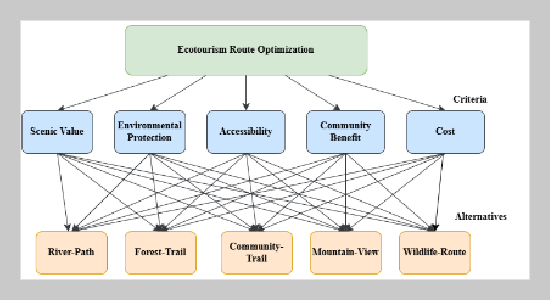
AHP Diagram for Ecotourism Route Optimization
Copyright The Author(s). This is an open access article distributed under the terms of the Creative Commons Attribution License (CC BY 4.0), which permits unrestricted use, distribution, and reproduction in any medium, provided the original author and source are cited.
Download Citation: BibTeX | http://dx.doi.org/10.6180/jase.202609_32.035
Ecotourism is a significant component of the global tourism industry, particularly in rural areas abundant in biodiversity and natural habitats… AHP prioritized criteria such as scenic value, safety, and environmental impact, while GWO identified the most sustainable routes. The River Path achieved the highest Composite Route Utility Score of 834.2, with 86% of respondents preferring low-impact, uncrowded routes (less than 10% crowding, under 15% degradation). Community involvement positively influenced over 70% of participants, with 86% agreeing it improves route sustainability. This framework helps policymakers design routes that maximize visitor satisfaction while promoting ecological conservation and sustainable tourism.
Keywords: Ecotourism, Route Optimization, Analytical Hierarchy Process, Grey Wolf Optimizer, Sustainable Resource Management.
- [1] M. Heshmati, M. Gheitury, and S. Shadfar, (2022) “Factors affecting possibility of ecotourism development and sustaining natural resources using SWOT approach in west Iran” International Journal of Geoheritage and Parks 10(2): 173–183. DOI: 10.1016/j.ijgeop.2022.03.004.
- [2] M. Godovykh, A. Fyall, and A. Pizam, (2025) “Exploring the Impacts of Tourism on the Well-Being of Local Communities” Sustainability 17(13): 5849. DOI: 10.3390/su17135849.
- [3] K. Kotis et al., (2022) “Towards Optimal Planning for Green, Smart, and Semantically Enriched Cultural Tours” Smart Cities 6(1): 123–136. DOI: 10.3390/smartcities6010007.
- [4] S. Seifollahi-Aghmiuni, Z. Kalantari, G. Egidi, L. Gaburova, and L. Salvati, (2022) “Urbanisation-driven land degradation and socioeconomic challenges in peri-urban areas: Insights from Southern Europe” Ambio 51(6): 1446–1458. DOI: 10.1007/s13280-022-01701-7.
- [5] F. Nocca, M. Bosone, P. De Toro, and L. Fusco Girard, (2023) “Towards the Human Circular Tourism: Recommendations, Actions, and Multidimensional Indicators for the Tourist Category” Sustainability 15(3): 1845. DOI: 10.3390/su15031845.
- [6] O. Mazele and C. Amoah, (2022) “The causes of poor infrastructure management and maintenance in South African municipalities” Property Management 40(2): 192–206. DOI: 10.1108/PM-06-2021-0042.
- [7] G. Kolkos, (2025) “Geospatial Decision Support for Forest Trail Constructions Allocation Using GIS-Network Analysis and Hybrid MADM Methods (AHP–PROMETHEE II)” Geographies 5(4): 72. DOI: 10.3390/geographies5040072.
- [8] K. Sun, Z. Xing, X. Cao, and W. Li, (2021) “The Regime of Rural Ecotourism Stakeholders in Poverty-Stricken Areas of China: Implications for Rural Revitalization” International Journal of Environmental Research and Public Health 18(18): 9690. DOI: 10.3390/ijerph18189690.
- [9] J. Yuan, H. Gao, Y. Shen, and G. Ma, (2024) “Spatial Differentiation of Ecotourist Perceptions Based on the Random Forest Model: The Case of the Gansu Section of the Yellow River Basin” Land 13(4): 560. DOI: 10.3390/land13040560.
- [10] X. Wang, (2024) “The analysis of rural tourism image optimization under the internet of things and deep learning” Scientific Reports 14(1): 29898. DOI: 10.1038/s41598-024-81868-z.
- [11] S. Ferdowsi, (2025) “Site selection of ecotourism eco-camps for sustainable development of rural areas” Journal of Ecotourism 24(2): 95–113. DOI: 10.1080/14724049.2024.2366928.
- [12] R. Pitakaso, T. Srichok, S. Khonjun, S. Gonwirat, N. Nanthasamroeng, and C. Boonmee, (2024) “Multi-objective sustainability tourist trip design: An innovative approach for balancing tourists’ preferences with key sustainability considerations” Journal of Cleaner Production 449: 141486. DOI: 10.1016/j.jclepro.2024.141486.
- [13] R. Samal and M. Dash, (2023) “Ecotourism, biodiversity conservation and livelihoods: Understanding the convergence and divergence” International Journal of Geoheritage and Parks 11(1): 1–20. DOI: 10.1016/j.ijgeop.2022.11.001.
- [14] J. Li, J. A. Coca-Stefaniak, T. H. H. Nguyen, and A. M. Morrison, (2024) “Sustainable tourist behavior: A systematic literature review and research agenda” Sustainable Development 32(4): 3356–3374. DOI: 10.1002/sd.2859.