


Ye Su1, Zhenzhong Huang2 , and Yuewang Cao3
1Guangxi Normal University, School of DesignGuilin, Guangxi Province 541004, China
2Guangxi Science & Technology Normal University, Future Teachers College, Laibin, Guangxi province 546199, China
3Nanning University, School of Marxism, Nanning, Guangxi province 530299, China
Received: January 31, 2026
Accepted: March 9, 2026
Publication Date: May 13, 2026
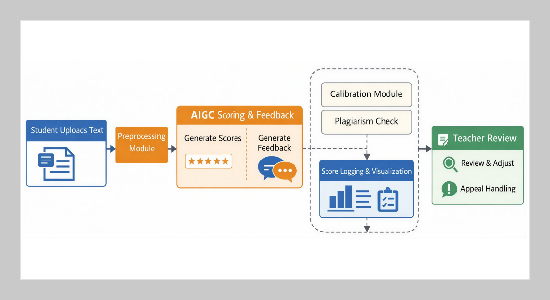
Conceptual Workflow of the Implemented AIGC Evaluation Process for Text-Based Assignments
Copyright The Author(s). This is an open access article distributed under the terms of the Creative Commons Attribution License (CC BY 4.0), which permits unrestricted use, distribution, and reproduction in any medium, provided the original author and source are cited.
Download Citation: BibTeX | http://dx.doi.org/10.6180/jase.202609_32.032
With the rapid advancement of Large Language Models (LLMs) and AI-Generated Content (AIGC) technologies, educational assessment is entering a new phase of intelligent upgrading. LLM-based teaching evaluation faces rubric misalignment, scale drift, and low interpretability. This study proposes an AIGC framework using automated testing, LLM analysis, rubric alignment, and Low-Rank Adaptation (LoRA) fine-tuning for multidimensional assessment of text, code, and learning behavior. Experimental results demonstrate that rubric-structured prompting combined with LoRA fine-tuning effectively mitigates scoring scale drift by calibrating model outputs to instructor-defined grading distributions, improving Pearson correlation from
0.72 to 0.89 while significantly reducing systematic bias. The dual-channel evaluation strategy (functional testing + AIGC static analysis) enhances interpretability by separating execution correctness from structural quality, achieving 0.88 overall agreement with instructor grading. Furthermore, the proposed human-machine collaborative mechanism dynamically balances automated efficiency and expert validation, reducing grading time by approximately 75% while preserving grading reliability. Collectively, these components establish a unified, interpretable, and scale-stable intelligent educational evaluation system.
Keywords: AIGC; Large Language Models; Intelligent Educational Assessment; LoRA FineTuning; Automated Code Grading; Rubric Alignment
- [1] Q. Huang, C. Lv, L. Lu, and S. Tu, (2025) “Evaluating the quality of AI-generated digital educational resources for university teaching and learning” Systems 13(3): 174. DOI: 10.3390/systems13030174.
- [2] R. K. Sinha and P. Kumar, (2024) “EduGorilla: Gen AI for educational content creation” Journal of Information Technology Teaching Cases: 20438869251328998. DOI: 10.1177 / 20438869251328998.
- [3] J. Li, S. Zhu, H. H. Yang, and J. Xu. “What does Artificial Intelligence Generated Content bring to Teaching and Learning? A literature review on AIGC in Education”. In: International Symposium on Educational Technology (ISET). IEEE, 2024, 18–23. DOI: 10.1109/ISET61814.2024.00013.
- [4] C. Zhu, L. Cui, Y. Tang, and J. Wang, (2025) “The Evolution and Future Perspectives of Artificial Intelligence-Generated Content” IEEE Transactions on Systems, Man, and Cybernetics: Systems 56(1): 546–564. DOI: 10.1109/TSMC.2025.3627806.
- [5] K. Tan, J. Yao, T. Pang, C. Fan, and Y. Song, (2025) “ELF: Educational LLM framework of improving and evaluating AI-generated content for classroom teaching” ACM Journal of Data and Information Quality 17(3): 1–23. DOI: 10.1145/3712065.
- [6] A. O. Kolhatin. “From automation to augmentation: a human-centered framework for generative AI in adaptive educational content creation”. In: CEUR Workshop Proceedings. 4060. 2025, 143–195.
- [7] G. Wang and F. Sun, (2025) “A review of generative AI in digital education: transforming learning, teaching, and assessment” International Journal of Information and Communication Technology 26(19): 102–127. DOI: 10.1504/IJICT.2025.146701.
- [8] V. R. K. Reddy, N. Tharun, K. S. R. Reddy, S. Hariharan, B. P. Maddala, and S. Baduguna. “Student Assessment using Generative AI by for Content Specific Challenge Identification”. In: International Conference on Trends in Electronics and Informatics (ICOEI). IEEE, 2025, 1079–1084. DOI: 10.1109/ICOEI65986.2025.11013397.
- [9] C. Zhang, G. Shan, B.-H. Roh, and J. Jiang, (2025) “FM2 learning: LLM-based federated multi-task multidomain learning for consumer electronics and IoT enhancement” IEEE Transactions on Consumer Electronics 71(4): 11977–11988. DOI: 10.1109/TCE.2025.3603592.
- [10] N. Pellas, (2025) “The impact of AI-generated instructional videos on problem-based learning in science teacher education” Education Sciences 15(1): 102. DOI: 10.3390/educsci15010102.
- [11] J. Han, Y. Yang, and G. Liu, (2025) “Are Teachers Assessing Work Written by Students or by AI? A Rapid Literature Review of Research on Detecting Content Generated by Generative AI” European Journal of Education 60(4): e70240. DOI: 10.1111/ejed.70240.
- [12] X. Yang, X. Xie, and R. Cui. “Integration of intelligent generation and education: Research and practice of AIGC-driven intelligent teaching resources in universities”. In: International Conference on Computer Science and Technologies in Education (CSTE). IEEE, 2025, 656–660. DOI: 10.1109/CSTE64638.2025.11092085.
- [13] Y. Wang and G. Zhang, (2025) “Multigraph-based Deep Programming Ability Tracing Method For Students” Journal of Applied Science and Engineering 28(8): DOI: 10.6180/jase.202508_28(8).0019.
- [14] M. S. Sundari, H. R. Penthala, and A. Nayyar. “Transforming education through AI-enhanced content creation and personalized learning experiences”. In: Impact of Artificial Intelligence on Society. Chapman and Hall/CRC, 2024, 98–118. DOI: 10.1201/9781032644509.
- [15] Q. Li, Z. Zeng, T. Li, and S. Sun, (2024) “Identifying artificial intelligence–generated content in online QA communities through interpretable machine learning” Journal of Information Science: 01655515241281491. DOI: 10.1177/01655515241281491.
- [16] S. Vadivel, R. Banupriya, M. K. Nivodhini, N. D. Surendhar, N. Subashree, and M. S. Murali. “AI-Powered Personalization in Online Learning Systems for Enhanced Engagement and Effective Learning using Collaborative and Content-Based filtering algorithms”. In: International Conference on Sustainability Innovation in Computing and Engineering (ICSICE 2024). Atlantis Press, 2025, 1114–1139. DOI: 10.2991/978-94-6463-718-2_94.
- [17] X. Ma, W. Pan, and X. N. Yu, (2025) “Evaluating AI-generated examination papers in periodontology: a comparative study with human-designed counterparts” BMC Medical Education 25(1): 1099. DOI: 10.1186/s12909-025-07706-6.
- [18] S. R. Ansari and I. N. Qamari, (2025) “Artificial intelligence and students’ cognitive learning outcomes with bibliometric and content analysis for future research agenda” Discover Education 4(1): 441. DOI: 10.1007/s44217-025-00865-0.
- [19] S. Hernando-Castro, J. D. López-Arquillo, and M. Perea-Álvarez-de-Eulate, (2024) “The use of AI tools and their impact on the assessment of postgraduate courses in the technological field” Advances in Building Education 8(3): 9–23. DOI: 10.20868/abe.2024.3.5407.
- [20] X. Wang, Y. Hong, and X. He, (2024) “Exploring artificial intelligence generated content (AIGC) applications in the metaverse: Challenges, solutions, and future directions” IET Blockchain 4(4): 365–378. DOI: 10.1049/blc2.12076.
- [21] X. Liu and Z. Li. “Research on the Application of Artificial Intelligence in Elementary School Contextual Composition Teaching”. In: Proceedings of the 2nd International Conference on Intelligent Education and Computer Technology. 2025, 189–197. DOI: 10.1145/3764206.3764234.
- [22] Q. Lin, M. Xie, H. Ye, H. Wu, X. Li, D. Ruan, and H. Zhong, (2025) “Empowering Island Cultural Resource Education through Generative Artificial Intelligence: Value Logic, Challenges, and Implementation Strategies” International Journal of Education and Humanities 5(3): 463–478. DOI: 10.58557/(ijeh).v5i3.335.
- [23] X. He, (2024) “Enhancing Reading Comprehension with AI-Generated Adaptive Texts” International Journal of New Developments in Education 6(7): 46–52. DOI: 10.25236/IJNDE.2024.060708.
- [24] C. S. Veluru, (2024) “The Impact of Generative AI on Content Curation and Content Advancements in Education and Training” European Journal of Advances in Engineering and Technology 11(4): 121–130. DOI: 10.5281/zenodo.12737572.
- [25] J. Wang, H. Du, D. Niyato, Z. Xiong, J. Kang, S. Mao, and X. Shen, (2024) “Guiding AI-generated digital content with wireless perception” IEEE Wireless Communications 31(4): 147–154. DOI: 10.1109/MWC.008.2300162.
- [26] H. Abbas and A. Meraj, (2025) “Integrating AI-Generated Materials in EFL: Institutional Dynamics, Teacher Productivity, and Shifts in Instructional Practices in Dir Lower, Pakistan” Research Journal for Social Affairs 3(6): 907–923. DOI: 10.71317/RJSA.003.06.0526.
- [27] H. Zhang and H. Long. “Evaluation of the Effectiveness of AI-Enabled Journalism Education Based on Empirical Research”. In: International Conference on Educational Innovation and Multimedia Technology (EIMT 2025). Atlantis Press, 2025, 119–126. DOI: 10.2991/978-94-6463-750-2_11.
- [28] O. I. Nwoyibe, (2025) “Deploying AI technology for effective teaching and learning: The need to always verify information gathered from generative AI tools” Caliphate Journal of Science and Technology 7(1): 22–29. DOI: 10.4314/cajost.v7i1.3.
- [29] Y. Xing, W. Gan, Q. Chen, and P. S. Yu, (2025) “AI-generated content in landscape architecture: a survey” AI Open: DOI: 10.1016/j.aiopen.2025.10.002.