




Received: November 28, 2025
Accepted: February 10, 2026
Publication Date: May 11, 2026
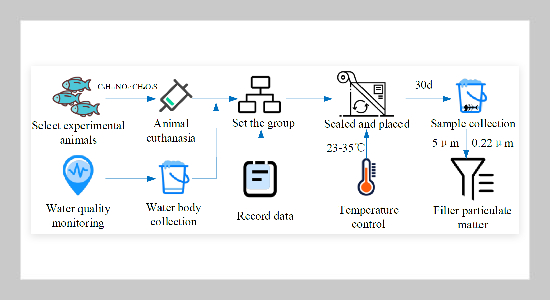
Flow chart of water sample preparation with decomposing animal carcasses
Copyright The Author(s). This is an open access article distributed under the terms of the Creative Commons Attribution License (CC BY 4.0), which permits unrestricted use, distribution, and reproduction in any medium, provided the original author and source are cited.
Download Citation: BibTeX | http://dx.doi.org/10.6180/jase.202609_32.030
Under the influence of climate change and human activities, the retention of animal carcasses in river water has become increasingly frequent, posing disturbances to the physicochemical properties and ecosystem of river environments. This study analyzes the impact of carcass decomposition on river ecosystems by measuring changes in water physicochemical parameters, microbial community structure, and the abundance of virulence genes. The results show that decomposition significantly decreases Dissolved Oxygen levels in water, with the lowest concentration reaching 0.08 mg/L. Meanwhile, ammonium nitrogen concentration rises sharply to 14.32 µg/ml, whereas nitrate nitrogen shows minimal change. Among microbial groups, bacteria are the dominant group, with a relative abundance of >60%. However, the abundance of archaea increases significantly in the carcass group (p<0.05). Analysis of virulence genes indicates that genes such as phoP and glnAl reach their highest abundance at 32°C in the carcass group. The structure of virulence gene profiles is strongly correlated with microbial communities, as shown by Procrustes analysis (r=0.810, p<0.05). These findings demonstrate that carcass decomposition drives microbial succession and promotes the enrichment of virulence genes by altering oxygen availability and nitrogen cycling. This provides valuable data for understanding the link between organic pollution and pathogenic risk in river ecosystems.
Keywords: River water; Animal carcass decomposition; Microbial communities; Virulence genes; Disturbance effects
- [1] A. Talema, (2023) “Causes, negative effects, and preventive methods of water pollution in Ethiopia” Quality Assurance and Safety of Crops & Foods 15(2): 129–139. DOI: 10.15586/qas.v15i2.1271.
- [2] M. L. Viljur, S. R. Abella, and M. Adámek, (2022) “The effect of natural disturbances on forest biodiversity: an ecological synthesis” Biological Reviews 97(5): 1930–1947. DOI: 10.1111/brv.12876.
- [3] C. Yang, Z. Zeng, Y. Wang, G. He, and Y. Hu, (2023) “Ecological risk assessment and identification of the distinct microbial groups in heavy metal-polluted river sediments” Environmental Geochemistry and Health 45(5): 1311–1329. DOI: 10.1007/s10653-022-01343-4.
- [4] G. Barceló, P. L. Perrig, P. Dharampal, E. Donadio, and S. A. Steffan, (2022) “More than just meat: carcass decomposition shapes trophic identities in a terrestrial vertebrate” Functional Ecology 36(6): 1473–1482. DOI: 10.1111/1365-2435.14041.
- [5] A. H. Rasmi, E. F. Ahmed, A. M. A. Darwish, and G. F. M. Gad, (2022) “Virulence genes distributed among Staphylococcus aureus causing wound infections and their correlation to antibiotic resistance” BMC Infectious Diseases 22(1): 652–663. DOI: 10.1186/s12879-022-07624-8.
- [6] I. K. Hamasalih, A. M. Salih, S. J. M. Sdiq, K. Q. Yaqub, and S. M. Raheem, (2025) “Tanjaro River pollution and its impact on the aquatic food chain” Science and Education 5(3): 235–244. DOI: 10.55677/ijssers/V05I03Y2025-01.
- [7] D. Onyejike, U. G. Esomonu, V. A. Fischer, I. M. Onyejike, and E. N. Ezenwatu, (2022) “Visible post mortem changes as a tool for decomposition timeline estimation in a tropical rainforest vegetation of Nigeria” Tropical Journal of Medical Research 21(1): 49–60. DOI: 10.5281/zenodo.6568722.
- [8] A. Khalil, M. M. M. Zidan, R. Alajmi, and A. M. Ahmed, (2023) “Impact of envenomation with snake venoms on rabbit carcass decomposition and differential adult dipteran succession patterns” Journal of Medical Entomology 60(1): 40–50. DOI: 10.1093/jme/tjac173.
- [9] M. Daniels, S. Reynolds, and D. Umstead, (2025) “Assessment of common nutrient levels and water quality in town run tributary of the Potomac river” Proceedings of the West Virginia Academy of Science 97(2): 19–32. DOI: 10.55632/pwvas.v97i2.1187.
- [10] S. M. Syed Mohd Daud, C. C. Heo, M. Y. P. Mohd Yusof, L. S. Khoo, and M. K. Chainchel Singh, (2024) “Use of thermal drone in detection and assessment of larval mass temperature in decomposed rabbit carcasses” Journal of Forensic Sciences 69(2): 542–553. DOI: 10.1111/1556-4029.15466.
- [11] E. Wenting, P. A. Jansen, S. Burggraeve, D. F. Delsman, and H. L. Siepel, (2024) “The influence of vertebrate scavengers on leakage of nutrients from carcasses” Oecologia 206(1): 21–35. DOI: 10.1007/s00442-024-05608-w.
- [12] P. Borah, R. Dutta, L. Das, G. Hazarika, and M. Choudhury, (2022) “Prevalence, antimicrobial resistance and virulence genes of Salmonella serovars isolated from humans and animals” Veterinary Research Communications 46(3): 799–810. DOI: 10.1007/s11259-022-09900-z.
- [13] M. Ahmadi, R. Ranjbar, P. Behzadi, and T. Mohammadian, (2022) “Virulence factors, antibiotic resistance patterns, and molecular types of clinical isolates of Klebsiella Pneumoniae” Expert Review of Anti-Infective Therapy 20(3): 463–472. DOI: 10.1080/14787210.2022.1990040.
- [14] Z. Bourhane, A. Lanzén, C. Cagnon, O. B. Said, and E. Mahmoudi, (2022) “Microbial diversity alteration reveals biomarkers of contamination in soil-river-lake continuum” Journal of Hazardous Materials 421: 126789. DOI: 10.1016/j.jhazmat.2021.126789.
- [15] P. K. Parida, B. K. Behera, B. Dehury, A. K. Rout, and D. J. Sarkar, (2022) “Community structure and function of microbiomes in polluted stretches of river Yamuna in New Delhi, India, using shotgun metagenomics” Environmental Science and Pollution Research 29(47): 71311–71325. DOI: 10.1007/s11356-022-20766-1.
- [16] A. Pedrinho, L. W. Mendes, A. P. de Araujo Pereira, A. S. F. Araujo, and A. Vaishnav, (2024) “Soil microbial diversity plays an important role in resisting and restoring degraded ecosystems” Plant and Soil 500(1): 325–349. DOI: 10.1007/s11104-024-06489-x.
- [17] C. R. Cornell, Y. Zhang, and D. Ning, (2023) “Land use conversion increases network complexity and stability of soil microbial communities in a temperate grassland” The ISME Journal 17(12): 2210–2220. DOI: 10.1038/s41396-023-01521-x.
- [18] Y. Wang, G. Wang, Y. Wan, X. Yu, and J. Zhao, (2022) “Recycling of dredged river silt reinforced by an eco-friendly technology as microbial induced calcium carbonate precipitation (MICP)” Soils and Foundations 62(6): 101216. DOI: 10.1016/j.sandf.2022.101216.
- [19] D. P. H. M. Amaral, D. M. P. de Castro, M. S. Linares, R. M. Hughes, and E. van den Berg, (2025) “Small hydropower dam alters the functional structure of macroinvertebrate assemblages in a Neotropical savanna river” Hydrobiologia 852(12): 3137–3154. DOI: 10.1007/s10750-024-05720-1.
- [20] H. Mokayed, T. Z. Quan, L. Alkhaled, and V. Sivakumar, (2023) “Real-time human detection and counting system using deep learning computer vision techniques” Artificial Intelligence and Applications 1(4): 221–229. DOI: 10.47852/bonviewAIA2202391.
- [21] M. Yosri, A. Z. A. Herrawy, S. M. Bassem, E. E. Hafez, A. M. Abu-Elsaoud, and M. I. Abo-Alkasem, (2025) “Aquatic environments resilience: Third-generation sequencing of fungi community of urban wastewater treatment plant and Nile River (Egypt)” Euro-Mediterranean Journal for Environmental Integration 10(1): 15–23. DOI: 10.1007/s41207-024-00600-5.
- [22] M. Gad, M. Yosri, M. E. Fawzy, A. K. Saleh, H. M. R. Abdel-Latif, A. M. Abu-Elsaoud, M. M. El-Sheekh, and M. I. Abo-Alkasem, (2024) “Microeukaryotic communities diversity with a special emphasis on protozoa taxa in an integrated wastewater treatment system” Environmental Sciences Europe 36(1): 101. DOI: 10.1186/s12302-024-00907-8.