




Cintantya Budi Casita1,2, Data Iranata3, Budi Suswanto4, Masahide Matsumura5, and Abdul Rochim6
1Institut Teknologi Sepuluh Nopember, Surabaya, Indonesia, 60111
2Universitas Pembangunan Nasional Veteran Jawa Timur, 60294
3Institut Teknologi Sepuluh Nopember, Surabaya, Indonesia, 60111
4Institut Teknologi Sepuluh Nopember, Surabaya, Indonesia, 60111
5Kumamoto University, Kumamoto, Japan, 860-8555
6Design Engineer, PT. Inti Teknik Solusi Cemerlang, Surabaya, Indonesia 60239
Received: October 17, 2025
Accepted: March 01, 2026
Publication Date: May 4, 2026
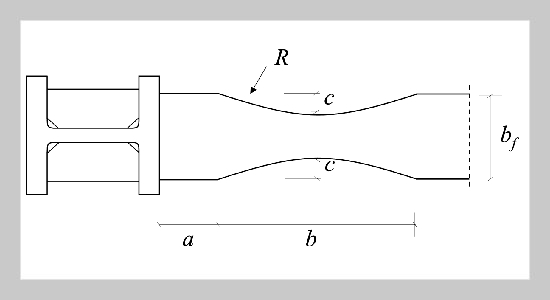
Geometry of radius cut RBS
Copyright The Author(s). This is an open access article distributed under the terms of the Creative Commons Attribution License (CC BY 4.0), which permits unrestricted use, distribution, and reproduction in any medium, provided the original author and source are cited.
Download Citation: BibTeX | http://dx.doi.org/10.6180/jase.202609_32.027
This study presents a comparative evaluation of four steel beam-to-column connection configurations: Conventional (CONV), Cover Plate (CP), Reduced Beam Section (RBS), and a hybrid Reduced Beam Section with Cover Plate (RBSCP), under cyclic loading conditions, with particular emphasis on hysteresis behavior and energy dissipation capacity. Finite element simulations were performed up to 6 % story drift to evaluate each model’s performance against the seismic demand limits prescribed in ASCE/SEI 41-17. All configurations demonstrated adequate ductility for moderate to severe seismic events. The CONV connection underperformed in both energy dissipation and stiffness retention, producing narrower hysteresis loops and exhibiting earlier stiffness degradation. In contrast, the CP connection achieved the highest energy dissipation and moment strength at all drift levels, attributed to the increased flange stiffness from the cover plates. The RBS connection exhibited stable, well balanced hysteresis loops with slightly lower strength but effective energy dissipation, benefiting from the intentional relocation of the plastic hinge away from the column face. The RBSCP connection combined the advantages of strength and ductility, sustaining broad and stable hysteresis loops with minor asymmetry between the positive and negative directions. Although it did not surpass the CP connection in peak strength, the RBSCP connection offered a well-balanced seismic performance. Analysis of the cyclic hysteresis loops revealed distinct differences in stiffness characteristics and degradation behavior. These findings highlight the potential of hybrid configurations such as the RBSCP connection, with further geometric optimization recommended to enhance consistency and reliability.
Keywords: Cover Plate; Cyclic Loading; RBSCP Connection; Reduced Beam Section; Seismic Performance; Seismic Enhancement
- [1] C. Sofias, C. Kalfas, and D. Pachoumis, (2014) “Experimental and FEM analysis of reduced beam section moment endplate connections under cyclic loading” Engineering Structures 59: 320–329. DOI: 10.1016/j.engstruct.2013.11.010.
- [2] C. Casita, B. Suswanto, C. Chiu, Triwulan, H. Masiran, H. Kristijanto, and D. Iranata, (2025) “Post-Northridge Welded Connections To Concrete Filled Steel Tube Columns: An Advancement In Seismic Performance” Advances in Civil Engineering Materials 635: 1002–1012. DOI: 10.1007/978-981-96-5654-7_91.
- [3] A. Saleh, S. Mirghaderi, and S. Zahrai, (2016) “Cyclic Testing Of Tubular Web RBS Connections In Deep Beams” Journal of Constructional Steel Research 117: 214–226. DOI: 10.1016/j.jcsr.2015.10.020.
- [4] L. Qi, R. Leon, M. Eatherton, and J. Paquette, (2021) “Parametric Investigation On The Design Of RBS Moment Connections With Jumbo Beams And Columns” Journal of Constructional Steel Research 177: 106436. DOI: 10.1016/j.jcsr.2020.106436.
- [5] S. Paul and S. Deb, (2022) “Experimental Study On A New V-Cut RBS And CFT Connections With Bidirectional Bolts Under Cyclic Loadings” Journal of Building Engineering 46: 103688. DOI: 10.1016/j.jobe.2021.103688.
- [6] C. Casita, D. Iranata, B. Suswanto, and M. Matsumura, (2024) “Determining The Optimal Cutting Geometry Of RBS Connection To Enhance Seismic Behavior In Steel Moment Frames” Advances in Civil Engineering Materials: 99–109. DOI: 10.1007/978-981-97-0751-5_10.
- [7] A. Deylami and A. Moslehi Tabar, (2013) “Promotion Of Cyclic Behavior Of Reduced Beam Section Connections Restraining Beam Web To Local Buckling” Thin-Walled Structures 73: 112–120. DOI: 10.1016/j.tws.2013.07.013.
- [8] A. 41-17, “Seismic Evaluation And Retrofit Of Existing Buildings. American Society of Civil Engineers”:
- [9] M. Morshedi, K. Dolatshahi, and S. Maleki, (2017) “Double Reduced Beam Section Connection.” Journal of Constructional Steel Research 138: 283–297. DOI: 10.1016/j.jcsr.2017.07.013.
- [10] A. Mansouri, M. Shakiba, and E. Fereshtehpour, (2021) “Two Novel Corrugated Web Reduced Beam Section Connections For Steel Moment Frames” Journal of Building Engineering 43: 103187. DOI: 10.1016/j.jobe.2021.103187.
- [11] H. Qiao, J. Xia, Y. Chen, C. Chen, and J. Zheng, (2022) “A Novel Principle For Improving Collapse Resistance Of Steel Frame Structures” Journal of Constructional Steel Research 196: 107408. DOI: 10.1016/j.jcsr.2022.107408.
- [12] O. Yilmaz and S. Bekiroglu, (2018) “Seismic Performance Of Post-Northridge Welded Connections” Latin American Journal of Solids and Structures 15: DOI: 10.1590/1679-78254574.
- [13] C. Casita, B. Suswanto, and I. Komara, (2022) “Experimental and FEM analysis of reduced beam section moment endplate connections under cyclic loading” Trends in Sciences 19: DOI: 10.48048/tis.2022.5746.
- [14] C. Lee, S. Jeon, J. Kim, and C. Uang, (2005) “Effects Of Panel Zone Strength And Beam Web Connection Method On Seismic Performance Of Reduced Beam Section Steel Moment Connections” Journal of Structural Engineering 131: 1854–1865. DOI: 10.1061/(asce)0733-9445(2005)131:12(1854).
- [15] L. Jia and H. Kuwamura, (2014) “Prediction Of Cyclic Behaviors Of Mild Steel At Large Plastic Strain Using Coupon Test Results” Journal of Structural Engineering 140: DOI: 10.1061/(asce)st.1943-541x.0000848.
- [16] A. 341-22, “Seismic Provisions For Structural Steel Buildings”: