




Minghao Li1,2, Shuting Wang1,2, Dongsheng Wu1,2, and Lijuan Zhao3,4
1School of Mechanical Engineering, Shenyang Ligong University, Shenyang, 110159, China
2Science and Technology Development Corporation, Shenyang Ligong University, Shenyang, 110159, China
3College of Mechanical Engineering, Liaoning Technical University, Fuxin 123000, China
4Liaoning Provincial Key Laboratory of Large-Scale Mining Equipment, Fuxin 123000, China
Received: March 7, 2026
Accepted: March 31, 2026
Publication Date: May 4, 2026
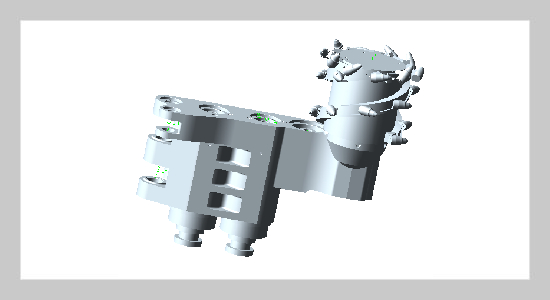
Overall Model of the Shearer Cutting Unit
Copyright The Author(s). This is an open access article distributed under the terms of the Creative Commons Attribution License (CC BY 4.0), which permits unrestricted use, distribution, and reproduction in any medium, provided the original author and source are cited.
Download Citation: BibTeX | http://dx.doi.org/10.6180/jase.202609_32.025
To improve the working efficiency of the cutting head of a coal cutter, studying the reliability of the heavy-duty gears in the cutting head under the condition of competitive failure was an effective approach. A reliability model for the gears under natural aging and sudden shock failure is established using stochastic processes. The three forces and three torques acting on the gears were obtained using mechanical system simulation software,
and the fatigue damage accumulation value of the gears was obtained using fatigue analysis software. The reliability model for the large gear in the cutting head under the competitive failure condition of natural aging and sudden shock failure is obtained based on the stochastic process solution parameters. The results show that the competitive reliability model proposed in this paper is beneficial for improving the accuracy of gear reliability calculation and thereby improving the working efficiency of the cutting head of the coal cutter.
Keywords: Gear; Stochastic process; Fatigue analysis; Competing reliability
- [1] X. Fu, Y. Fang, Y. Xu, H. Xu, G. Ma, and N. Peng, (2024) “Current Status of Research on Fault Diagnosis Using Machine Learning for Gear Transmission Systems” Machines 12(10): 679. DOI: 10.3390/machines12100679.
- [2] Q. Li, R. Yun, Z. Song, and S. Wei, (2016) “Analysis on reason of fracture and Improvement for planetary mechanism of shearer cutting unit” Coal Science and Technology 44(05): 172–176. DOI: 10.13199/j.cnki.cst.2016.05.033.
- [3] R. ZHANG, L. ZHU, and Y. ZHANG, (2019) “Experimental Research of Dynamic Characteristics for Long Wall Shearer Cutting Unit Gearbox in Straight Line Cutting” Journal of Northeastern University (Natural Science) 40(12): 1744–1749. DOI: 10.12068/j.issn.1005-3026.2019.12.014.
- [4] J. Liu. “Research on the Mechanical Characteristics of Transmission Parts in Gear Transmission System of a Shearer Cutting Section”. (mathesis). Liaoning Technical University, 2023. DOI: 10.27210/d.cnki.glnju.2023.000477.
- [5] L. Sheng, J. Chen, S. Jiang, and W. Li, (2024) “Research on the Reliability of the Gear System in Shearer Cutting Transmission Section” Machinery Design & Manufacture (6): 75–80. DOI: 10.19356/j.cnki.1001-3997.20240319.005.
- [6] W. Li and H. Pham, (2005) “Reliability modeling of multi-state degraded systems with multi-competing failures and random shocks” IEEE Transactions on Reliability 54(2): 297–303. DOI: 10.1109/TR.2005.847278.
- [7] L. Jiang, Q. Feng, and D. W. Coit, (2012) “Reliability and Maintenance Modeling for Dependent Competing Failure Processes With Shifting Failure Thresholds” IEEE Transactions on Reliability 61(4): 932–948. DOI: 10.1109/TR.2012.2221016.
- [8] M. Fan, Z. Zeng, E. Zio, and R. Kang, (2017) “Modeling dependent competing failure processes with degradation-shock dependence” Reliability Engineering & System Safety 165: 422–430. DOI: 10.1016/j.ress.2017.05.004.
- [9] C. CHANG and J. ZENG, (2015) “Reliability modeling for dependent competing failure process under extreme shock” Systems Engineering – Theory & Practice 35(5): 1332–1338. DOI: 10.12011/1000-6788(2015)5-1332.
- [10] X. Liu, Z. Wu, Y. Yuan, W. Sun, and J. Gao, (2025) “Reliability Modeling of Wind Turbine Gearbox System Considering Failure Correlation Under Shock-Degradation” Sensors 25(14): DOI: 10.3390/s25144425.
- [11] H. Peng, Q. Feng, and D. W. Coit, (2010) “Reliability and maintenance modeling for systems subject to multiple dependent competing failure processes” IIE transactions 43(1): 12–22. DOI: 10.1080/0740817X.2010.491502.
- [12] Z. Wang, H.-Z. Huang, Y. Li, and N.-C. Xiao, (2011) “An approach to reliability assessment under degradation and shock process” IEEE Transactions on Reliability 60(4): 852–863. DOI: 10.1109/TR.2011.2170254.
- [13] W. Huang and D. Dietrich, (2005) “An alternative degradation reliability modeling approach using maximum likelihood estimation” IEEE transactions on reliability 54(2): 310–317. DOI: 10.1109/TR.2005.845965.
- [14] Y. Sun, Y. Li, C. Gu, Q. Zhang, and K. Chen, (2025) “Dynamic reliability modeling and analysis of small modulus gear wear based on the Wiener process” Scientific Reports 15: DOI: 10.1038/s41598-025-09419-8.
- [15] X. LU, W. CHU, W. GAI, and D. CHEN, (2025) “Reliability modeling method in presence of non-conjugate distributions of random parameters” Journal of National University of Defense Technology 47(1): 230. DOI: 10.11887/j.cn.202501023.
- [16] J. Tang and H. Zhou, (2025) “Step-stress accelerated degradation test for Inverse Gaussian process based on M-optimality criterion” Scientific Reports 15(1): DOI: 10.1038/s41598-025-15171-w.
- [17] X. Liu, H. Wang, and X. Xu, (2017) “Reliability Assessment Based on Competition Failure Considering Multidegradation and Catastrophic Failure” China Mechanical Engineering 28: 7–12. DOI: 10.3969/j.issn.1004-132X.2017.01.002.
- [18] V. Couallier. “Some recent results on joint degradation and failure time modeling”. In: Probability, Statistics and Modelling in Public Health. Springer, 2006, 73–89. DOI: 10.1007/0-387-26023-4_6.
- [19] C. Liu, D. Qin, and Y. Liao, (2016) “Dynamic Analysis for the Cutting Electromechanical Transmission System in the Long-wall Shearer” Journal of Mechanical Engineering 52(7): 14–22. DOI: 10.3901/JME.2016.07.014.
- [20] H. Liu, B. Zhang, C. Zhu, and P. Wei, (2022) “State of Art of Gear Contact Fatigue Theories” Journal of Mechanical Engineering 58(03): 95–120. DOI: 10.3901/JME.2022.03.095.
- [21] G. Li, S. Zhang, L. Bian, F. Wang, Y. Feng, W. Liu, M. Zhang, and M. Qin, (2025) “Strength verification and failure analysis of wind turbine main shaft based on actual wind field loads” Machine Design and Manufacturing Engineering 54(7): 15–20. DOI: 10.3969/j.issn.2095-509x.2025.07.004.
- [22] Z. Zhao, (2025) “Analysis of Fatigue Wear Problems and Optimal Design of Output Spindle of Coal Cutting Section of Coal Mining Machine” Mechanical Management and Development 40(9): 197–199. DOI: 10.16525/j.cnki.cn14-1134/th.2025.09.070.
- [23] X. Pang, Y. He, X. Chen, J. Zhao, X. Luo, and K. Lv, (2025) “Research on Debris Characteristics and Wear Mechanism of Gear Material 18CrNiMo7-6 Used in Mining Reducer Under Dust-Contaminated Lubrication” Lubricants 13(3): DOI: 10.3390/lubricants13030107.