





Cheng-Wei Hung1, Sheng-Jung Pi2, and Pen-Chou Chen3
1Department of Civil Engineering and Environmental Informatics, Minghsin University of Science and Technology, Hsinchu 30401, Taiwan
2National Defense University, Chung Cheng Institute of Technology, School of National Defense Science, Taoyuan 33551, Taiwan
3Department of Civil Engineering, National Chung Hsing University, Taichung 40227, Taiwan
Received: April 4, 2026
Accepted: April 13, 2026
Publication Date: May 4, 2026
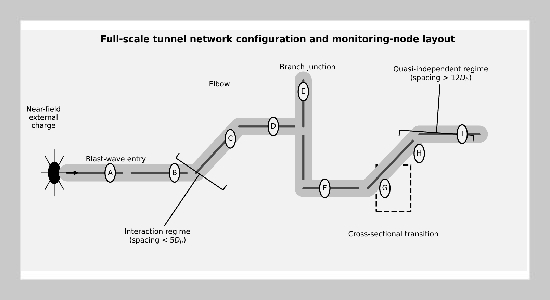
Full-scale tunnel network configuration and monitoring-node layout, showing the interaction regime for closely spaced discontinuities and the quasi-independent regime for larger spacing.
Copyright The Author(s). This is an open access article distributed under the terms of the Creative Commons Attribution License (CC BY 4.0), which permits unrestricted use, distribution, and reproduction in any medium, provided the original author and source are cited.
Download Citation: BibTeX | http://dx.doi.org/10.6180/jase.202609_32.024
Blast-wave transmission in underground tunnel systems is strongly affected by sequential geometric discontinuities, yet most previous studies have focused on isolated tunnel components or short-distance propagation. This study investigates pressure transmission behavior in a 100 m full-scale multi-node tunnel network subjected to near-field external detonation. The network contains elbows, branching junctions, and cross-sectional transitions, representing a realistic underground protective access system. Numerical simulations were conducted using a validated arbitrary Lagrangian–Eulerian blast-analysis framework for 10 kg, 100 kg, and 500 kg C-4 charges. The validation lineage of the numerical framework, together with the mesh-sensitivity basis adopted in the present model, is summarized explicitly in the Methods section. To distinguish local geometric interaction from quasi-independent propagation, two spacing regimes were defined according to the hydraulic diameter of the tunnel. A Node Interaction Index (NII) was introduced to quantify the deviation between coupled multi-node transmission and independent attenuation prediction. The results show that closely spaced discontinuities produce wave recompression, extended positive-phase duration, and locally amplified peak pressure, whereas larger spacing leads to near-independent attenuation behavior. Comparison with conventional cube-root scaling further reveals a sustained deviation range in the full-scale tunnel network, indicating that classical similarity relations are conditionally valid in confined long-distance propagation. Across the three charge weights, the spatial pattern of interaction remains similar, while the persistence of impulse-related deviation becomes more pronounced as charge weight increases. The proposed interaction-aware framework provides a practical basis for blast-resistant assessment and design of underground protective tunnel systems.
Keywords: Blast wave transmission; Tunnel network; near-field explosion; Full-scale simulation; Geometric discontinuity; Wave recompression; Sscaling deviation; Protective structures
- [1] W. E. Baker. Explosions in Air. Austin: University of Texas Press, 1973. DOI: 10.7560/720022-fm.
- [2] W. E. Baker, P. A. Cox, P. S. Westine, J. J. Kulesz, and R. A. Strehlow. Explosion Hazards and Evaluation. Amsterdam: Elsevier, 1983. DOI: 10.1016/B978-0-444-42094-7.50005-7.
- [3] P. D. Smith and J. G. Hetherington. Blast and Ballistic Loading of Structures. Oxford: Butterworth-Heinemann, 1994. DOI: 10.1201/9781482269277-9.
- [4] A. M. Remennikov, (2003) “A review of methods for predicting bomb blast effects on buildings” Journal of Battlefield Technology 6(3): 5–10. DOI: 10.1680/beob2e.35218.0003.
- [5] Department of Defense. UFC 3-340-02: Structures to Resist the Effects of Accidental Explosions. Tech. rep. Washington, DC: Department of Defense, 2008. DOI: 10.14359/51683616.
- [6] V. R. Feldgun, A. V. Kochetkov, Y. S. Karinski, and D. Z. Yankelevsky, (2008) “Internal blast loading in a buried lined tunnel” International Journal of Impact Engineering 35(3): 172–183. DOI: 10.1016/j.ijimpeng.2007.01.001.
- [7] T. Ngo, P. Mendis, A. Gupta, and J. Ramsay, (2007) “Blast loading and blast effects on structures” Electronic Journal of Structural Engineering 7: 76–91. DOI: 10.56748/ejse.671.
- [8] A. M. Benselama, M. J. P. William-Louis, and F. Monnoyer, (2009) “A 1D-3D mixed method for the numerical simulation of blast waves in confined geometries” Journal of Computational Physics 228(18): 6796–6810. DOI: 10.1016/j.jcp.2009.06.010.
- [9] A. M. Benselama, M. J. P. William-Louis, F. Monnoyer, and C. Proust, (2010) “A numerical study of the evolution of the blast wave shape in tunnels” Journal of Hazardous Materials 181(1–3): 609–616. DOI: 10.1016/j.jhazmat.2010.05.056.
- [10] O. Pennetier, M. William-Louis, and A. Langlet, (2015) “Numerical and reduced-scale experimental investigation of blast wave shape in underground transportation infrastructure” Process Safety and Environmental Protection 94: 96–104. DOI: 10.1016/j.psep.2015.01.002.
- [11] D. Uystepruyst and F. Monnoyer, (2015) “A numerical study of the evolution of the blast wave shape in rectangular tunnels” Journal of Loss Prevention in the Process Industries 34: 225–231. DOI: 10.1016/j.jlp.2015.03.003.
- [12] M. Silvestrini, B. Genova, and F. J. Leon Trujillo, (2009) “Energy concentration factor: a simple concept for the prediction of blast propagation in partially confined geometries” Journal of Loss Prevention in the Process Industries 22(4): 449–454. DOI: 10.1016/j.jlp.2009.02.018.
- [13] S. Kasilingam, M. Sethi, L. Pelecanos, and N. K. Gupta, (2022) “Mitigation strategies of underground tunnels against blast loading” International Journal of Protective Structures 13(1): 21–44. DOI: 10.1177/20414196211038018.
- [14] R. Cheng, H. Hao, W. Chen, et al., (2021) “A state-of-the-art review of road tunnel subjected to blast loads” Tunnelling and Underground Space Technology 112: 103911. DOI: 10.1016/j.tust.2021.103911.
- [15] L. Pei, H. Li, Z. Wang, G. Zhang, F. Gao, and S. Sun, (2025) “Propagation Characteristics of Shock Waves and Distribution Features of Loads in T-Shaped Tunnels with Protected Door” Applied Sciences 15(20): 11210. DOI: 10.3390/app152011210.
- [16] W. Li, (2025) “Numerical simulation study on the propagation and attenuation of shock waves in ventilation tunnels” Scientific Reports 15: 45385. DOI: 10.1038/s41598-025-29039-6.
- [17] T. Borenshtain, A. Urlainis, and A. Mitelman, (2026) “3D simulations of large blast loads above underground tunnels” International Journal of Protective Structures 17(1): 102–119. DOI: 10.1177/20414196251333080.
- [18] C.-W. Hung, S.-J. Pi, and P.-C. Chen, (2021) “Numerical study of pressure attenuation effect on tunnel structures subjected to blast loads” Applied Sciences 11: 5646. DOI: 10.3390/app11125646.
- [19] C.-W. Hung, S.-J. Pi, and P.-C. Chen, (2026) “Experimental and numerical study of tunnel variations effects on blast wave transmission mechanism” Journal of Applied Engineering Science 24(1): 93–106. DOI: 10.5937/jaes0-62333.
- [20] C.-W. Hung, Y.-K. Tsai, L.-K. Chien, and S.-J. Pi, (2023) “Numerical study of a near-field explosion using arbitrary Lagrangian-Eulerian mapping technique” International Journal of Protective Structures: 1–21. DOI: 10.1177/20414196231166067.