




School of Foreign Languages, Jiujing University, Jiujiang Jiangxi, 332005, China
Received: February 21, 2026
Accepted: March 27, 2026
Publication Date: May 4, 2026
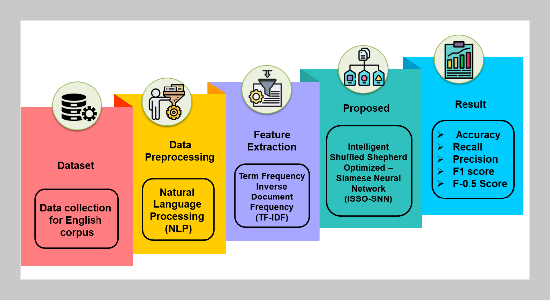
Overall flow for the research
Copyright The Author(s). This is an open access article distributed under the terms of the Creative Commons Attribution License (CC BY 4.0), which permits unrestricted use, distribution, and reproduction in any medium, provided the original author and source are cited.
Download Citation: BibTeX | http://dx.doi.org/10.6180/jase.202609_32.023
This study proposes the ISSO-SNN model for semantic readability assessment in a college English corpus, addressing limitations of traditional methods. Using NLP preprocessing and TF-IDF features, the model leverages a Siamese network optimized with ISSO for improved prediction. The study proposes an Intelligent Shuffled Shepherd Optimized Siamese Neural Network (ISSO-SNN) model for semantic readability assessment in a college English corpus. Implemented in Python 3.11, it achieved high performance (accuracy 0.98, precision 0.97, recall 0.97 , F1 0.98 ), supporting effective and personalized English learning.
Keywords: Natural Language Processing (NLP); Intelligent Shuffled Shepherd optimized Siamese Neural Network (ISSO-SNN); deep learning (DL); English Corpus
- [1] A. Lusta, Ö. Demirel, and B. Mohammadzadeh, (2023) “Language corpus and data driven learning (DDL) in language classrooms: A systematic review” Heliyon 9(12): e22731. DOI: 10.1016/j.heliyon.2023.e22731.
- [2] J. Panwar. “Techniques for text classification and text generation: Enhanced online sexism detection and template driven Wikipedia article generation”. (phdthesis). International Institute of Information Technology Hyderabad, India, 2024.
- [3] I. H. Sarker, (2021) “Deep learning: A comprehensive overview of techniques, taxonomy, applications, and research directions” SN Computer Science 2(6): 420. DOI: 10.1007/s42979-021-00815-1.
- [4] T. R. Lee and S. C. Mouritsen, (2021) “The corpus and the critics” The University of Chicago Law Review 88(2): 275–366.
- [5] J. Kozal, M. Leś, P. Zyblewski, P. Ksieniewicz, and M. Woźniak, (2022) “Lifelong learning natural language processing approach for multilingual data classification” arXiv preprint arXiv:2206.11867: DOI: 10.48550/arXiv.2206.11867.
- [6] J. Zhu, C. Zhu, and S. B. Tsai, (2021) “Construction and analysis of intelligent English teaching model assisted by personalized virtual corpus by big data analysis” Mathematical Problems in Engineering 2021: DOI: 10.1155/2021/5374832.
- [7] S. Vernim, M. Krauel, and G. Reinhart, (2021) “Identification of digitization trends and use cases in assembly” Procedia CIRP 97: 136–141. DOI: 10.1016/j.procir.2020.05.215.
- [8] N. L. Rane, O. Kaya, and J. Rane. “Artificial intelligence, machine learning, and deep learning applications in smart and sustainable industry transformation”. In: Artificial Intelligence, Machine Learning, and Deep Learning for Sustainable Industry. 5. Deep Science Publishing, 2024, 2–29. DOI: 10.70593/978-81-981271-8-1_2.
- [9] H. M. Nasir, N. M. A. Brahin, F. E. M. Sani, M. S. Mispan, and N. H. Abd Wahab, (2023) “AI educational mobile app using deep learning approach” JOIV: International Journal on Informatics Visualization 7(3): 952–958. DOI: 10.30630/joiv.7.3.1247.
- [10] S. Chauhan, R. Kumar, S. Saxena, A. Kaur, and P. Daniel, (2024) “Semsyn: Semantic-syntactic similarity-based automatic machine translation evaluation metric” IETE Journal of Research 70(4): 3823–3834. DOI: 10.1080/03772063.2023.2195819.
- [11] C. Zhai and S. Wibowo, (2023) “A systematic review on artificial intelligence dialogue systems for enhancing English as foreign language students’ interactional competence in the university” Computers and Education: Artificial Intelligence 4: 100134. DOI: 10.1016/j.caeai.2023.100134.
- [12] R. M. Horst. “Higher education executives and data-driven decision making: A phenomenological study”. (phdthesis). Concordia University, Oregon, 2020.
- [13] J. Cui, (2020) “Application of deep learning and target visual detection in English vocabulary online teaching” Journal of Intelligent & Fuzzy Systems 39(4): 5535–5545. DOI: 10.3233/JIFS-189035.
- [14] F. Jiao, J. Song, X. Zhao, P. Zhao, and R. Wang, (2021) “A spoken English teaching system based on speech recognition and machine learning” International Journal of Emerging Technologies in Learning (iJET) 16(14): 68–82. DOI: 10.3991/ijet.v16i14.24049.
- [15] A. D. Yacoub, S. Slim, and A. Aboutabl, (2024) “A survey of sentiment analysis and sarcasm detection: Challenges, techniques, and trends” International journal of electrical and computer engineering systems 15(1): 69–78. DOI: 10.32985/ijeces.15.1.7.
- [16] L. Lin, J. Liu, X. Zhang, and X. Liang, (2021) “Automatic translation of spoken English based on an improved machine learning algorithm” Journal of Intelligent & Fuzzy Systems 40(2): 2385–2395. DOI: 10.3233/JIFS-189234.
- [17] M. Ji, Y. Liu, M. Zhao, Z. Lyu, B. Zhang, X. Luo, Y. Li, and Y. Zhong, (2021) “Use of machine learning algorithms to predict the understandability of health education materials: Development and evaluation study” JMIR Medical Informatics 9(5): e28413. DOI: 10.2196/28413.
- [18] J. Wu and B. Chen, (2020) “English vocabulary online teaching based on machine learning recognition and target detection” Journal of Intelligent & Fuzzy Systems 39(2): 1745–1756. DOI: 10.3233/JIFS-179948.
- [19] R. Guha, (2021) “Designing a chat-bot for college information using information retrieval and automatic text summarization techniques” Current Chinese Computer Science 1(1): 42–51. DOI: 10.2174/2665997201999201022191540.
- [20] G. I. Ahmad, J. Singla, A. Anis, A. A. Reshi, and A. A. Salameh, (2022) “Machine learning techniques for sentiment analysis of code-mixed and switched Indian social media text corpus: A comprehensive review” International Journal of Advanced Computer Science and Applications 13(2): DOI: 10.14569/IJACSA.2022.0130254.
- [21] N. Shen. “A deep learning approach of English vocabulary for mobile platform”. In: 2021 13th International Conference on Measuring Technology and Mechatronics Automation (ICMTMA). IEEE, 2021, 463–466. DOI: 10.1109/ICMTMA52658.2021.00106.
- [22] L. Diao and P. Hu, (2021) “Deep learning and multimodal target recognition of complex and ambiguous words in an automated English learning system” Journal of Intelligent & Fuzzy Systems 40(4): 7147–7158. DOI: 10.3233/JIFS-189543.
- [23] D. Wang, J. Su, and H. Yu, (2020) “Feature extraction and analysis of natural language processing for deep learning English language” IEEE Access 8: 46335–46345. DOI: 10.1109/ACCESS.2020.2974101.
- [24] M. Alhamami, (2022) “Google Books corpus and designing English for specific purposes materials” Journal on English as a Foreign Language 12(2): 421–457. DOI: 10.23971/jefl.v12i2.4254.
- [25] S. Maqsood, A. Shahid, M. T. Afzal, M. Roman, Z. Khan, Z. Nawaz, and M. H. Aziz, (2022) “Assessing English language sentences readability using machine learning models” PeerJ Computer Science 8: e818. DOI: 10.7717/peerj-cs.818.
- [26] Y. Jiang, (2023) “The application of corpus linguistics under the computer-assisted instruction model in college English teaching” Revista Ibérica de Sistemas e Tecnologias de Informação (E55): 475–484.
- [27] J. Zhu, X. Shi, and S. Zhang, (2021) “Machine learning-based grammar error detection method in English composition” Scientific Programming 2021(1): 4213791. DOI: 10.1155/2021/4213791.