




Amanpreet Singh1, Mohit Yadav2, Osamah Ibrahim Khalaf3, Mohammed Sahib Mahdi Altaei4, Khushwant Singh5, and Fernando Moreira6,7
1Department of Mechanical Engineering, Chandigarh University, Mohali-140413, Punjab, India
2Department of Mathematics, University Institute of Sciences, Chandigarh University, Mohali-140413, Punjab, India
3Department of Solar, Al-Nahrain Renewable Energy Research Center, Al-Nahrain University, Jadriya, Baghdad, Iraq
4Department of Computer Science, College of Science, Al-Nahrain University, Baghdad, Iraq
5University School of Information, Communication & Technology, Guru Gobind Singh Indraprastha University, New Delhi-110075,
India
6Research on Economics, Management, and Information Technologies (REMIT), Universidade Portucalense, 4200-072, Porto, Portugal
7IEETA, Aveiro University, Aveiro, Portugal
Received: Decembe 10, 2025
Accepted: March 31, 2026
Publication Date: April 25, 2026
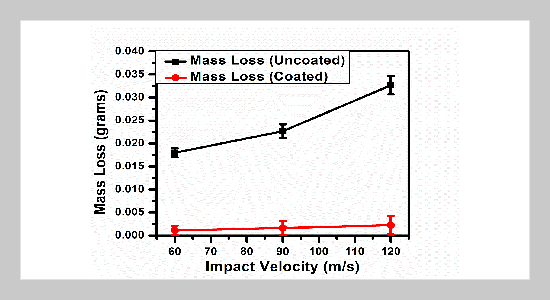
Mass Loss Due to Impact Velocity
Copyright The Author(s). This is an open access article distributed under the terms of the Creative Commons Attribution License (CC BY 4.0), which permits unrestricted use, distribution, and reproduction in any medium, provided the original author and source are cited.
Download Citation: BibTeX | http://dx.doi.org/10.6180/jase.202609_32.019
The aim of the research is to compare the erosion performance under the effect of polyurethane coated and uncoated wind turbine blade (WTB) with Glass Fiber Reinforced Polymer (GFRP) material in offshore environmental conditions. The experiments were conducted on erosion tester using two parameters such as impact velocity (60, 90,120 m/s) and impact angle (30°,45°,60°). The experimental design was generated with the help Taguchi L9 array. Polyurethane spray coating was applied and offshore conditions were simulated using salt water. Furthermore, SEM (Scanning Electron Microscope) testing was done to study the surface morphology and Minitab software was used for statistic and Origin software was used to create graphs. The main finding shows that the impact velocity is the most influencing factor as compared to impact angle. Moreover, the surface
morphology reveals the ductile mechanism of erosion and 93% more mass loss was measured in uncoated surface than coated surface.
Keywords: Taguchi; Erosion; Wind Turbine Blade; Composites; Scanning Electron Microscope; Polyurethane Coating.
- [1] T. H. Malik and C. Bak, (2025) “Challenges in Detecting Wind Turbine Power Loss: The Effects of Blade Erosion, Turbulence, and Time Averaging” Wind Energy Science 10(1): 227–243. DOI: 10.5194/wes-10-227-2025.
- [2] P. Rao and L. Mulky, (2023) “Erosion-Corrosion of Materials in Industrial Equipment: A Review” ChemElectroChem 10(16): e202300152. DOI: 10.1002/celc.202300152.
- [3] F. Papi, F. Balduzzi, G. Ferrara, and A. Bianchini, (2021) “Uncertainty Quantification on the Effects of Rain-Induced Erosion on Annual Energy Production of a Multi-MW Wind Turbine” Renewable Energy 165: 701–715. DOI: 10.1016/j.renene.2020.11.071.
- [4] J. Zhou, B. Han, and H. Wang, (2025) “Surface Roughness Characteristics and Their Influence on Wind Erosion and Sand Movement” Atmosphere 16(4): 443. DOI: 10.3390/atmos16040443.
- [5] W. Han, J. Kim, and B. Kim, (2018) “Effects of Contamination and Erosion at the Leading Edge of Blade Tip Airfoils on the Annual Energy Production of Wind Turbines” Renewable Energy 115: 817–823. DOI: 10.1016/j.renene.2017.09.002.
- [6] P. Yang, W. Yue, J. Li, G. Bin, and C. Li, (2022) “Review of Damage Mechanism and Protection of Aero-Engine Blades Based on Impact Properties” Engineering Failure Analysis 140: 106570. DOI: 10.1016/j.engfailanal.2022.106570.
- [7] A. Castorrini, A. Ortolani, and M. S. Campobasso, (2023) “Assessing the Progression of Wind Turbine Energy Yield Losses Due to Blade Erosion by Resolving Damage Geometries from Lab Tests and Field Observations” Renewable Energy 218: 119256. DOI: 10.1016/j.renene.2023.119256.
- [8] M. Carraro, F. De Vanna, F. Zweiri, E. Benini, A. Heidari, and H. Hadavinia, (2022) “CFD Modeling of Wind Turbine Blades with Eroded Leading Edge” Fluids 7(9): 302. DOI: 10.3390/fluids7090302.
- [9] A. Singh, G. Singh, and S. Kumar, (2025) “Comparative Analysis on Erosion Performance of Thin Coated GFRP Laminates in Offshore Conditions” Pigment & [9] Resin Technology 54(6): 820–828. DOI: 10.1108/PRT-07-2024-0071.
- [10] M. S. Campobasso, A. Castorrini, L. Cappugi, and A. Bonfiglioli, (2022) “Experimentally Validated Three-Dimensional Computational Aerodynamics of Wind Turbine Blade Sections Featuring Leading Edge Erosion Cavities” Wind Energy 25(1): 168–189. DOI: 10.1002/we.2666.
- [11] J. E. Zárate, M. D. L. G. López, J. A. C. Troyo, and L. Trujillo, (2022) “Analysis and Detection of Erosion in Wind Turbine Blades” Mathematical and Computational Applications 27(1): 5. DOI: 10.3390/mca27010005.
- [12] J. C. López, A. Kolios, L. Wang, and M. Chiachio, (2023) “A Wind Turbine Blade Leading Edge Rain Erosion Computational Framework” Renewable Energy 203: 131–141. DOI: 10.1016/j.renene.2022.12.050.
- [13] N. A. W. A. Yusof, T. F. Algaddaime, and M. M. Stack, (2025) “Advancements and Challenges in Coatings for Wind Turbine Blade Raindrop Erosion” Sustainability 17(21): 9611. DOI: 10.3390/su17219611.
- [14] L. Shi, H. Chen, S. Wang, L. Zhang, and X. Kou, (2025) “Experimental Study on Static Ice Adhesion Characteristics of Wind Turbine Blade Surfaces After Sand Erosion” Coatings 15(8): 955. DOI: 10.3390/coatings15080955.
- [15] M. Sha, Y. Li, Y. Sun, Y. Liu, A. Mednikov, and A. Tkhabisimov, (2025) “Experimental Study on Solid Particle Erosion of Protective Aircraft Coatings at Different Impact Angles” Reviews on Advanced Materials Science 64(1): 20250100. DOI: 10.1515/rams-2025-0100.
- [16] L. M. J. Mishnaevsky, A. Tempelis, N. Kuthe, and P. Mahajan, (2023) “Recent Developments in the Protection of Wind Turbine Blades Against Leading Edge Erosion: Materials Solutions and Predictive Modelling” Renewable Energy 215: 118966. DOI: 10.1016/j.renene.2023.118966.
- [17] A. Tempelis and L. M. J. Mishnaevsky, (2025) “Coating Material Loss and Surface Roughening Due to Leading Edge Erosion of Wind Turbine Blades: Probabilistic Analysis” Wear 566: 205755. DOI: 10.1016/j.wear.2025.205755.
- [18] A. Singh, G. Singh, and G. Singh, (2025) “Comparative Erosion Wear Analysis of Polyurethane-Coated and Uncoated GFRP Wind Turbine Blades Under Onshore Conditions” Particulate Science and Technology: 1–10. DOI: 10.02726351.2025.2521324.
- [19] Q. L. Oddo, Q. M. Ansari, F. Sánchez, L. M. J. Mishnaevsky, and T. M. Young, (2025) “Stress Development in Droplet Impact Analysis of Rain Erosion Damage on Wind Turbine Blades” Applied Sciences 15(15): 8682. DOI: 10.3390/app15158682.
- [20] J. I. Bech, N. F. J. Johansen, M. B. Madsen, Á. Hannesdóttir, and C. B. Hasager, (2022) “Experimental Study on the Effect of Drop Size in Rain Erosion Test and on Lifetime Prediction of Wind Turbine Blades” Renewable Energy 197: 776–789. DOI: 10.1016/j.renene.2022.06.127.
- [21] S. Groucott, K. Pugh, I. Zekos, and M. M. Stack, (2021) “A Study of Raindrop Impacts on a Wind Turbine Material: Velocity and Impact Angle Effects on Erosion Maps at Various Exposure Times” Lubricants 9(6): 60. DOI: 10.3390/lubricants9060060.
- [22] M. Godfrey, O. Siederer, J. Zekonyte, I. Barbaros, and R. Wood, (2021) “The Effect of Temperature on the Erosion of Polyurethane Coatings for Wind Turbine Leading Edge Protection” Wear 476: 203720. DOI: 10.1016/j.wear.2021.203720.
- [23] K. Vimalakanthan, H. van der Mijle Meijer, I. Bakhmet, and G. Schepers, (2023) “Computational Fluid Dynamics Modeling of Actual Eroded Wind Turbine Blades” Wind Energy Science 8(1): 41–69. DOI: 10.5194/wes-8-41-2023.
- [24] K. Anderson, N. Azimy, and S. Karimi, (2025) “Comparative Investigation Between Different Impact Angles for the Water Droplet Erosion of Wind Turbine Blades” Wear: 205768. DOI: 10.1016/j.wear.2025.205768.
- [25] A. S. Verma, Z. Jiang, Z. Ren, W. Hu, and J. J. Teuwen, (2021) “Effects of Onshore and Offshore Environmental Parameters on the Leading Edge Erosion of Wind Turbine Blades” Journal of Offshore Mechanics and Arctic Engineering 143(4): 042001. DOI: 10.1115/1.4049248.
- [26] Z. Mu, W. Guo, Y. Li, and H. Tagawa, (2023) “Wind Tunnel Test of Ice Accretion on Blade Airfoil for Wind Turbine under Offshore Atmospheric Condition” Renewable Energy 209: 42–52. DOI: 10.1016/j.renene.2023.03.126.
- [27] F. Ascione, G. Maselli, and A. Nesticò, (2024) “Sustainable Materials Selection in Industrial Construction” Journal of Cleaner Production 475: 143641. DOI: 10.1016/j.jclepro.2024.143641.
- [28] A. V. U. K. Kandala, D. G. Solomon, and J. J. Arulraj, (2022) “Advantages of Taguchi Method Compared to Response Surface Methodology for Achieving the Best Surface Finish in WEDM” Journal of Mechanical Engineering (JMechE) 19(1): 185–200. URL: https://ir.uitm.edu.my/id/eprint/60593.
- [29] M. W. Hisam, A. A. Dar, M. O. Elrasheed, M. S. Khan, R. Gera, and I. Azad, (2024) “The Versatility of the Taguchi Method: Optimizing Experiments Across Diverse Disciplines” Journal of Statistical Theory and Applications 23(4): 365–389. DOI: 10.1007/s44199-024-00093-9.
- [30] J. Antony, S. Bhat, A. Mittal, R. Jayaraman, E. V. Gijo, and E. A. Cudney, (2024) “Application of Taguchi Design of Experiments in the Food Industry” Total Quality Management & Business Excellence 35(5–6): 687–712. DOI: 10.1080/14783363.2024.2331758.
- [31] G. Box, (1988) “Signal-to-Noise Ratios, Performance Criteria, and Transformations” Technometrics 30(1): 1–17. DOI: 10.1080/00401706.1988.10488313.
- [32] K. Kumar, S. Kumar, C. B. Tripathi, H. Sharma, and S. B. Prasad, (2020) “Parametric Optimization of Slurry Erosion Behaviour of Brass” Materials Today: Proceedings 26: 1604–1609. DOI: 10.1016/j.matpr.2020.02.330.
- [33] R. Prieto and T. Karlsson, (2021) “A Model to Estimate the Effect of Variables Causing Erosion in Wind Turbine Blades” Wind Energy 24(9): 1031–1044. DOI: 10.1002/we.2615.
- [34] W. Zhou, D. Zhang, and M. Yang, (2024) “Effects of Surface Curvature on Rain Erosion of Wind Turbine Blades Under High-Velocity Impact” Heliyon 10(23): DOI: 10.1016/j.heliyon.2024.e40761.
- [35] K. Pugh, J. W. Nash, G. Reaburn, and M. M. Stack, (2021) “On Analytical Tools for Assessing the Raindrop Erosion of Wind Turbine Blades” Renewable and Sustainable Energy Reviews 137: 110611. DOI: 10.1016/j.rser.2020.110611.
- [36] A. F. Alajmi and M. Ramulu, (2025) “The Effectiveness of Graphene and Polyurethane Multilayer Coating on Minimizing the Leading-Edge Erosion of Wind Turbine Blades” Results in Engineering 26: 104804. DOI: 10.1016/j.rineng.2025.104804.
- [37] K. M. Jespersen, M. Eftekhar, N. F. J. Johansen, J. I. Bech, L. M. J. Mishnaevsky, and L. P. Mikkelsen, (2023) “High Rate Response of Elastomeric Coatings for Wind Turbine Blade Erosion Protection” International Journal of Impact Engineering 179: 104643. DOI: 10.1016/j.ijimpeng.2023.104643.
- [38] Z. Zheng, H. Sun, W. Xue, D. Duan, G. Chen, X. Zhou, and J. Sun, (2024) “Preparation of Protective Coatings for the Leading Edge of Wind Turbine Blades” Wear 558: 205568. DOI: 10.1016/j.wear.2024.205568.
- [39] H. Sun, Z. Zheng, W. Xue, J. Xu, F. Cao, D. Duan, and J. Sun, (2025) “Preparation of Polyurethane Protective Coating with Different Pigment-to-Binder Ratios” Tribology International: 110831. DOI: 10.1016/j.triboint.2025.110831.
- [40] S. M. Pathak, V. P. Kumar, V. Bonu, L. M. J. Mishnaevsky, R. V. Lakshmi, P. Bera, and H. C. Barshilia, (2025) “Enhancing Wind Turbine Blade Protection: Solid Particle Erosion Resistant Ceramic Oxides-Reinforced Epoxy Coatings” Renewable Energy 238: 121681. DOI: 10.1016/j.renene.2024.121681.
- [41] J. Bech and J. Simon, (2025) “Fatigue crack growth in elastomers for leading edge erosion protection of wind turbine blades” Wind Energy Science Discussions 2025: 1–32. DOI: https://doi.org/10.5194/wes-2025-247.
- [42] E. Saenz, B. Mendez, and A. Munoz, (2022) “Effect of Erosion Morphology on Wind Turbine Production Losses” Journal of Physics: Conference Series 2265(3): 032059. DOI: 10.1088/1742-6596/2265/3/032059.