
Received: February 22, 2026
Accepted: March 27, 2026
Publication Date: April 25, 2026
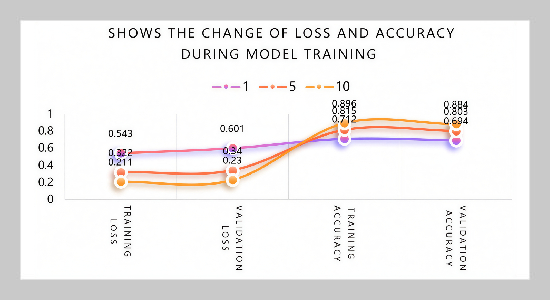
Change in loss and accuracy during model training
Copyright The Author(s). This is an open access article distributed under the terms of the Creative Commons Attribution License (CC BY 4.0), which permits unrestricted use, distribution, and reproduction in any medium, provided the original author and source are cited.
Download Citation: BibTeX | http://dx.doi.org/10.6180/jase.202609_32.018
This study tackles challenges in evaluating and improving broadcasting and hosting teaching by proposing an intelligent analysis method using deep learning models. It collects multisource data like speech, text, and feedback to build a multi-dimensional feature system. Combining LSTM networks with natural language processing, a predictive model for automatic expression quality scoring is designed. The system tracks individual performance, generating structured evaluations and personalized improvement suggestions. The model showed good accuracy and stability during experiments, and practical tests demonstrated significant student improvements in speech rate, emotional expression, and coherence. Teachers gave positive feedback on the system’s support for teaching. The study enhances personalized teaching strategies and shows that deep learning-based analysis has strong adaptability and potential for broadcasting and hosting courses.
Keywords: broadcasting and hosting; teaching quality; deep learning; LSTM network; natural language processing technology
- [1] S. AbuSalim, N. Zakaria, M. R. Islam, G. Kumar, N. Mokhtar, and S. J. Abdulkadir, (2022) “Analysis of Deep Learning Techniques for Dental Informatics: A Systematic Literature Review” Healthcare 10(10): 1892. DOI: 10.3390/healthcare10101892.
- [2] H. Aizenstein, R. C. Moore, I. Vahia, and A. Ciarleglio, (2024) “Deep Learning and Geriatric Mental Health” American Journal of Geriatric Psychiatry 32(3): 270–279. DOI: 10.1016/j.jagp.2023.11.008.
- [3] M. Attig, F. Hoferichter, I. Steinmann, and R. Strietholt, (2024) “Teaching Quality and Student Reading Outcomes: Evidence from a Longitudinal Study from Grade 5 to 7” Studies in Educational Evaluation 81: 101347. DOI: 10.1016/j.stueduc.2024.101347.
- [4] C. Beciu, M. Lazar, and I. D. Madroane, (2018) “Mediating Public Issues in Romanian Broadcast Talk: Personalized Communication Strategies” Television & New Media 19(1): 75–92. DOI: 10.1177/1527476417697270.
- [5] S. Cadez, V. Dimovski, and M. Z. Groff, (2017) “Research, Teaching and Performance Evaluation in Academia: The Salience of Quality” Studies in Higher Education 42(8): 1455–1473. DOI: 10.1080/03075079.2015.1104659.
- [6] C. Y. Charalambous and A. K. Praetorius, (2020) “Creating a Forum for Researching Teaching and Its Quality More Synergistically” Studies in Educational Evaluation 67: 100894. DOI: 10.1016/j.stueduc.2020.100894.
- [7] O. Estrada-Molina, J. Mena, and A. López-Padrón, (2024) “The Use of Deep Learning in Open Learning: A Systematic Review (2019 to 2023)” International Review of Research in Open and Distributed Learning 25(3): 370–393. DOI: 10.19173/irrodl.v25i3.7396.
- [8] G. Fele and G. M. Campagnolo, (2021) “Expertise and the Work of Football Match Analysts in TV Sport Broadcasts” Discourse Studies 23(5): 616–635. DOI: 10.1177/14614456211016799.
- [9] Y. Himeur, S. Al-Maadeed, I. Varlamis, N. Al-Maadeed, K. Abualsaud, and A. Mohamed, (2023) “Face Mask Detection in Smart Cities Using Deep and Transfer Learning: Lessons Learned from the COVID-19 Pandemic” Systems 11(2): 107. DOI: 10.3390/systems11020107.
- [10] M. S. Iqbal, W. Ahmad, R. Alizadehsani, S. Hussain, and R. Rehman, (2022) “Breast Cancer Dataset, Classification and Detection Using Deep Learning” Healthcare 10(12): 2395. DOI: 10.3390/healthcare10122395.
- [11] A. Panayiotou, B. Herbert, P. Sammons, and L. Kyriakides, (2021) “Conceptualizing and Exploring the Quality of Teaching Using Generic Frameworks: A Way Forward” Studies in Educational Evaluation 70: 101028. DOI: 10.1016/j.stueduc.2021.101028.
- [12] D. Ramya and O. T. Poongodi, (2021) “A Study on the Usage of Information Communication Technology Tools in the Teaching–Learning Process of Engineering Education” Journal of Applied Science and Engineering 25(2): 321–326. DOI: 10.6180/jase.202204_25(2).0017.
- [13] S. Saumya and J. P. Singh, (2022) “Spam Review Detection Using LSTM Autoencoder: An Unsupervised Approach” Electronic Commerce Research 22(1): 113–133. DOI: 10.1007/s10660-020-09413-4.
- [14] J. Schloemerkemper, (2020) “Teaching Quality: Concepts and Assessments of Successful Teaching and Learning” Zeitschrift für Pädagogik 66(6): 901–905.
- [15] G. Van Houdt, C. Mosquera, and G. Nápoles, (2020) “A Review on the Long Short-Term Memory Model” Artificial Intelligence Review 53(8): 5929–5955. DOI: 10.1007/s10462-020-09838-1.
- [16] R. N. Vasconcelos, W. J. S. F. Rocha, D. P. Costa, S. G. Duverger, M. M. M. D. Santana, E. C. B. Cambui, J. Ferreira-Ferreira, M. Oliveira, L. D. Barbosa, and C. L. Cordeiro, (2024) “Fire Detection with Deep Learning: A Comprehensive Review” Land 13(10): 1696. DOI: 10.3390/land13101696.
- [17] S. Wurster and T. Feldhoff, (2019) “School and Teaching Quality from a Multi-Level Perspective: Is the School or the Class the Relevant Pedagogical Unit of Action?” Zeitschrift für Pädagogik 65(1): 24–39.
- [18] Q. Xu, (2022) “Innovative Thinking of Teaching Reform of News Broadcasting and Hosting Specialty Based on Social Psychology” Psychiatria Danubina 34(Suppl. 1): S376–S377.
- [19] L. Yu, (2022) “Exploring Strategies to Improve the Psychological Quality of Broadcasting Professionals under the New Media” Psychiatria Danubina 34(Suppl. 5): S456–S457.
- [20] S. S. Zhang, (2022) “Mental Health Status and Personality Traits of College Students Majoring in Broadcasting and Hosting Art in the Era of Financial Media” Psychiatria Danubina 34(Suppl. 2): S404–S405.
- [21] L. Zhu, (2022) “Analysis on the Role of Host’s Tension Counseling in Broadcasting Profession” Psychiatria Danubina 34(Suppl. 5): S266–S267.