




Xu Jiang, Pingping Long, and Zeng Wang
College of Marxism, Chongqing Vocational and Technical University of Mechatronics. Chongqing 400000, Chongqing, China
Received: December 26, 2025
Accepted: March 27, 2026
Publication Date: April 25, 2026
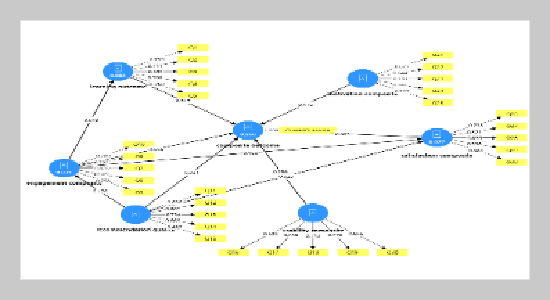
SEM diagram for hypothesis testing
Copyright The Author(s). This is an open access article distributed under the terms of the Creative Commons Attribution License (CC BY 4.0), which permits unrestricted use, distribution, and reproduction in any medium, provided the original author and source are cited.
Download Citation: BibTeX | http://dx.doi.org/10.6180/jase.202609_32.016
Background: Ideological and Political Education (IPE) based on the traditional teaching model typically offered in universities, is not always effective in attracting contemporary students due to its lack of interactivity and personalization. Objective: The proposed study will assess the effectiveness of an AIVR based hybrid personalized recommendation system for improving student engagement, satisfaction, and learning outcomes in IPE. Methods: 250 university students were used in a quantitative research design. Al based models customized learning material, whereas VR simulations gave context rich interactions. Pre and post assessments were used to collect data, and Structural Equation Modeling (SEM) is employed in the study to rigorously examine and validate the complex relationships among Al based personalization, VR immersion, student engagement, satisfaction, and learning outcomes within the proposed educational framework. SEM enables simultaneous testing of both the measurement and structural models, ensuring that observed variables reliably represent their underlying constructs and that directional relationships between them are assessed. Using goodness of fit indices and path coefficients, SEM assesses whether the conceptual model aligns with the empirical data and evaluates the mediating role of student engagement in the relationship between Aland VRsupported teaching methods and improved learning effectiveness. This comprehensive analytical approach strengthens the reliability of the findings and supports the theoretical contributions of the hybrid AIVR learning model. Findings: The combination of AI and VR made a big difference in terms of student engagement and learning. Al based personalization and VR immersion increased motivation and knowledge retention, and student engagement mediated the relationship between teaching methods and outcomes Conclusion: The paper has demonstrated that AI and VR can transform IPE by providing more personalized, interactive, and immersive learning experiences and by serving as a better alternative to traditional learning.
Keywords: Artificial Intelligence, Virtual Reality, Ideological and Political Education, Personalization, Student Engagement, Learning Outcomes
- [1] C. Simut, J. F. Kiss, F. Ortan, and L. Mandrea, (2025) “Pedagogy and Civic Engagement: Theoretical Insights into Fostering Active Citizenship in University Education” Scientific MORALITAS – International Journal of Multidisciplinary Research 10(1): 230–241. DOI: 10.1080/14649365.2012.723736.
- [2] T. Halytska-Didukh, N. Hrytsak, S. Tetiana, O. Yablonska, and M. Yablonskyi, (2023) “Increasing the Effectiveness of the Quality of Education Among Students of Higher Education on the Basis of Modern Information Technologies” Conhecimento Diversidade 15(37): 1–15. DOI: 10.18316/rcd.v15i37.10919.
- [3] W. Chengyuan, (2025) “Research on the Integration Path of College Students’ Mental Health Education and Ideological and Political Education” International Education Research 8(2): 44. DOI: 10.30560/ier.v8n2p44.
- [4] H. Gao, Y. Xie, and E. Kasneci, (2026) “PerVRML: ChatGPT-Driven Personalized VR Environments for Machine Learning Education” International Journal of Human–Computer Interaction 42(1): 40–54. DOI: 10.1080/10447318.2025.2504188.
- [5] R. Li, (2022) “Chinese folk music: Study and dissemination through online learning courses” Education and Information Technologies 27(7): 8997–9013. DOI: 10.1007/s10639-022-11003-w.
- [6] M. Michalik-Śnieżek, E. Trzaskowska, M. Nowak-Kępczyk, A. Kułak, H. Lipińska, and T. Wyłupek, (2025) “Experiential Environmental Education as a Tool to Enhance Awareness of Ecosystem Services Among Adolescents” Sustainability 17(23): 10439. DOI: 10.3390/su172310439.
- [7] B. Y. Bora and C. Ş. Kölemen, (2025) “Integrating AI into instructional design: A case study on digital photography education” Contemporary Educational Technology 17(3): ep583. DOI: 10.30935/cedtech/16433.
- [8] R. S. Siregar, (2024) “Students’ Preferences for Varied Learning Methods” Jurnal Profesi Guru Indonesia 1(2): 140–152. DOI: 10.62945/jpgi.v1i2.679.
- [9] J. Lu, S. Zhu, R. Wang, and T. Liu, (2025) “Exploring the Influencing Factors of Learning Burnout” Behavioral Sciences 15(7): 903. DOI: 10.3390/bs15070903.
- [10] R. H. Agustina, A. Alfiyanto, S. Suhendri, E. Wihardjo, and A. S. Pranajaya, (2025) “Optimizing Learning: Adaptive Technology Integration in Indonesia’s Education System” Jurnal Ilmu Pendidikan 16(2): 304–317. DOI: 10.37640/jip.v16i2.2293.
- [11] Y. Li and P. Yan, (2024) “Analysis of the Content of Ideological and Political Education for College Students” Journal of Computer Technology and Electronic Research 1(1): DOI: 10.70767/jcter.v1i1.67.
- [12] W. S. e. a. Sayed, (2023) “AI-based adaptive personalized content presentation and exercises navigation” Multimedia Tools and Applications 82(3): 3303–3333. DOI: 10.1007/s11042-022-13076-8.
- [13] Y. Xu and T. Chen, (2023) “Design of Personalized Learning Resource Recommendation System” International Journal of Reliability, Quality and Safety Engineering 30(1): 2250020. DOI: 10.1142/S0218539322500206.
- [14] Z. Zhong, W. Guo, and R. Nacional, (2025) “Reform and innovation of physical education teaching methods based on fuzzy systems” Scientific Reports 15(1): 21320. DOI: 10.1038/s41598-025-05417-y.
- [15] S. K. S. Cheung, F. L. Wang, and L. F. Kwok, (2021) “The Continuous Pursuit of Smart Learning” Australasian Journal of Educational Technology 37(2): 1–6. DOI: 10.14742/ajet.7207.
- [16] A. Kumar, A. K. J. Saudagar, A. Kumar, Y. M. Alkhrijah, and L. Raja, (2025) “Innovating medical education using a cost effective and scalable VR platform with AI-Driven haptics” Scientific Reports 15(1): 26360. DOI: 10.1038/s41598-025-10543-8.
- [17] J. Peng and Y. Li, (2025) “Frontiers of Artificial Intelligence for Personalized Learning in Higher Education: A Systematic Review” Applied Sciences 15(18): 10096. DOI: 10.3390/app151810096.
- [18] S. P. Suryodiningrat, H. Prabowo, A. Ramadhan, and H. B. Santoso, (2024) “The Essential Components of Metaverse-based Mixed Reality for Machinery Vocational Schools” Journal of Applied Engineering and Technological Science 5(2): 1069–1085. DOI: 10.37385/jaets.v5i2.4117.
- [19] S. Lyu, (2024) “The Application of Generative AI in Virtual Reality and Augmented Reality” Journal of Industrial Engineering and Applied Science 2(6): 1–9. DOI: 10.70393/6a69656173.323339.
- [20] S. Yue, J. Wei, H. Aziz, and K. Liew, (2023) “A study on the effectiveness of self-assessment learning system of ideological and political education” Learning and Motivation 84: 101929. DOI: 10.1016/j.lmot.2023.101929.
- [21] X. Ren, J. Han, L. Zhu, H. Jing, Q. Li, and S. He, (2025) “Integrating Ideological and Political Education Elements Into the Advanced Nursing Practice Course” Journal of Evaluation in Clinical Practice 31(5): e70142. DOI: 10.1111/jep.70142.
- [22] H. Liu, H. Ye, and Y. Ye, (2025) “Construction and Application of a Digital Platform for Charitable Cultural Resources Integrating VR Technology and BiGRU” Concurrency and Computation: Practice and Experience 37(12): e70123. DOI: 10.1002/cpe.70123.
- [23] Y. Xing, H. Y. Kwan, F. Xu, and Q. Chen, (2025) “Designing a Virtual Learning Platform for Enhanced Campus Epidemic Prevention” International Journal of Human–Computer Interaction 41(4): 2289–2300. DOI: 10.1080/10447318.2024.2319915.
- [24] J. Kim and H. Shin, (2024) “Exploring the effects of extended reality head-mounted display training for nursing students” Nurse Education Today 133: 106089. DOI: 10.1016/j.nedt.2023.106089.
- [25] A. Christopoulos, M. Styliou, N. Ntalas, and C. Stylios, (2024) “The Impact of Immersive Virtual Reality on Knowledge Acquisition and Adolescent Perceptions” Information 15(5): 261. DOI: 10.3390/info15050261.
- [26] M. H. Hatta, H. Sidi, S. Sharip, S. Das, and S. M. Saini, (2022) “The Role of Virtual Reality as a Psychological Intervention for Mental Health Disturbances” International Journal of Environmental Research and Public Health 19(4): 2390. DOI: 10.3390/ijerph19042390.
- [27] Y. Sanjalawe, S. Al-Emari, S. Fraihat, and S. Makhadmeh, (2025) “AI-driven job scheduling in cloud computing: a comprehensive review” Artificial Intelligence Review 58(7): 197. DOI: 10.1007/s10462-025-11208-8.
- [28] R. Shadiev, X. Wang, and S. Shen, (2025) “Effects of immersion and interactive strategies on students’ intercultural competence” Education and Information Technologies 30(5): 5883–5919. DOI: 10.1007/s10639-024-13030-1.
- [29] Z. Hui and Y. Geng, (2025) “Enhancing the Ideological and Political Education Experience using VR Technology” International Journal of Web-Based Learning and Teaching Technologies 20(1): 1–16. DOI: 10.4018/IJWLTT.377444.
- [30] X. Zhao and D. Wang, (2025) “Unpacking the Antecedents of Boredom and Its Impact on University Learners’ Engagement” International Journal of Applied Linguistics 35(3): 1121–1133. DOI: 10.1111/ijal.12680.
- [31] Z. Qing, (2024) “Innovating Content and Methods of Ideological and Political Education in the New Era” International Journal of Education and Humanities 4(4): 479–487. DOI: 10.58557/ijeh.v4i4.270.
- [32] N. Zhang and J. Wang, (2025) “Integration Between College English Teaching and Ideological and Political Education” Education Review USA 9(4): 460–465. DOI: 10.26855/er.2025.04.011.
- [33] M. Qorib, (2024) “Analysis Of Differentiated Instruction As A Learning Solution In Student Diversity” International Journal of Reglement Society 5(1): 43–55. DOI: 10.55357/ijrs.v5i1.452.
- [34] E. e. a. Childs, (2024) “Enhancing Distance Learning Through Augmented and Virtual Reality Technologies” IEEE Transactions on Visualization and Computer Graphics 30(8): 4480–4496. DOI: 10.1109/TVCG.2023.3264577.
- [35] M. J. Shumski and M. R. Bradford, (2025) “Features of the Self-Directed Education Environment” Schools 22(2): 279–308. DOI: 10.1086/737546.