




College of Economic and Management, Shenyang Institute of Technology, Shenyang 113122 China
Received: January 28, 2026
Accepted: March 9, 2026
Publication Date: April 12, 2026
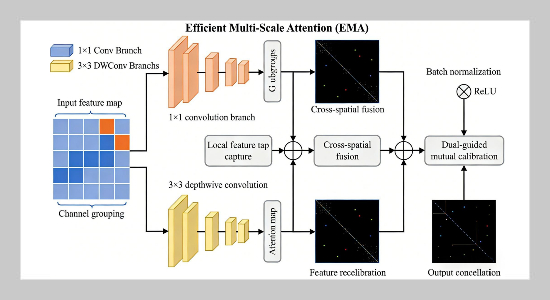
Architecture of the Efficient Multi-Scale Attention (EMA) module
Copyright The Author(s). This is an open access article distributed under the terms of the Creative Commons Attribution License (CC BY 4.0), which permits unrestricted use, distribution, and reproduction in any medium, provided the original author and source are cited.
Download Citation: BibTeX | http://dx.doi.org/10.6180/jase.202609_32.002
Deep learning-based image classification has achieved remarkable progress in recent years, but the contradiction between model performance and computational efficiency remains a critical challenge for edge-device deployment. To address this issue, this paper proposes a lightweight deep learning framework integrated with an efficient multi-scale attention (EMA) module for high-performance feature extraction. The EMA module adopts a channel-grouping strategy and parallel multi-branch architecture to capture multi-scale contextual information without dimensionality reduction, which effectively avoids the loss of feature details caused by traditional attention mechanisms. Specifically, it divides input features into multiple subgroups and employs 1 ×1 and 3×3 convolutional branches to model local and global dependencies respectively, followed by cross-spatial learning to fuse complementary features across branches. The proposed framework is evaluated on three benchmark datasets (CIFAR-100, ImageNet-1k, and Tiny-ImageNet) against state-of-the-art lightweight models and attention mechanisms. Experimental results demonstrate that the proposed framework achieves a better trade-off between classification accuracy and computational cost. The proposed framework provides a promising solution for efficient image classification in resource-constrained scenarios.
Keywords: Image Classification; Lightweight Deep Learning; Multi-Scale Attention; Feature
- [1] X. Meng, X. Wang, S. Yin, and H. Li,(2023)“Few-shot image classification algorithm based on attention mechanism and weight fusion “Journal of Engineering and AppliedScience70(1):14.DOI:10.1186/s44147-023-00186-9.
- [2] L. Wang, H. Wang, S. Yin, and L. Wang, (2025) “Masked vision transformer for fast hyperspectral image classification” IEEE Transactions on Geoscience and Remote Sensing 63: DOI: 10.1109 / TGRS . 2025 . 3572242.
- [3] Y. Wang, Y. Deng, Y. Zheng, P. Chattopadhyay, and L. Wang, (2025) “Vision transformers for image classification: A comparative survey” Technologies 13(1): 32. DOI: 10.3390/technologies13010032.
- [4] H. Song, H. Xie, Y. Duan, X. Xie, F. Gan, W. Wang, and J. Liu, (2025) “Pure data correction enhancing remote sensing image classification with a lightweight ensemble model” Scientific Reports 15(1): 5507. DOI: 10.1038/s41598-025-89735-1.
- [5] Y. Shao, J. Yang, W. Zhou, H. Sun, and Q. Gao, (2025) “Fractal-Inspired Region-Weighted Optimization and Enhanced MobileNet for Medical Image Classification” Fractal and Fractional 9(8): 511. DOI: 10.3390/fractalfract9080511.
- [6] Q. Du, Z. Liu, Y. Song, N. Wang, Z. Ju, and S. Gao, (2025) “A lightweight dendritic shufflenet for medical image classification” IEICE Transactions on Information and Systems: 2024EDP7059. DOI: 10.1587/transinf.2024EDP7059.
- [7] G. Sangar and V. Rajasekar, (2025) “Optimized classification of potato leaf disease using EfficientNet-LITE and KE-SVM in diverse environments” Frontiers in plant science 16: 1499909. DOI: 10.3389/fpls.2025.1499909.
- [8] S. Zheng and Y. Wang, (2025) “SF Net: A Pyramid-Based Feature Fusion Convolutional Neural Network With Embedded Squeeze-and-Excitation Mechanism for Retinal OCT Image Classification” International Journal of Imaging Systems and Technology 35(5): e70197. DOI: 10.1002/ima.70197.
- [9] C. Zhuang, X. Yuan, L. Gu, Z. Wei, Y. Fan, and X. Guo, (2025) “Frequency Regulated Channel-Spatial Attention module for improved image classification” Expert Systems with Applications 260: 125463. DOI: 10.1016/j.eswa.2024.125463.
- [10] R. Shang, M. Hu, J. Feng, W. Zhang, and S. Xu, (2025) “A lightweight PolSAR image classification algorithm based on multi-scale feature extraction and local spatial information perception” Applied Soft Computing 170: 112676. DOI: 10.1016/j.asoc.2024.112676.
- [11] T. Jinaga, B. Banothu, S. Nickolas, and G. R. Patil, (2025) “An Adaptive Lightweight Sequence Space Model for Medical Image Classification” SN Computer Science 6(7): 892. DOI: 10.1007/s42979-025-04387-2.
- [12] D. Ouyang, S. He, G. Zhang, M. Luo, H. Guo, J. Zhan, and Z. Huang. “Efficient multi-scale attention module with cross-spatial learning”. In: ICASSP 2023-2023 IEEE international conference on acoustics, speech and signal processing (ICASSP). IEEE. 2023, 1–5. DOI: 10.1109/ICASSP49357.2023.10096516.
- [13] L. Liu, B. Zhou, Q. Li, G. Fu, Y. Wang, and H. Chu, (2025) “Parallel joint encoding for drone-view object detection under low-light conditions” Frontiers in Artificial Intelligence 8: 1622100. DOI: 10.3389/frai.2025.1622100.
- [14] B. Guan, G. Chu, Z. Wang, J. Li, and B. Yi, (2025) “Instance-level semantic segmentation of nuclei based on multimodal structure encoding” BMC bioinformatics 26(1): 42. DOI: 10.1186/s12859-025-06066-8.
- [15] R. Boukhenoun, H. Doghmane, K. Messaoudi, and E.-B. Bourennane, (2025) “Comparative Analysis of CNN Performances Using CIFAR-100 and MNIST Databases: GPU vs. CPU Efficiency” Recent Advances in Electrical & Electronic Engineering 18(10): 2025–2037. DOI: 10.2174/0123520965348453250226080233.
- [16] L. Teng, H. Li, and Y. Si, “Neural Tensor Network And Adaptive Graph Convolution For Sports” Journal of Applied Science and Engineering 29(6): 1483–1491. DOI: 10.6180/jase.202606_29(6).0015.
- [17] V. Pentsos, S. Tragoudas, K. Nagesh Gowda, and M. Schmit, (2026) “Improved Image Classification using Lightweight Deep Neural Network Enhancements” ACM Transactions on Intelligent Systems and Technology 17(1): 1–26. DOI: 10.1145/3779421.
- [18] S. Yin, L. Wang, T. Chen, H. Huang, J. Gao, J. Zhang, M. Liu, P. Li, and C. Xu, (2025) “LKAFormer: A lightweight kolmogorov-arnold transformer model for image semantic segmentation” ACM Transactions on Intelligent Systems and Technology: DOI: 10.1145/3759254.
- [19] Z. Liu, Z. Sun, Y. Zang, W. Li, P. Zhang, X. Dong, Y. Xiong, D. Lin, and J. Wang, (2026) “Rar: Retrieving and ranking augmented mllms for visual recognition” IEEE Transactions on Image Processing 35: 388–401. DOI: 10.1109/TIP.2025.3644175.
- [20] A. Umamageswari, S. Deepa, and K. Raja. “Deep Learning and Image Processing for Cancer Cell Identification”. In: AI in Diagnostic Radiology: Clinical Applications and Case-Based Insights. IGI Global Scientific Publishing, 2026, 1–40. DOI: 10.4018/979-8-3373-5801-7.ch001.