


E.N. Neverov, A.K. Gorelkina, E.S. Mikhalova, and P.S. Korotkih
Kemerovo State University, 6 Krasnaya str., Kemerovo, 650000, Russia
Received: August 5, 2024
Accepted: September 29, 2024
Publication Date: April 6, 2026
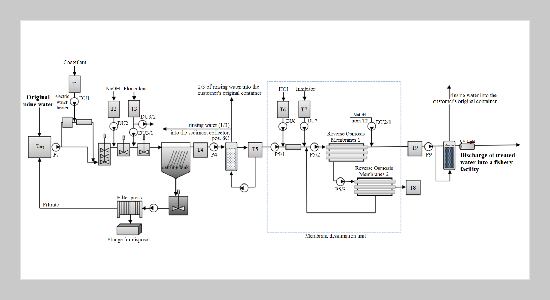
A schematic flow diagram of a wastewater treatment plant according to the first option for organizing the operation of a pilot plant
Copyright The Author(s). This is an open access article distributed under the terms of the Creative Commons Attribution License (CC BY 4.0), which permits unrestricted use, distribution, and reproduction in any medium, provided the original author and source are cited.
Download Citation: BibTeX | http://dx.doi.org/10.6180/jase.202508_28(8).0018
Currently, the issue of recycling coal waste becomes quite relevant all over the world, which is associated with tightening environmental standards and increasing production rates in the coal industry. So, to reduce the environmental load of effective coal waste management, innovative developments and implementation are required, aimed at processing, purification and disposal. The aim of this work is to evaluate methods for treating water containing suspended coal dust and to develop a treatment plant design along with approaches for pilot testing. A design of the plant for purifying water with suspended coal dust particles, a diagram of the interaction of elements, feasible technological solutions and options for the operation of the plant are proposed. The implementation of the proposed installation in the ports that ship coal allows us to evaluate not only water purification processes, but also measures aimed at optimizing expended resources and reducing the negative impact on the environment. The research results and technical characteristics of the proposed plant are discussed in the context of its application and benefits to industrial enterprises in the field of coal transportation. The water installation project can serve as the basis for implementing environmentally sustainable solutions in the field of water treatment and increasing the economic efficiency of transporting coal by water in the Caspian area. The proposed water purification plant incurs significant operational costs. Fire hazards in closed systems and coal dust pollution are still issues, even with the plant’s adaptable design.
Keywords: coal waste; mine water; ecology; water treatment facilities; coal; filtration
- [1] E. N. Neverov, A. K. Gorelkina, I. V. Tymoshchuk, M. L. Fuks, and L. A. Ivanova, (2023) “High-efficiency hydrocyclone” (RU219222U1):
- [2] C. S. S. D. of the Russian Federation. Resolution of July 21, 2011 No. 102 “On approval of SanPiN 2.2.2948-11 ’Hygienic requirements for organizations engaged in the extraction and processing of coal (oil shale) and organization of work’”. 2011.
- [3] E. N. Neverov, I. V. Tymoshchuk, A. K. Gorelkina, M. L. Fuks, E. I. Stabrovskaya, and N. N. Turova, (2023) “Sludge tank with replaceable container for hydrocyclone” (RU219524U1):
- [4] A. K. Gorelkina, E. S. Mikhailova, I. V. Tymoshchuk, L. A. Ivanova, and E. N. Neverov, (2023) “Wastewater treatment of coal mining enterprises” Coal S12(1175): 63–66.
- [5] M. of Construction of the Russian Federation. Order of December 27, 2021 No. 1016/pr “On approval of SP 31.13330.2021 “SNiP 2.04.02-84* Water supply. Outdoor networks and structures”. 2021.
- [6] A. Haslinah, T. Thamrin, T. N. Bandrang, T. Taryana, T. B. Karyasa, B. Purwoko, and A. Andiyan, (2024) “Green technology’s function in the production of renewable energy and mineral extraction” Caspian Journal of Environmental Sciences 22(1): 93–102.
- [7] O. A. Gurova and M. P. Sartakov, (2023) “Thermogravimetric analysis of brown coals and also humic acids as well as their extracted bitumens in the Circumpolar
Urals” Caspian Journal of Environmental Sciences 21(5): 1309–1313. - [8] A. K. Gorelkina, T. A. Krasnova, I. V. Tymoshchuk, N. Gora, and N. Golubeva, (2019) “Study of the dynamics of the adsorption of trichloroethylene (TCE) on active carbons” Ecology and Industry of Russia 23(9): 30–35. DOI: 10.18412/1816-0395-2019-9-30-35.
- [9] E. N. Neverov, A. K. Gorelkina, and R. Y. Shaplok, (2023) “Analysis of modern methods and technologies of industrial water treatment” Polzunovskiy vestnik 3: 215–225. DOI: 10.25712/ASTU.2072-8921.2023.03.30.
- [10] A. Y. Prosekov, I. V. Tymoshchuk, and A. K. Gorelkina, (2021) “On the issue of the use of waste from water desalting ion exchange units of power plants” Theoretical and Applied Ecology 4: 127–132. DOI: 10.25750/1995-4301-2021-4-127-132.
- [11] E. S. Mikhailova, I. V. Tymoshchuk, and A. K. Gorelkina, (2023) “Methodology for constructing patent landscapes on the example of wastewater treatment of coal mining enterprises” Coal 10(1172): 28–35. DOI: 10.18796/0041-5790-2023-10-28-35.
- [12] A. Y. Prosekov, I. V. Tymoshchuk, A. K. Gorelkina, E. S. Mikhailova, N. S. Golubeva, and L. A. Ivanova, (2023) “Comparative assessment of the content of pollutants in quarry wastewater of Kuzbass coal enterprises” Coal 4(1166): 69–73. DOI: 10.18796/0041-5790-2023-4-69-73.
- [13] A. K. Gorelkina, E. S. Mikhailova, I. V. Tymoshchuk, L. A. Ivanova, and T. A. Utrobina, (2023) “Technogenic load on water resources of coal-mining regions” Occupational safety in industry 8: 26–32. DOI: 10.24000/ 0409-2961-2023-8-26-32.
- [14] A. K. Gorelkina, I. V. Tymoshchuk, N. S. Golubeva, O. V. Belyaeva, and E. S. Mikhailova, (2023) “Reduction of impact of mining on water ecosystems” Mining Information and Analytical Bulletin (Scientific and Technical Journal) 7: 64–75. DOI: 10.25018/0236_1493_2023_7_0_64.
- [15] O. V. Belyaeva, N. V. Gora, A. K. Gorelkina, N. S. Golubeva, and L. A. Ivanova, (2023) “Analysis of the leaching process of overburden rocks as an additional source of some ions entering quarry wastewater” Ecology of industrial production 3(123): 33–36.
- [16] A. M. Koganovsky, L. A. Kulsky, and E. V. Sotnikova. Industrial wastewater treatment. Moscow: Technika, 1974, 257.
- [17] F. A. Afanasyeva, A. P. Ivanov, and A. E. Lovtsov, (2003) “Purification of domestic wastewater in compact installations” Water Supply and Sanitary Engineering 11: 34–39.
- [18] G. of the Russian Federation. Resolution of July 29, 2013 No. 644 “On approval of the Rules of cold water supply and sanitation and on amendments to certain acts of the Government of the Russian Federation” (with amendments and additions). 2013.
- [19] I. S. Buzin. Modern methods of wastewater treatment. Date of reference: March 26, 2023. 2022.
- [20] V. P. Myazin and O. V. Litvintseva. Circulating water supply of processing plants. Methods of purification and conditioning of wastewater and recycled water. Chita: State Educational Institution of Higher Education “Chita State University” (CHITSU), 2011, 153.
- [21] L. A. Ivanova, O. V. Salishcheva, I. V. Timoshchuk, N. S. Golubeva, and A. K. Gorelkina, (2023) “Major wastewater pollutants in coal mining” Coke and Chemistry 66(4): 227–231. DOI: 10.3103/S1068364X23700722.
- [22] E. Neverov, A. Gorelkina, I. Korotkiy, and R. Skhaplok, (2023) “Influence of the properties and concentration of pollutants in wastewater on the choice of methods and technologies of industrial water treatment: A systematic review” Advancements in Life Sciences 10(3): 341–349.
- [23] A. Prosekov, I. Timoshchuk, A. Gorelkina, N. Golubeva, L. Ivanova, and S. Onopenko. “Environmental monitoring in the area of the Krapivinsky hydroelectric complex during the assessment of the current state and during the construction period of HPP”. In: AIP Conference Proceedings. 2636. 2022, 030003. DOI: 10.1063/5.0104303.
- [24] A. K. Gorelkina, T. A. Krasnova, I. V. Timoshchuk, N. V. Gora, and N. S. Golubeva. “Dynamics of trichloroethylene adsorption on activated carbons”. In: IOP Conference Series: Earth and Environmental Science. 315. 2019, 052026. DOI: 10.1088/1755-1315/315/5/052026.
- [25] T. Krasnova, Y. L. Skolubovich, D. Volkov, I. Timoshchuk, and A. Gorelkina. “Study of disinfectant type effect on the organohalogen compounds formation in water treatment”. In: IOP Conference Series: Materials Science and Engineering. 953. 2020, 012018. DOI: 10.1088/1757-899X/953/1/012018.
- [26] D. Dutta, S. Arya, and S. Kumar, (2021) “Industrial wastewater treatment: Current trends, bottlenecks, and best practices” Chemosphere 285: 131245. DOI: 10.1016/j.chemosphere.2021.131245.
- [27] M. B. Ceretta, D. Nercessian, and E. A. Wolski, (2021) “Current trends on role of biological treatment in integrated treatment technologies of textile wastewater” Frontiers in Microbiology 12: DOI: 10.3389/fmicb.2021.651025.
- [28] P. Sanghamitra, D. Mazumder, and S. Mukherjee, (2021) “Treatment of wastewater containing oil and grease by biological method- a review” Journal of Environmental Science and Health Part A 56(4): 394–412. DOI: 10.1080/10934529.2021.1884468.
- [29] M. Simoniˇc, (2021) “Reverse Osmosis Treatment of Wastewater for Reuse as Process Water—A Case Study” Membranes 11(12): 976. DOI: 10.3390/membranes11120976.
- [30] H. Valdés, A. Saavedra, M. Flores, I. Vera-Puerto, H. Aviña, and M. Belmonte, (2021) “Reverse osmosis concentrate: physicochemical characteristics, environmental impact, and technologies” Membranes 11(10): 753. DOI: 10.3390/membranes11100753.
- [31] A. Anderson, A. Anbarasu, R. R. Pasupuleti, S. Manigandan, T. Praveenkumar, and J. A. Kumar, (2022) “Treatment of heavy metals containing wastewater using biodegradable adsorbents: A review of mechanism and future trends” Chemosphere 295: 133724. DOI: 10.1016/j.chemosphere.2022.133724.
- [32] Z. Zhang, Y. Wu, L. Luo, G. Li, Y. Li, and H. Hu, (2021) “Application of disk tube reverse osmosis in wastewater treatment: A review” The Science of the Total Environment 792: 148291. DOI: 10.1016/j.scitotenv.2021.148291.
- [33] M. T. Sturm, E. Myers, D. Schober, C. Thege, A. Korzin, and K. Schuhen, (2022) “Adaptable process design as a key for sustainability Upgrades in wastewater treatment: Comparative study on the removal of micropollutants by advanced oxidation and granular activated carbon processing at a German municipal wastewater treatment plant” Sustainability 14(18): 11605. DOI: 10.3390/su141811605.
- [34] D. Patel, A. Mudgal, V. Patel, and J. Patel. “Water desalination and wastewater reuse using integrated reverse osmosis and forward osmosis system”. In: IOP Conference Series: Materials Science and Engineering. 1146. 1. 2021, 012029. DOI: 10.1088/1757-899X/1146/1/012029.