




Received: November 12, 2024
Accepted: December 21, 2024
Publication Date: April 6, 2026
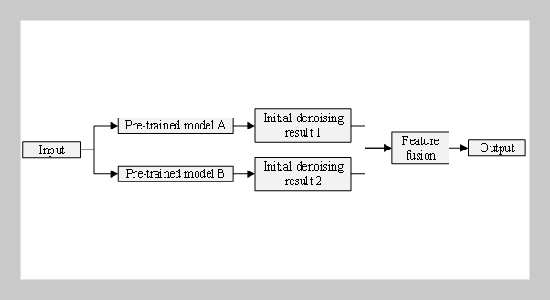
Proposed image denoising method
Copyright The Author(s). This is an open access article distributed under the terms of the Creative Commons Attribution License (CC BY 4.0), which permits unrestricted use, distribution, and reproduction in any medium, provided the original author and source are cited.
Download Citation: BibTeX | http://dx.doi.org/10.6180/jase.202510_28(10).0020
Image noise hinders the understanding of images by advanced visual tasks, and removing image noise is a challenging task. The traditional denoising methods can not only destroy the texture of the image, but can not save the image texture after removing the noise. Therefore, we propose a novel image denoising method based on deep feature fusion and U-Net network. This new method uses a two-branch U-Net network to fuse features and preserve image texture. In this paper, two encoders with independent parameters are proposed to extract more useful information respectively, and a fusion module with series connection is proposed to make better use of the extracted information and remove redundant information. Finally, the decoder is used to reconstruct the image, and the U-Net peer connection is used on the symmetric convolutional layer in the network. A large number of experimental results show that the proposed algorithm can effectively remove synthetic noise and real noise, and the reconstructed image has a good effect on both subjective visual effect and objective evaluation index.
Keywords: Image denoising, deep feature fusion, U-Net network, symmetric convolutional layer
- [1] Y. Li, G. Liu, D. P. Bavirisetti, X. Gu, and X. Zhou, (2023) “Infrared-visible image fusion method based on sparse and prior joint saliency detection and LatLRRFPDE” Digital Signal Processing 134: 103910. DOI: 10.1016/j.dsp.2023.103910.
- [2] L. Teng, Y. Qiao, M. Shafiq, G. Srivastava, A. R. Javed, T. R. Gadekallu, and S. Yin, (2023) “FLPK-BiSeNet: Federated learning based on priori knowledge and bilateral segmentation network for image edge extraction” IEEE Transactions on Network and Service Management 20(2): 1529–1542. DOI: 10.1109/TNSM.2023.3273991.
- [3] X. Meng, X. Wang, S. Yin, and H. Li, (2023) “Few-shot image classification algorithm based on attention mechanism and weight fusion” Journal of Engineering and Applied Science 70(1): 14. DOI: 0.1186/s44147-023-00186-9.
- [4] S. Wang, L. Li, X. Li, J. Zhang, L. Zhao, X. Su, and F. Chen, (2023) “A denoising network based on frequencyspectral-spatial-feature for hyperspectral image” IEEE Journal of Selected Topics in Applied Earth Observations and Remote Sensing 16: 6693–6710. DOI: 10.1109/JSTARS.2023.3285454.
- [5] A. Ulu, G. Yildiz, and B. Dizdaro˘glu, (2023) “MLFAN: Multilevel Feature Attention Network With Texture Prior for Image Denoising” IEEE Access 11: 34260–34273.
- [6] Z. Li, H. Liu, L. Cheng, and X. Jia, (2023) “Image denoising algorithm based on gradient domain guided filtering and NSST” IEEE Access 11: 11923–11933. DOI: 10.1109/ACCESS.2023.3242050.
- [7] A. M. H. Abadi and M. R. H. Fatemi, (2023) “Iterative based image and video denoising by fractional block matching and transform domain filtering” Authorea Preprints:
- [8] K. Dabov, A. Foi, V. Katkovnik, and K. Egiazarian, (2007) “Image denoising by sparse 3-D transform-domain collaborative filtering” IEEE Transactions on image processing 16(8): 2080–2095. DOI: 10.1109/TIP.2007.901238.
- [9] S. Yin, H. Li, Y. Sun, M. Ibrar, and L. Teng, (2024) “Data Visualization Analysis Based on Explainable Artificial Intelligence: A Survey” IJLAI Transactions on Science and Engineering 2(2): 13–20.
- [10] S. Yin, H. Li, A. A. Laghari, T. R. Gadekallu, G. A. Sampedro, and A. Almadhor, (2024) “An anomaly detection model based on deep auto-encoder and capsule graph convolution via sparrow search algorithm in 6G internet-of-everything” IEEE Internet of Things Journal 11(18): 13–20. DOI: 10.1109/JIOT.2024.3353337.
- [11] H. Li and C. Zhao, (2024) “Fusion Cycle GAN: A Multiple Feature Fusion based Cycle-consistent Generative Adversarial Network for Person Re-Identification” Journal of Science and Engineering 1(1): 7–12.
- [12] X. Mao, C. Shen, and Y.-B. Yang, (2016) “Image restoration using very deep convolutional encoder-decoder networks with symmetric skip connections” Advances in neural information processing systems 29: 2810–2818.
- [13] C. Shan, X. Guo, and J. Ou, (2019) “Residual learning of deep convolutional neural networks for image denoising” Journal of Intelligent & Fuzzy Systems 37(2): 2809–2818. DOI: 10.3233/JIFS-190017.
- [14] Y. Li, Y. Wang, and N. Wu, (2021) “Noise suppression method based on multi-scale Dilated Convolution Network in desert seismic data” Computers & Geosciences 156: 104910. DOI: 10.1016/j.cageo.2021.104910.
- [15] S. Lee, M. Negishi, H. Urakubo, H. Kasai, and S. Ishii, (2020) “Mu-net: Multi-scale U-net for two-photon microscopy image denoising and restoration” Neural Networks 125: 92–103. DOI: 10.1016/j.neunet.2020.01.026.
- [16] X. Wu, K. Zhang, Y. Hu, X. He, and X. Gao, (2024) “Multi-scale non-local attention network for image superresolution” Signal Processing 218: DOI: 10.1016/j.sigpro.2023.109362.
- [17] S. Yin, L. Wang, M. Shafiq, L. Teng, A. A. Laghari, and M. F. Khan, (2023) “G2Grad-CAMRL: an object detection and interpretation model based on gradient-weighted class activation mapping and reinforcement learning in remote sensing images” IEEE Journal of Selected Topics in Applied Earth Observations and Remote Sensing 16: 3583–3598. DOI: 10.1109/JSTARS.2023.3241405.
- [18] Y. Chen and T. Pock, (2016) “Trainable nonlinear reaction diffusion: A flexible framework for fast and effective image restoration” IEEE transactions on pattern analysis and machine intelligence 39(6): 1256–1272. DOI: 10.1109/TPAMI.2016.2596743.
- [19] G. Cheng, A. Matsune, Q. Li, L. Zhu, H. Zang, and S. Zhan. “Encoder-decoder residual network for real super-resolution”. In: Proceedings of the IEEE/CVF Conference on Computer Vision and Pattern Recognition Workshops. 2019. DOI: 10.1109/CVPRW.2019.00270.
- [20] X. Deng and P. L. Dragotti, (2020) “Deep convolutional neural network for multi-modal image restoration and fusion” IEEE transactions on pattern analysis and machine intelligence 43(10): 3333–3348. DOI: 10.1109/TPAMI.2020.2984244.
- [21] K. Zhang, W. Zuo, and L. Zhang, (2018) “FFDNet: Toward a fast and flexible solution for CNN-based image denoising” IEEE Transactions on Image Processing 27(9): 4608–4622. DOI: 10.1109/TIP.2018.2839891.
- [22] R. Ma, S. Li, B. Zhang, and Z. Li, (2021) “Towards fast and robust real image denoising with attentive neural network and PID controller” IEEE Transactions on Multimedia 24: 2366–2377. DOI: 10.1109/TMM.2021.3079697.
- [23] D. Honzátko and M. Kruliš, (2019) “Accelerating blockmatching and 3D filtering method for image denoising on GPUs” Journal of Real-Time Image Processing 16(6): 2273–2287. DOI: 10.1007/s11554-017-0737-9.
- [24] R. Kaftory, Y. Y. Schechner, and Y. Y. Zeevi. “Variational distance-dependent image restoration”. In: 2007 IEEE conference on computer vision and pattern recognition. IEEE. 2007, 1–8. DOI: 10.1109/CVPR.2007.383262.
- [25] T. Ma, H. Zhou, Y. Tian, and N. Al-Nabhan, (2021) “A novel rumor detection algorithm based on entity recognition, sentence reconfiguration, and ordinary differential equation network” Neurocomputing 447: 224–234. DOI: 10.1016/j.neucom.2021.03.055.