




Received: September 29, 2024
Accepted: April 4, 2025
Publication Date: April 2, 2026
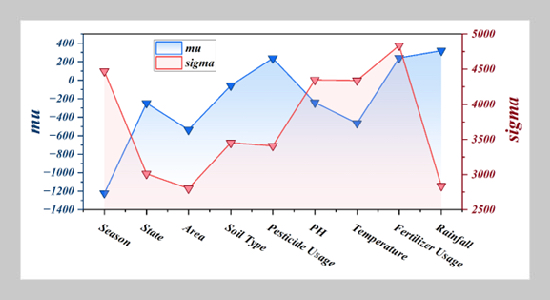
Analysis of feature selection given the input parameters.
Copyright The Author(s). This is an open access article distributed under the terms of the Creative Commons Attribution License (CC BY 4.0), which permits unrestricted use, distribution, and reproduction in any medium, provided the original author and source are cited.
Download Citation: BibTeX | https://doi.org/10.6180/jase.202605_29(5).0010
Accurate prediction of agricultural commodity prices, such as potatoes, is crucial for enhancing market efficiency, supporting supply chain decisions, and ensuring economic stability in the agricultural sector. This study proposes an enhanced machine learning framework for potato price prediction using Light Gradient Boosting Regression (LGBR), optimized through two metaheuristic algorithms: the Stochastic Paint Optimizer (SPO) and the Population-based Vortex Search Algorithm (PVSA). The hybrid models LGSP (LGBR+SPO) and LGPB (LGBR+PVSA) were developed to reduce prediction error and improve generalization. Experimental results demonstrate that the optimized models outperform the baseline LGBR model. Specifically, LGPB achieved the lowest training mean squared error (MSE) of 3.33E+03, though it increased to 6.30E+03 in validation, indicating a potential overfitting issue. LGSP achieved moderate performance with a training MSE of 5.35E+03 and validation MSE of 7.77E+03. In contrast, the baseline LGBR model had the highest MSE values in both training (1.13E+04) and validation (1.34E+04), reflecting weaker predictive accuracy. Uncertainty measures (U95) followed a similar trend. The findings confirm that metaheuristic optimization can significantly improve regression performance in price forecasting tasks. However, challenges in model generalization highlight the need for further tuning and diverse datasets.
Keywords: Potato Prices, Decision-Making Process, Machine Learning, Light Gradient Boosting Regression, Stochastic Paint Optimizer
- [1] J. E. da Silva Ribeiro, A. G. C. da Silva, J. V. L. Lima, P. H. de Almeida Oliveira, E. dos Santos Coêlho, L. M. da Silveira, and A. P. B. Júnior, (2024) “Leaf area prediction of sweet potato cultivars: An approach to a non-destructive and accurate method” South African Journal of Botany 172: 42–51. DOI: https://doi.org/10.1016/j.sajb.2024.07.006.
- [2] X. Lei, X. Xu, and S. Zhou, (2025) “Potato Yield Prediction Research Based on Improved Artificial Neural Networks Using Whale Optimization Algorithm” Potato Research 68: 1717–1726. DOI: https://doi.org/10.1007/s11540-024-09819-9.
- [3] M. Hassan, K. Khosravi, A. A. Farooque, T. J. Esau, A. Boluwade, and R. Sadiq, (2024) “Prediction of carbon dioxide emissions from Atlantic Canadian potato fields using advanced hybridized machine learning algorithms—Nexus of field data and modelling” Smart Agricultural Technology 9: 100559. DOI: https://doi.org/10.1016/j.atech.2024.100559.
- [4] P. Chaukhande, S. K. Luthra, R. N. Patel, S. R. Padhi, P. Mankar, M. Mangal, J. K. Ranjan, A. U. Solanke, G. P. Mishra, and D. C. Mishra, (2024) “Development and validation of near-infrared reflectance spectroscopy prediction modeling for the rapid estimation of biochemical traits in potato” Foods 13: 1655. DOI: https://doi.org/10.3390/foods13111655.
- [5] Y. Wang, Y. Xu, X. Wang, H. Wang, S. Liu, S. Chen, and M. Li, (2024) “Optimizing the effects of potato size and shape on near-infrared prediction models of potato quality using a linear-nonlinear algorithm” Journal of Food Composition and Analysis 135: 106679. DOI: https://doi.org/10.1016/j.jfca.2024.106679.
- [6] P. Jha, D. Dembla, and W. Dubey, (2024) “Deep learning models for enhancing potato leaf disease prediction: Implementation of transfer learning based stacking ensemble model” Multimedia Tools and Applications 83: 37839–37858. DOI: https://doi.org/10.1007/s11042-023-16993-4.
- [7] E.-S. M. El-Kenawy, A. A. Alhussan, N. Khodadadi, S. Mirjalili, and M. M. Eid, (2025) “Predicting potato crop yield with machine learning and deep learning for sustainable agriculture” Potato Research 68: 759–792. DOI: https://doi.org/10.1007/s11540-024-09753-w.
- [8] S. A. Alzakari, A. A. Alhussan, A.-S. T. Qenawy, A. M. Elshewey, and M. Eed, (2025) “An enhanced long short-term memory recurrent neural network deep learning model for potato price prediction” Potato Research 68: 621–639. DOI: https://doi.org/10.1007/s11540-024-09744-x.
- [9] A. Gupta, A. Chug, and A. P. Singh, (2024) “Potato disease prediction using machine learning, image processing and IoT–a systematic literature survey” Journal of Crop Improvement 38: 95–137. DOI: https://doi.org/10.1080/15427528.2023.2285827.
- [10] A. A. Abdelhamid, A. A. Alhussan, A.-S. T. Qenawy, A. M. Osman, A. M. Elshewey, and M. Eed, (2024) “Potato harvesting prediction using an Improved ResNet-59 model” Potato Research: 1–20. DOI: https://doi.org/10.1007/s11540-024-09773-6.
- [11] M. Piekutowska and G. Niedbała, (2025) “Review of methods and models for potato yield prediction” Agriculture 15: 367. DOI: https://doi.org/10.3390/agriculture15040367.
- [12] A. Mukiibi, A. T. B. Machakaire, A. C. Franke, and J. M. Steyn, (2025) “A systematic review of vegetation indices for potato growth monitoring and tuber yield prediction from remote sensing” Potato research 68: 409–448. DOI: https://doi.org/10.1007/s11540-024-09748-7.
- [13] S. K. Seelan, S. Laguette, G. M. Casady, and G. A. Seielstad, (2003) “Remote sensing applications for precision agriculture: A learning community approach” Remote sensing of environment 88: 157–169. DOI: https://doi.org/10.1016/j.rse.2003.04.007.
- [14] H. Lotze-Campen, C. Müller, A. Bondeau, S. Rost, A. Popp, and W. Lucht, (2008) “Global food demand, productivity growth, and the scarcity of land and water resources: a spatially explicit mathematical programming approach” Agricultural Economics 39: 325–338. DOI: https://doi.org/10.1111/j.1574-0862.2008.00336.x.
- [15] R. FR. “Balancing water uses: water for food and water for nature. Thematic background paper”. In: International Conference on Freshwater. December 2001, Bonn, Germany. 2001.
- [16] G. C. Nelson, H. Valin, R. D. Sands, P. Havlík, H. Ahammad, D. Deryng, J. Elliott, S. Fujimori, T. Hasegawa, and E. Heyhoe, (2014) “Climate change effects on agriculture: Economic responses to biophysical shocks” Proceedings of the National Academy of sciences 111: 3274–3279. DOI: https://doi.org/10.1073/pnas.1222465110.
- [17] P. Loudjani, (2014) “Precision Agriculture: An Opportunity for EU-Farmers–Potential Support with the CAP 2014-2020″: 1–50.
- [18] R. Gebbers and V. I. Adamchuk, (2010) “Precision agriculture and food security” Science 327: 828–831. DOI: https://doi.org/10.1126/science.1183899.
- [19] R. Raymundo, S. Asseng, R. Robertson, A. Petsakos, G. Hoogenboom, R. Quiroz, G. Hareau, and J. Wolf, (2018) “Climate change impact on global potato production” European Journal of Agronomy 100: 87–98. DOI: https://doi.org/10.1016/j.eja.2017.11.008.
- [20] A.Devaux,P.Kromann,andO.Ortiz,(2014)“Potatoes for sustainable global food security” Potato research 57: 185–199. DOI: https://doi.org/10.1007/s11540-014-9265-1.
- [21] L. Sharma, S. K. Bali, and J. D. Dwyer, (2017) “Study of Improving Yield Prediction and Sulfur Deficiency Detection Using Optical Sensors” ASA, CSSA and SSSA International Annual (2017): DOI: http://dx.doi.org/10.3390/s17051095.
- [22] S. Wolfert, L. Ge, C. Verdouw, and M.-J. Bogaardt, (2017) “Big data in smart farming–a review” Agricultural systems 153: 69–80. DOI: https://doi.org/10.1016/j.agsy.2017.01.023.
- [23] D.ZhangandJ.J. P. Tsai. Advances in machine learning applications in software engineering. Igi Global, 2006. DOI: http://dx.doi.org/10.4018/978-1-59140-941-1.
- [24] A. Chlingaryan, S. Sukkharieh, and B. Whelan, (2018) “Machine learning approaches for crop yield prediction and nitrogen status estimation in precision agriculture: A review” Computers and electronics in agriculture 151: 61–69. DOI: https://doi.org/10.1016/j.compag.2018.05.012.
- [25] S. S. Dahikar and S. V. Rode, (2014) “Agricultural crop yield prediction using artificial neural network approach” International journal of innovative research in electrical, electronics, instrumentation and control engineering 2: 683–686.
- [26] X. E. Pantazi, D. Moshou, T. Alexandridis, R. L. Whetton, and A. M. Mouazen, (2016) “Wheat yield prediction using machine learning and advanced sensing techniques” Computers and electronics in agriculture 121: 57–65. DOI: https://doi.org/10.1016/j.compag.2015.11.018.
- [27] S. Veenadhari, B. Misra, and C. D. Singh. “Machine learning approach for forecasting crop yield based on climatic parameters”. In: 2014 International Conference on Computer Communication and Informatics. IEEE, 2014, 1–5. DOI: https://doi.org/10.1109/ICCCI.2014.6921718.
- [28] W. Bowen, H. Cabrera, V. H. Barrera, and G. Baigorria, (1999) “Simulating the response of potato to applied nitrogen”:
- [29] A. T. B. Machakaire, J. M. Steyn, D. O. Caldiz, and A. J. Haverkort, (2016) “Forecasting yield and tuber size of processing potatoes in South Africa using the LINTUL-potato-DSS model” Potato research 59: 195–206. DOI: https://doi.org/10.1007/s11540-016-9321-0.
- [30] S. A. Yadav, X. Zhang, N. K. Wijewardane, M. Feldman, R. Qin, Y. Huang, S. Samiappan, W. Young, and F. G. Tapia, (2025) “Context-Aware Deep Learning Model for Yield Prediction in Potato Using Time-Series UAS Multispectral Data” IEEE Journal of Selected Topics in Applied Earth Observations and Remote Sensing: DOI: https://doi.org/10.1109/JSTARS.2025.3539217.
- [31] M. Eed, A. A. Alhussan, A.-S. T. Qenawy, A. M. Osman, A. M. Elshewey, and R. Arnous, (2025) “Potato consumption forecasting based on a hybrid stacked deep learning model” Potato Research 68: 809–833. DOI: https://doi.org/10.1007/s11540-024-09764-7.
- [32] R.-F. Wang and W.-H. Su, (2024) “The application of deep learning in the whole potato production Chain: A Comprehensive review” Agriculture 14: 1225. DOI: https://doi.org/10.3390/agriculture14081225.
- [33] D. Borus, D. Parsons, M. Boersma, H. Brown, and C. Mohammed, (2018) “Improving the prediction of potato productivity: APSIM-Potato model parameterization and evaluation in Tasmania, Australia” Australian Journal of Crop Science 12: 32–43.
- [34] R. Radha and M. K. Singh, (2023) “Axial groundwater contaminant dispersion modeling for a finite heterogeneous porous medium” Water 15: 2676. DOI: https://doi.org/10.3390/w15142676.
- [35] M. M. Awad, (2019) “Toward precision in crop yield estimation using remote sensing and optimization techniques” Agriculture 9: 54. DOI: https://doi.org/10.3390/agriculture9030054.
- [36] V. UmaRani and S. Thirisaa. “Analysis of Pre-Trained CNN Models for Pepper and Potato Leaf Disease Prediction”. In: 2024 International Conference on Emerging Smart Computing and Informatics (ESCI). IEEE, 2024, 1–5. DOI: https://doi.org/10.1109/ESCI59607.2024.10497250.
- [37] K. Tatsumi and T. Usami, (2024) “Plant-level prediction of potato yield using machine learning and unmanned aerial vehicle (UAV) multispectral imagery” Discover Applied Sciences 6: 649. DOI: https://doi.org/10.1007/s42452-024-06362-7.
- [38] J. G. P. W. Clevers and A. A. Gitelson, (2013) “Remote estimation of crop and grass chlorophyll and nitrogen content using red-edge bands on Sentinel-2 and -3” International Journal of Applied Earth Observation and Geoinformation 23: 344–351. DOI: https://doi.org/10.1016/j.jag.2012.10.008.
- [39] D. Phiri, M. Simwanda, S. Salekin, V. R. Nyirenda, Y. Murayama, and M. Ranagalage, (2020) “Sentinel-2 data for land cover/use mapping: A review” Remote sensing 12: 2291. DOI: https://doi.org/10.3390/rs12142291.
- [40] G. Ke, Q. Meng, T. Finley, T. Wang, W. Chen, W. Ma, Q. Ye, and T.-Y. Liu, (2017) “Lightgbm: A highly efficient gradient boosting decision tree” Advances in neural information processing systems 30:
- [41] X. Sun, M. Liu, and Z. Sima, (2020) “A novel cryptocurrency price trend forecasting model based on LightGBM” Finance Research Letters 32: 101084. DOI: https://doi.org/10.1016/j.frl.2018.12.032.
- [42] B. Doğan and T. Ölmez, (2015) “A new metaheuristic for numerical function optimization: Vortex Search algorithm” Information sciences 293: 125–145. DOI: https://doi.org/10.1016/j.ins.2014.08.053.
- [43] T. Sağ, (2022) “PVS: a new population-based vortex search algorithm with boosted exploration capability using polynomial mutation” Neural Computing and Applications 34: 18211–18287. DOI: https://doi.org/10.1007/s00521-022-07671-x.
- [44] S. S. Adudotla, P. Bobba, Z. Pathan, T. Kata, C. C. Sobin, and Jahfar. “A Method for Price Prediction of Potato Using Deep Learning Techniques”. In: International Conference on Intelligent Vision and Computing. Springer, 2022, 619–629. DOI: https://doi.org/10.1007/978-3-031-31164-2_53.