





Vijayakumar Kolandapaiyan, L. V. Muralikrishna Reddy, M. Sakthivel
1National Design and Research Forum, The Institution of Engineers, India
2Foundation for Educational Excellence (FEE)
Anna University
Received: September 12, 2017
Accepted: January 17, 2018
Publication Date: August 16, 2026
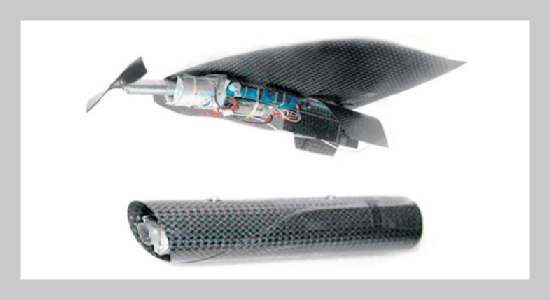
Foldable wing MAV [4].
Copyright The Author(s). This is an open access article distributed under the terms of the Creative Commons Attribution License (CC BY 4.0), which permits unrestricted use, distribution, and reproduction in any medium, provided the original author and source are cited.
Download Citation: BibTeX | https://doi.org/10.6180/jase.201806_21(2).0013
The enabling technologies for the development of micro air vehicles (MAV) are matured and realistic in the application arena. The foldable MAV is a family of MAV, which are gaining interest due to its unique storing capability in field of operation. The recent developments in foldable wing MAV are enhancing wing design with foldability characteristics including wing profile, material selection and canister capability. The overall objective of this work is to design and develop a mission based foldable wing MAV, which can be packed in minimal volume, unpacked in minimum time and deployed in time-critical situations. In this paper, the main objective is to show the foldable wing capability with the help of canister design. It also discusses the foldable wing profiles, identification of suitable composite materials, orientation, 3D printing and component selection. To consider the suitable wing shape, rectangular and taper wing has been taken. The structural stress analysis of these wing configurations for CFRP and GFRP materials have been analyzed and compared. Analysis of these wing has variation in deformation, strain and factor of safety. Besides, foldable wings and canister design are fabricated. The development and widespread use of MAV in the real life environment have constraint and limitations with respect to handling the vehicle because of its size of the wing and sensitive components attached to it. Foldable wing structures and storage capability in canister is one of the alternatives and has created lots of interest among the MAV development activity.
Keywords: Wing Profile; Stress Analysis; Composite Materials; Canister Design; 3D Printing
- [1] K. Valavanis, et al., Handbook of Unmanned Aerial Vehicles, Springer Netherlands (2015). DOI: 10.1007/978-90-481-9707-1.
- [2] S. Umezu, et al., (2017) “Bio-inspired wing-folding mechanism of micro air vehicle (MAV)” Artificial Life and Robotics 22: 203. DOI: 10.1007/s10015-016-0339-9.
- [3] Raul, et al., Advanced Composite Materials for Aerospace Engineering, 1st Edition, Woodhead Publishing, Elsevier. DOI: 10.1016/B978-0-08-100037-3.00001-8.
- [4] T. J. Mueller, et al., Introduction to the Design of Fixed-wing Micro Air Vehicles: Including Three Case Studies, AIAA (2007). DOI: 10.2514/4.862106.
- [5] G. Hicks, et al., (1999) “Multidisciplinary Design and Prototype Development of a Micro Air Vehicle” Journal of Aircraft 36(1): 227–234. DOI: 10.2514/2.2429.
- [6] Q. T. Truong, et al., (2014) “Design and Demonstration of Insect Mimicking Foldable Artificial Wing Using Four-bar Linkage Systems” Journal of Bionic Engineering 11(3): 449–458. DOI: 10.1016/S1672-6529(14)60057-3.
- [7] Albertani, et al., “Wind Tunnel Testing of Micro Air Vehicles at Low Reynolds Numbers”. In: SAE World Conference. 2004. DOI: 10.4271/2004-01-3090.
- [8] J. Anderson, Fundamental of Aerodynamics, Fifth Edition, McGraw-Hill (2011). DOI: 10.1017/S000192400000676X.
- [9] M. Secanell, et al., (2006) “Design of a Morphing Airfoil Using Aerodynamic Shape Optimization” AIAA Journal 44(7). DOI: 10.2514/1.18109.
- [10] M. Hyer, Stress Analysis of Fiber-reinforced Composite Materials, McGraw-Hill (1998). DOI: 10.1017/S0001924000096366.
- [11] J. D. Whitcomb, et al., (1998) “Analysis of Plain Weave Composites Subjected to Flexure” Mechanics of Composite Materials and Structures 5(1): 41–53. DOI: 10.1080/10759419808945892.
- [12] D. Lee, et al., “Aeroelastic Studies on a Folding Wing Configuration”. In: 46th AIAA/ASME/ASCE/AHS/ASC Structures, Structural Dynamics & Materials Conference. 2005. DOI: 10.2514/6.2005-1996.
- [13] D. Tang, et al., (2008) “Theoretical and Experimental Aeroelastic Study for Folding Wing Structures” Journal of Aircraft 45: 1136–1147. DOI: 10.2514/1.32754.
- [14] R. Wlezien, et al., “Aircraft Morphing Program”. In: Proc. SPIE Conference on Smart Structures and Materials. 1998, 176–187. DOI: 10.1117/12.310633.
- [15] R. Haftka, et al., Design and Optimization of Laminated Composite Materials, Wiley (1999). DOI: 10.1.1.170.9445.
- [16] D. Backman, et al., “Composite Materials and Joining Technologies for Composites”. In: Proceedings of the 2012 Annual Conference on Experimental and Applied Mechanics. Vol. 7. 2012. DOI: 10.1007/978-1-4614-4553-1.
- [17] E. Stanewsky, (2000) “Aerodynamic Benefits of Adaptive Wing Technology” Aerospace Science and Technology 4(7): 439–452. DOI: 10.1016/S1270-9638(00)01069-5.
- [18] C. K. Chua, et al., 3D Printing and Additive Manufacturing: Principles and Applications, Fifth Edition, World Scientific Publishing Company (2016). DOI: 10.18063/IJB.2016.02.002.
- [19] N. M. Wereley, et al., “Morphing Wings of a Small Scale UAV Using Inflatable Actuators for Sweep Control”. In: AIAA-2003-1802. 2003. DOI: 10.2514/6.2003-1802.
- [20] R. Lind, et al., “Roll Control for a Micro Air Vehicle Using Active Wing Morphing”. In: AIAA Paper AIAA-2003-5347. 2003. DOI: 10.2514/6.2003-5347.
- [21] T. Ng and G. Leng, (2002) “Application of Genetic Algorithms to Conceptual Design of a Micro Air Vehicle” Engineering Applications of Artificial Intelligence 15(5): 439–445. DOI: 10.1016/S0952-1976(02)00072-6.
- [22] J. Bowman, et al., “Development of Next Generation Morphing Aircraft Structures”. In: 48th AIAA/ASME/ASCE/AHS/ASC Structures, Structural Dynamics, and Materials Conference. 2007. DOI: 10.2514/6.2007-1730.
- [23] F. Lau, et al., (2011) “Aero-structural Optimization and Performance Evaluation of a Morphing Wing with Variable Span and Camber” Journal of Intelligent Material Systems and Structures. DOI: 10.1177/1045389X11416031.
- [24] M. H. Basri, et al., (2014) “Optimization of Aerodynamic Efficiency for Twist Morphing MAV Wing” Chinese Journal of Aeronautics 27(3): 475–487. DOI: 10.1016/j.cja.2014.04.017.