




Chien-Ching Chiu1, Chien-Hung Chen1, Yu-Ting Cheng2, Yu-Lin Lee, Yu-Kai Chou1
1Department of Electrical Engineering, Tamkang University, Tamsui, Taiwan 251, R.O.C.
2Department of Digital Game and Animation Design, Taipei University of Marine Technology, Tamsui, Taiwan 251, R.O.C.
Received: October 25, 2017
Accepted: January 19, 2018
Publication Date: August 16, 2018
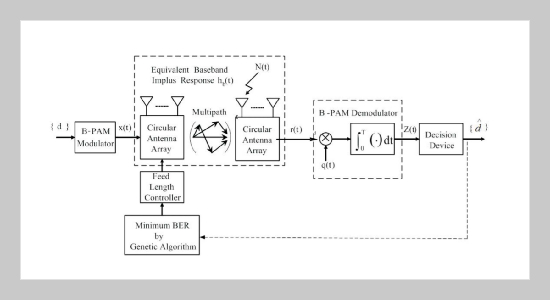
Block diagram of the simulated system.
Copyright The Author(s). This is an open access article distributed under the terms of the Creative Commons Attribution License (CC BY 4.0), which permits unrestricted use, distribution, and reproduction in any medium, provided the original author and source are cited.
Download Citation: BibTeX | http://dx.doi.org/10.6180/jase.201809_21(3).0011
In this paper, we use eight transmitter antennas and eight receiver antennas as the circle antenna arrays. Shooting and bouncing ray/image (SBR/Image) techniques combining with antenna pattern are used to calculate the impulse response in indoor wireless environment. Beamforming techniques are employed to reduce the multi-path effect of the channel and bit error rate (BER). We adjust the excitation amplitude and feed length of each array element to synthesize the pattern of the antenna array by using the genetic algorithms (GA) and self-adaptive dynamic differential evolution (SADDE). Numerical results show that SADDE algorithm outperforms GA algorithm in terms of bit error rate performance and convergence speed.
Keywords: Circle antenna Array; Beamforming; GA; SADDE; BER
- [1] Ghavami, M., “Wideband Smart Antenna Theory Using Rectangular Array Structures,” IEEE Trans. Signal Processing, Vol. 50, No. 9, pp. 2143-2151 (2002). doi: 10.1109/TSP.2002.801891
- [2] Tarokh, V., Seshadri, N. and Calderbank, A. R., “Space-time Codes for High Data Rate Wireless Communications: Performance Criterion and Code Construction,” IEEE Trans. Inform. Theory, Vol. 44, pp. 744-745 (1998). doi: 10.1109/18.661517
- [3] Chiu, C. C., Chen, C. H., Liao, S. H. and Chen, K. C., “Bit Error Rate Reduction by Smart UWB Antenna Array in Indoor Wireless Communication,” Journal of Applied Science and Engineering, Vol. 15, No. 2, pp. 139-148 (2012). doi: 10.6180/jase.2012.15.2.07
- [4] Peng, M. and Wang, W., “Comparison of Capacity between Adaptive Tracking and Switched Beam Smart Antenna Techniques in TDD-CDMA Systems,” Microwave, Antenna, Propagation and EMC Technologies for Wireless Communications, Vol. 1, pp. 135-139 (2005). doi: 10.1109/MAPE.2005.1617866
- [5] Sun, S., Theodore, S. R., Robert, W. H., Nix, A. and Rangan, S., “MIMO for Millimeter-wave Wireless Communications: Beamforming, Spatial Multiplexing, or Both,” IEEE Communications Magazine, pp. 110-121 (2014). doi: 10.1109/MCOM.2014.6979962
- [6] Guo, L., Deng, H., Himed, B., Ma, T. and Geng, Z., “Waveform Optimization for Transmit Beamforming with MIMO Radar Antenna Arrays,” IEEE Transactions on Antennas and Propagation, pp. 543-552 (2015). doi: 10.1109/TAP.2014.2382637
- [7] Jo, O., Hong, W., Choi, S. T., Chang, S. H., Kweon, C. Y., Oh, J. and Cheun, K., “Holistic Design Considerations for Environmentally Adaptive 60 GHz Beamforming Technology,” IEEE Communications Magazine, pp. 30-38 (2014). doi: 10.1109/MCOM.2014.6957140
- [8] Wu, S. H., Chiu, L. K., Lin, K. Y. and Chang, T. H., “Robust Hybrid Beamforming with Phased Antenna Arrays for Downlink SDMA in Indoor 60 GHz Channels,” IEEE Transactions on Communications, pp. 4542-4557 (2013). doi: 10.1109/TWC.2013.072313.121749
- [9] Ram, G., Mandal, D., Kar, R. and Ghoshal, S. P., “Synthesis of Circular Antenna Arrays with Improved Radiation Patterns Using DE Algorithm,” IEEE International Conference on Communication and Signal Processing, pp. 1178-1182 (2014). doi: 10.1109/ICCSP.2014.6950028
- [10] Chen, W., Chiu, C. C., Cheng, Y. T., Liao, S. H. and Yen, H. S., “Multi-objective Optimization for UWB Antenna Array by APSO Algorithm,” Telecommunication System, Vol. 64, No. 4, pp. 649-600 (2017). doi: 10.1007/s11235-016-0197-8
- [11] Tang, H. Y. and Chen, W., “Achieving Global Optimality for Joint Source and Relay Beamforming Design in Two-hop Relay Channels,” IEEE Transactions on Vehicular Technology, pp. 4422-4435 (2014). doi: 10.1109/TVT.2014.2311472
- [12] Gueguen, E., Thudor, F. and Chambelin, P., “A Low Cost UWB Printed Dipole Antenna with High Performance,” IEEE International Conference on Ultra-Wideband, pp. 89-92 (2005). doi: 10.1109/ICU.2005.1569963
- [13] Talom, F. T., Uguen, B., Rudant, L., Keignart, J., Pintos, J. F. and Chambelin, P., “Evaluation and Characterization of an UWB Antenna in Time and Frequency Domains,” IEEE International Conference on Ultra-Wideband, pp. 669-673 (2006). doi: 10.1109/ICU.2006.281628