




Yong Liu1, Yue Tong1, Jianwei Hou1, Ming Shi1, and Yunlong Guo2
1Yunnan Xuanhui Expressway Co., LTD., Qujing, 654299, China
2Jiangsu Dongjiao Intelligent Control Technology Group Co., LTD. Nanjing,210023, China
Received: March 12, 2025
Accepted: May 1, 2025
Publication Date: March 29, 2026
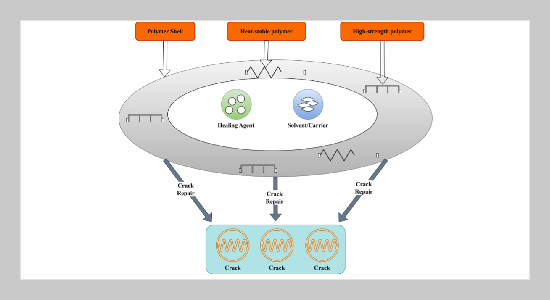
Microcapsule structure and function.
Copyright The Author(s). This is an open access article distributed under the terms of the Creative Commons Attribution License (CC BY 4.0), which permits unrestricted use, distribution, and reproduction in any medium, provided the original author and source are cited.
Download Citation: BibTeX | https://doi.org/10.6180/jase.202602_29(2).0020
Traditional stress-controlled release microcapsules used for asphalt self-healing suffer from poor strength, low thermal stability, and inconsistent release rates, limiting their practical application. This study proposes the design of high-strength, thermally stable stress-controlled release microcapsules to enhance asphalt’s self healing performance. By using high-performance polymer materials as the shell and employing the solution
impregnation method for microcapsule synthesis, the proposed microcapsules exhibit improved stability in high-temperature environments. The shell thickness, core content, and preparation conditions such as temperature, pH, and solvent selection are optimized to achieve precise control over the release rate and amount. Customizable microcapsules are developed to meet varying self-healing needs. These microcapsules are uniformly dispersed in the asphalt matrix through heating and stirring, ensuring an even distribution for effective self-healing. Experimental verification under different stress conditions confirms their stress-controlled release capabilities and crack-healing performance. Results demonstrate a crack closure degree of 0.87 at a stress frequency of 6 Hz, a compressive strength recovery rate of 0.82, and a repair time of 14 minutes. The microcapsules achieve a release rate accuracy between 0.90 and 0.97 across the stress frequency range, providing superior control over the healing agent release. This research offers a promising solution for improving asphalt durability.
Keywords: Stress Controlled Release Microcapsules; Asphalt Materials; Asphalt Self-Healing; Self-Healing Effect; Release Rate
- [1] P. Wan, S. Wu, Q. Liu, et al., (2022) “Recent advances in calcium alginate hydrogels encapsulating rejuvenator for asphalt self-healing” Journal of Road Engineering 2(3): 181–220.
- [2] Y. Y. Wang and Y. Q. Tan, (2023) “Preparation, with graphene, of novel biomimetic self-healing microcapsules with high thermal stability and conductivity” Frontiers of Structural and Civil Engineering 17(8): 1188–1198. DOI: https://doi.org/10.1007/s11709-023-0027-5.
- [3] J. Norambuena-Contreras, J. L. Concha, G. Valdes-Vidal, et al., (2024) “Optimised biopolymer-based capsules for enhancing the mechanical and self-healing properties of asphalt mixtures” Materials and Structures 57(10): 1–21. DOI: https://doi.org/10.1617/s11527-024-02508-6.
- [4] X. Qiu, W. Cheng, W. Xu, et al., (2022) “Fatigue evolution characteristic and self-healing behaviour of asphalt binders” International Journal of Pavement Engineering 23(5): 1459–1470. DOI: https://doi.org/10.1080/10298436.2020.1806277.
- [5] M. Hu, D. Sun, T. Lu, et al., (2020) “Laboratory investigation of the adhesion and self-healing properties of high-viscosity modified asphalt binders” Transportation Research Record 2674(1): 307–318. DOI: https://doi.org/10.1177/03611981209029.
- [6] S. Inozemtcev, E. Korolev, and T. Do, (2023) “Intrinsic self-healing potential of asphalt concrete” Magazine of Civil Engineering 123(7): 95–104. DOI: 10.34910/MCE.123.8.
- [7] P. Cheng, Z. Zhang, Z. Yang, et al., (2022) “Evaluation of self-healing performance and mechanism analysis of nano-montmorillonite-modified asphalt” International Journal of Pavement Research and Technology 15(4): 876–888. DOI: https://doi.org/10.1007/s42947-021-00059-5.
- [8] C. Shi, R. Luo, H. Liu, et al., (2022) “Evaluation of self-healing characteristics of asphalt materials by intermittent loading tests” Road Materials and Pavement Design 23(11): 2684–2696. DOI: https://doi.org/10.1080/14680629.2021.1978525.
- [9] Y. Li, R. Gu, L. Lyu, et al., (2024) “Tracking the Aging-Induced Evolution in Self-Healing Capacities of Asphalt Binder: Microstructure and Rheology Analysis” Langmuir 40(49): 26179–26192. DOI: https://pubs.acs.org/doi/epdf/10.1021/acs.langmuir.4c03687.
- [10] J. L. Concha, L. E. Arteaga-Pérez, E. Alpizar-Reyes, et al., (2023) “Effect of rejuvenating oil type on the synthesis and properties of alginate-based polynuclear capsules for asphalt self-healing” Road Materials and Pavement Design 24(7): 1669–1694. DOI: https://doi.org/10.1080/14680629.2022.2092026.
- [11] J. Norambuena-Contreras, L. E. Arteaga-Pérez, J. L. Concha, et al., (2021) “Pyrolytic oil from waste tyres as a promising encapsulated rejuvenator for the extrinsic self-healing of bituminous materials” Road Materials and Pavement Design 22(sup1): S117–S133. DOI: https://doi.org/10.1080/14680629.2021.1907216.
- [12] Y. Wang, R. Zhai, B. Sun, et al., (2022) “Microcapsule synthesis and evaluation on fatigue and healing of microcapsule-based asphalt by the entropy and TOPSIS method” International Journal of Pavement Engineering 23(13): 4610–4621. DOI: https://doi.org/10.1080/10298436.2021.1968395.
- [13] E. Alpizar-Reyes, J. L. Concha, F. J. Martín-Martínez, et al., (2022) “Biobased spore microcapsules for asphalt self-healing” ACS Applied Materials & Interfaces 14(27): 31296–31311. DOI: https://pubs.acs.org/doi/abs/10.1021/acsami.2c07301.
- [14] W. Mamo, A. Ambaye, A. Beshir, et al., (2025) “Comprehensive review of the recent advancements in self-healing asphalt utilizing nanotechnology” Ethiopian Journal of Science and Sustainable Development 12(1): 16–27. DOI: https://www.ajol.info/index.php/ejssd/article/view/285893.
- [15] D. Grossegger, A. Garcia, and G. Airey, (2022) “The composition of the material phase responsible for the self-healing of macro-cracks in asphalt mortar beams” Road Materials and Pavement Design 23(3): 656–665. DOI: https://doi.org/10.1080/14680629.2020.1482793.
- [16] R. Barbaz-Isfahani, S. Saber-Samandari, and M. Salehi, (2023) “Experimental and numerical research on healing performance of reinforced microcapsule-based self-healing polymers using nanoparticles” Journal of Reinforced Plastics and Composites 42(3–4): 95–109. DOI: https://doi.org/10.1177/07316844221102945.
- [17] J. Sun, Y. Li, B. Liao, et al., (2024) “Development and performance evaluation of bioenzyme-responsive temporary plugging materials” Advances in Geo-Energy Research 11(1): 20–28. DOI: https://ager.yandypress.com/index.php/2207-9963/article/view/327.
- [18] X. Li, J. Wang, X. Li, et al., (2024) “Compatibility of high strength silica-modified microcapsules modified with polydopamine in elastomer substrates” Polymer Composites 45(2): 1250–1265. DOI: https://doi.org/10.1002/pc.27850.
- [19] A. Teimouri, R. Barbaz Isfahani, S. Saber-Samandari, et al., (2022) “Experimental and numerical investigation on the effect of core-shell microcapsule sizes on mechanical properties of microcapsule-based polymers” Journal of Composite Materials 56(18): 2879–2884. DOI: https://doi.org/10.1177/00219983221107831.
- [20] S. S. Chaudhari, N. G. Patil, and P. A. Mahanwar, (2024) “A review on microencapsulated phase change materials in building materials” Journal of Coatings Technology and Research 21(1): 173–198. DOI: https://doi.org/10.1007/s11998-023-00814-2.
- [21] M. M. Hilal and M. Y. Fattah, (2022) “Evaluation of Resilient Modulus and Rutting for Warm Asphalt Mixtures: A Local Study in Iraq” Applied Science 12: 12841. DOI: 10.3390/app122412841.
- [22] M. Q. Ismael, H. H. Joni, and M. Y. Fattah, (2022) “Neural Network Modeling of Rutting Performance for Sustainable Asphalt Mixtures Modified by Industrial Waste Alumina” Ain Shams Engineering Journal: DOI: 10.1016/j.asej.2022.101972.
- [23] M. Q. Ismael, M. Y. Fattah, and A. F. Jasim, (2021) “Improving the Rutting Resistance of Asphalt Pavement Modified with the Carbon Nanotubes Additive” Ain Shams Engineering Journal: DOI: 10.1016/j.asej.2021.02.038.