




Fengxia Han1,2, Hongjun Wang1,2, and Jianing Zhang1,2
1School of Mechanical and Electrical Engineering, Beijing Information Science and Technology University, 100192, Beijing, China
2Beijing International Science Cooperation Base of High-end Equipment Intelligent Perception and Control, 100192, Beijing, China
Received: May 8, 2025
Accepted: June 13, 2025
Publication Date: April 2, 2026
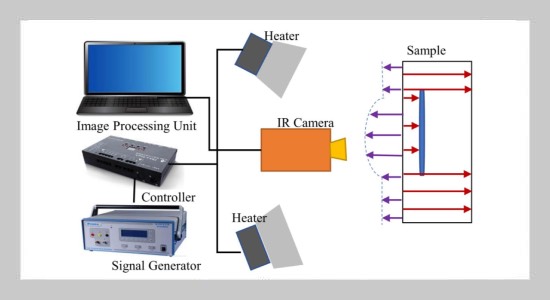
OST schematic.
Copyright The Author(s). This is an open access article distributed under the terms of the Creative Commons Attribution License (CC BY 4.0), which permits unrestricted use, distribution, and reproduction in any medium, provided the original author and source are cited.
Download Citation: BibTeX | https://doi.org/10.6180/jase.202605_29(5).0003
The distinctive characteristics of composite materials make them indispensable across sectors like aviation, transportation, and power generation. However, these materials are subject to the risk of defects and damage during production and usage, affecting their reliability. To address this challenge, early detection and real time monitoring through active infrared thermography have become essential. The current study offers a comprehensive examination of the latest progress and real-world uses of infrared thermography within the realm of non-destructive testing for composite substances. It focuses on discussing typical excitation sources, excitation methods, and proposing future directions for infrared thermography. Additionally, practical case studies highlighting the technology’s application in production settings are presented. The discoveries act as an indispensable guide for scholars aiming to delve into the present state and prospective trends of Non-Destructive Testing (NDT).
Keywords: Composites, Infrared Thermography, Excitation sources, Excitation functions, Development trend
- [1] F. Wang, J. Sheng, S. Sfarra, Y. Zhou, L. Xu, L. Liu, and S. Liu. (2023). “Multimode infrared thermal-wave imaging via non-destructive testing and evaluation (NDT&E): Physical principles, modulated waveform, and excitation heat source.” Infrared Physics & Technology 135:104993. DOI: 10.1016/j.infrared.2023.104993.
-
[2] M. Ishikawa, M. Ando, M. Koyama, and H. Nishino. (2019). “Active thermographic inspection of carbon fiber reinforced plastic laminates using laser scanning heating.” Composite Structures 209:515–522. DOI: 10.1016/j.compstruct.2018.10.113.
-
[3] H. Zhang, H. Fernandes, F. B. Djupkep Dizeu, U. Hassler, J. Jeuret, M. Genest, and X. Maldague. (2016). “Pulsed micro-laser line thermography on submillimeter porosity in carbon fiber reinforced polymer composites: experimental and numerical analyses for the capability of detection.” Applied Optics 55(34):D1–D10. DOI: 10.1364/AO.55.00D1.
-
[4] W. Guo, L. Dong, H. Wang, Z. Xing, F. Feng, Z. Gao, and B. Wang. (2019). “Discriminating the substrate crack under sprayed coatings using ultrasonic infrared thermography.” Infrared Physics & Technology 102:103073. DOI: 10.1016/j.infrared.2019.103073.
-
[5] Q. Yi, G. Y. Tian, H. Malekmohammadi, J. Zhu, S. Laureti, and M. Ricci. (2019). “New features for delamination depth evaluation in carbon fiber reinforced plastic materials using eddy current pulse-compression thermography.” NDT & E International 102:264–273. DOI: 10.1016/j.ndteint.2018.12.010.
-
[6] Y. He, B. Gao, A. Sophian, and R. Yang. (2017). “Transient electromagnetic-thermal nondestructive testing: pulsed eddy current and transient eddy current thermography.” Butterworth-Heinemann.
-
[7] F. Wang, J. Liu, Y. Liu, and Y. Wang. (2016). “Research on the fiber lay-up orientation detection of unidirectional CFRP laminates composite using thermal-wave radar imaging.” NDT & E International 84:54–66. DOI: 10.1016/j.ndteint.2016.08.002.
-
[8] D. Sharath, M. Menaka, and B. Venkatraman. (2013). “Defect characterization using pulsed thermography.” Journal of Nondestructive Evaluation 32:134–141. DOI: 10.1007/s10921-012-0166-4.
-
[9] M. Ishikawa, M. Ando, M. Koyama, and H. Nishino. (2019). “Active thermographic inspection of carbon fiber reinforced plastic laminates using laser scanning heating.” Composite Structures 209:515–522. DOI: 10.1016/j.compstruct.2018.10.113.
-
[10] D. P. Almond and S. G. Pickering. (2012). “An analytical study of pulsed thermography defect detection.” Journal of Applied Physics 111(9). DOI: 10.1063/1.4706484.
-
[11] R. Maranin, D. Palmieri, and T. D’Orazio. (2021). “Deep learning for defect characterization in composites inspected by terahertz thermography.” Optics and Lasers in Engineering 145:106679. DOI: 10.1016/j.optlaseng.2021.106679.
-
[12] C. M. Cea, G. Marmoglou, A. Squillace, and G. Giordano. (2002). “Non-destructive control of industrial materials by means of lock-in thermography.” Measurement Science and Technology 13(10):1583. DOI: 10.1088/0957-0233/13/10/311.
-
[13] S. Ekkanayaka, S. Gurram, and R. H. Schmitt. (2018). “Depth determination of defects in CFRP structures using lock-in thermography.” Composites Part B: Engineering 147:128–134. DOI: 10.1016/j.compositesb.2018.04.012.
-
[14] L. Liu, A. Mandelis, A. Melnikov, and L. Wang. (2022). “Comparative analysis of single and multiple-frequency thermal wave radar imaging inspection of glass fiber reinforced polymer (GFRP) internal delamination.” Journal of Extreme Manufacturing 4(2):025201. DOI: 10.1088/2631-7990/a57c8c.
-
[15] R. Yang, Y. He, A. Mandelis, N. Wang, X. Wu, and S. Huang. (2018). “Induction infrared thermography and thermogram-radar analysis for imaging inspection and diagnosis of blade composites.” IEEE Transactions on Industrial Informatics 14(12):5637–5647. DOI: 10.1109/TII.2018.2844462.
-
[16] F. Wang, Y. Wang, J. Liu, and Y. Wang. (2019). “The feature recognition of CFRP subsurface defects using low-energy chirp-pulsed radar thermography.” IEEE Transactions on Industrial Informatics 16(8):5160–5168. DOI: 10.1109/TII.2019.2954718.
-
[17] S. Hevyrat, S. Poelman, J. Segers, W. Van Paepegem, and M. Kersemans. (2019). “Performance of frequency and phase modulated excitation waveforms for optimal infrared thermography of CFRP through-thickness.” Composites Structures 225:111177. DOI: 10.1016/j.compstruct.2019.111177.
-
[18] Z. T. Luo, P. Shen, H. Luo, S. K. Wu, and H. Zhang. (2022). “Advanced orthogonal frequency and phase modulated waveform for contrast-enhanced photo-thermal radar thermography.” Journal of Applied Physics 131(22). DOI: 10.1063/5.0087734.
-
[19] R. Li, C. Bu, H. Zhang, F. Wang, G. T. Vesala, V. S. Ghali, and V. P. Vasilov. (2024). “Dynamic infrared scanning thermography based on CNN: a novel large-scale honeycomb defect detection and classification technique.” Journal of Thermal Analysis and Calorimetry 1–17. DOI: 10.1007/s10973-024-13355-4.
-
[20] G. Liu, W. Gao, W. Liu, X. Gao, W. Bai, and E. Chen. (2024). “Low-velocity impact damage detection of CFRP composites by applying long pulsed thermography based on post-processing techniques.” Nondestructive Testing and Evaluation 39(2):196–199. DOI: 10.1080/10589759.2023.2282448.
-
[21] K. Matasre, D. Palumbo, and U. Galietti. (2023). “Comparison in transient regime of four lock-in thermography algorithms by means of synthetic and experimental data on CFRP.” NDT & E International 139:102925. DOI: 10.1016/j.ndteint.2023.102925.
-
[22] Y. He, X. Wu, J. Wu, Y. Ma, Z. Yang, H. Zhang, P. Wang, H. Wang, and Y. Wang. (2024). “Intelligent defect location algorithm based on 2D/3D pulse thermographic imaging for CFRP composites.” Nondestructive Testing and Evaluation 39(4):923–938. DOI: 10.1080/10589759.2023.2282458.
-
[23] Y. Dong, B. Zhao, J. Yang, Y. Cao, and Y. Cao. (2023). “Two-stage convolutional neural network for joint removal of sensor noise and background interference in lock-in thermography.” NDT & E International 137:102816. DOI: 10.1016/j.ndteint.2023.102816.
-
[24] Z. Tong, L. Cheng, S. Xie, and M. Keseramans. (2023). “A flexible deep learning framework for thermographic inspection of composites.” NDT & E International 139:102926. DOI: 10.1016/j.ndteint.2023.102926.
-
[25] J. Liu, X. Long, C. Jiang, and W. Liao. (2024). “Multi-feature vision transformer for automatic defect detection and quantification in composites using thermography.” NDT & E International 143:103033. DOI: 10.1016/j.ndteint.2023.103033.
-
[26] A. Katunin, K. Dragan, T. Nowak, and M. Chalimoniuk. (2021). “Quality control approach for the detection of internal low density areas in composite disks in industrial conditions based on a combination of NDT techniques.” Sensors 21(12):7174. DOI: 10.3390/s21127174.
-
[27] Y. He, S. Chen, D. Zhou, S. Huang, and P. Wang. (2018). “Shear delamination hybridibrandurable and vibrothermography testing for CFRP barely visible impact damage inspection.” IEEE Transactions on Industrial Informatics 14(12):5575–5584. DOI: 10.1109/TII.2018.2820816.
-
[28] X. Meng, Y. Wang, J. Liu, and W. He. (2019). “Non-destructive inspection of curved clad composites with subsurface defects by combination active thermography and three-dimensional (3D) structural optical imaging.” Infrared Physics & Technology 97:424–431. DOI: 10.1016/j.infrared.2019.01.026.
-
[29] J. Li, B. Gao, W. L. Woo, J. Xu, L. Liu, and Y. Zeng. (2023). “A novel multiscpectral fusion defect detection framework with coarse-to-fine multispectral registration.” IEEE Transactions on Instrumentation and Measurement 73:1–13. DOI: 10.1109/TIM.2023.3344145.
-
[30] J. Liu, X. Long, C. Jiang, and W. Liao. (2024). “Multi-feature vision transformer for automatic defect detection and quantification in composites using thermography.” NDT & E International 143:103033. DOI: 10.1016/j.ndteint.2023.103033.