




Manzhi Zheng, Changming Zhao, and Chunxu Wu
Southwest Jiaotong University Hope College, Chengdu City, Sichuan Province, China
Received: March 24, 2025
Accepted: June 29, 2025
Publication Date: April 2, 2026
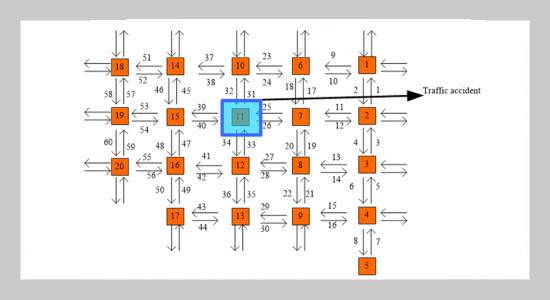
Road network structure
Copyright The Author(s). This is an open access article distributed under the terms of the Creative Commons Attribution License (CC BY 4.0), which permits unrestricted use, distribution, and reproduction in any medium, provided the original author and source are cited.
Download Citation: BibTeX | https://doi.org/10.6180/jase.202604_29(4).0007
To address the delayed adaptation of conventional traffic diversion methods in dynamic accident scenarios, this study proposes an immune clone annealing algorithm (ICAA)-based framework with three key innovations. First, a residual capacity analysis model is developed to pre-identify high-congestion-risk road sections (threshold: congestion probability CP ≥ 0.65) using directed graph theory, enabling proactive congestion management. Second, an enhanced support vector machine (SVM) classifier is introduced, integrating vehicle speed, density, and occupancy with cuckoo search optimization, achieving a congestion detection accuracy of 93.2%. Third, a throughput-maximizing objective function, resolved by the ICAA, is designed to optimize traffic flowredistribution. Simulation results under peak-hour accident conditions demonstrate that the proposed framework reduces average delays by 37.5% and reduces probability of congestion by 20%. These advancements highlight the framework’s robust adaptability in multi-accident scenarios, and make it a practical solution for real-time traffic management in complex urban networks.
Keywords: Immuneclone annealing algorithm; Accident section; Traffic diversion; Traffic network model; Improve support vector machines; Cuckoo search algorithm
- [1] Y. Karnati, R. Sengupta, A. Rangarajan, and S. Ranka, (2022) “Subcycle Waveform Modeling of Traffic Intersections Using Recurrent Attention Networks” IEEE TRANSACTIONS ON INTELLIGENT TRANSPORTATION SYSTEMS 23(3): 2538–2548. DOI: 10.1109/TITS.2021.3121250.
- [2] M. J. A. Jude, V. C. Diniesh, M. Shivaranjani, S. Muthusamy, H. Panchal, S. C. M. Sundararajan, and K. K. Sadasivuni, (2023) “On Minimizing TCP Traffic Congestion in Vehicular Internet of Things (VIoT)” WIRELESS PERSONAL COMMUNICATIONS 128(3): 1873–1893. DOI: 10.1007/s11277-022-10024-5.
- [3] M. L. M. Peixoto, E. Mota, A. H. O. Maia, W. Lobato, M. A. Salahuddin, R. Boutaba, and L. A. Villas, (2023) “FogJam: A Fog Service for Detecting Traffic Congestion in a Continuous Data Stream VANET” AD HOC NETWORKS 140: DOI: 10.1016/j.adhoc.2022.103046.
- [4] R. Ducrocq and N. Farhi, (2023) “Deep Reinforcement Q-Learning for Intelligent Traffic Signal Control with Partial Detection” INTERNATIONAL JOURNAL OF INTELLIGENT TRANSPORTATION SYSTEMS RESEARCH 21(1): 192–206. DOI: 10.1007/s13177-023-00346-4.
- [5] C. Hua and W. ( Fan, (2022) “Freeway Traffic Speed Prediction under the Intelligent Driving Environment: A Deep Learning Approach” JOURNAL OF ADVANCED TRANSPORTATION 2022: DOI: 10.1155/2022/6888115.
- [6] T. Mao, A.-S. Mihaita, F. Chen, and H. L. Vu, (2022) “Boosted Genetic Algorithm Using Machine Learning for Traffic Control Optimization” IEEE TRANSACTIONS ON INTELLIGENT TRANSPORTATION SYSTEMS 23(7): 7112–7141. DOI: 10.1109/TITS.2021.3066958.
- [7] Z. Oreg, H.-S. Shin, and A. Tsourdos, (2022) “Traffic conflict reduction based on distributed stochastic task allocation” AERONAUTICAL JOURNAL 126(1300): 993–1025. DOI: 10.1017/aer.2021.119.
- [8] O. Idrissi, A. Bikir, and K. Mansouri, (2023) “Improving the management of air traffic congestion during the approach phase” AERONAUTICAL JOURNAL 127(1316): 1752–1773. DOI: 10.1017/aer.2023.20.
- [9] P. Choudhary, R. K. Dwivedi, and U. Singh, (2022) “An analysis of real-time traffic congestion optimisation through VTL in VANETs” INTERNATIONAL JOURNAL OF COMPUTER APPLICATIONS IN TECHNOLOGY 68(1): 12–26.
- [10] A. M. Kishk, M. Badawy, H. A. Ali, and A. Saleh I, (2022) “A new traffic congestion prediction strategy (TCPS) based on edge computing” CLUSTER COMPUTING-THE JOURNAL OF NETWORKS SOFTWARE TOOLS AND APPLICATIONS 25(1): 49–75. DOI: 10.1007/s10586-021-03377-2.
- [11] A. Moyano, M. Stepniak, B. Moya-Gomez, and J. C. Garcia-Palomares, (2021) “Traffic congestion and economic context: changes of spatiotemporal patterns of traffic travel times during crisis and post-crisis periods” TRANSPORTATION 48(6): 3301–3324. DOI: 10.1007/s11116-021-10170-y.
- [12] M. Drliciak, M. Cingel, J. Celko, and Z. Panikova, (2024) “Research on Vehicle Congestion Group Identification for Evaluation of Traffic Flow Parameters” SUSTAINABILITY 16(5): DOI: 10.3390/su16051861.
- [13] T. Kim and K. Jerath, (2022) “Congestion-Aware Cooperative Adaptive Cruise Control for Mitigation of Self-Organized Traffic Jams” IEEE TRANSACTIONS ON INTELLIGENT TRANSPORTATION SYSTEMS 23(7): 6621–6632. DOI: 10.1109/TITS.2021.3059237.
- [14] A. Mohanty, S. K. Mohanty, B. Jena, A. G. Mohapatra, A. N. Rashid, A. Khanna, and D. Gupta, (2022) “Identification and evaluation of the effective criteria for detection of congestion in a smart city” IET COMMUNICATIONS 16(5, SI): 560–570. DOI: 10.1049/cmu2.12344.
- [15] X. Liu, C. Qian, and X. Zhao, (2025) “A Dynamic Regional-Aggregation-Based Heterogeneous Graph Neural Network for Traffic Prediction” MATHEMATICS 13(9): 1448–1458. DOI: 10.3390/math13091458.
- [16] Y. Wang, X. Lv, X. Gu, and D. Li, (2025) “A New Edge Computing Method Based on Deep Learning in Intelligent Transportation System” IEEE TRANSACTIONS ON VEHICULAR TECHNOLOGY 74(2): 2210–2219. DOI: 10.1109/TVT.2024.3408163.