





Received: June 9, 2026
Accepted: June 26, 2026
Publication Date: July 25, 2026
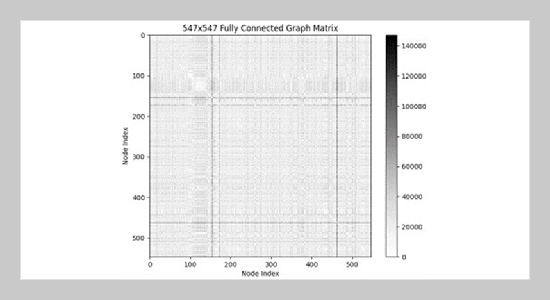
Charging station node distance matrix.
Copyright The Author(s). This is an open access article distributed under the terms of the Creative Commons Attribution License (CC BY 4.0), which permits unrestricted use, distribution, and reproduction in any medium, provided the original author and source are cited.
Download Citation: BibTeX | http://dx.doi.org/10.6180/jase.202610_33.059
As a core part of Cyber-Physical Systems (CPS), EV charging networks face limitations in traditional spatiotemporal models due to static spatial representation and poor heterogeneous data fusion. This paper proposes a Multi-Scale Subgraph Spatiotemporal Graph Convolutional Network (MSG-STGCN) for predictive load management. By integrating multi-modal data- including POI semantics and traffic conditions- into a dynamic heterogeneous graph, the model utilizes a condition-triggered mechanism to adaptively capture multi-scale spatial contexts. Experiments on real-world datasets show MSG-STGCN achieves MAE of 0.22 and MAPE of 9.75%, outperforming the baseline AGCRN by 0.07 in MAE and 0.81% in MAPE. Ablation studies further verify the effectiveness of multi-scale subgraph embedding and spatiotemporal attention.
Keywords: Cyber-Physical Systems, AI-Driven Predictive Maintenance, Spatiotemporal Graph Neural Networks
- [1] Z. Lv, M. Wu, Z. Song, and S. Zhou, (2022) “Special Issue: Operation and control of Modular DC Transformer Applied to Energy Internet” Mechatron. Syst. Control. 50: URL: https://api.semanticscholar.org/CorpusID:247170808.
- [2] Y. Bing, W. Lifang, and L. Chenglin, (2013) “Large-scale Electric Vehicle Charging Demand and Its Influencing Factors” Transactions of the China Electrotechnical Society: 7. DOI: 10.19595/j.cnki.1000-6753.tces.2013.02.003.
- [3] P. Adsule and M. Manoj, (2025) “A stated choice study to assess charging and travel decisions of electric car users considering car attributes and trip chaining complexity – Case New Delhi, India” Transportation Research Part A: Policy and Practice 192: 104366. DOI: 10.1016/j.tra.2024.104366.
- [4] J. Huber, D. Dann, and C. Weinhardt, (2020) “Probabilistic forecasts of time and energy flexibility in battery electric vehicle charging” Applied Energy 262: 114525. DOI: 10.1016/j.apenergy.2020.114525.
- [5] Y. Kim and S. Kim, (2021) “Forecasting Charging Demand of Electric Vehicles Using Time-Series Models” Energies 14(5): DOI: 10.3390/en14051487. URL: https://www.mdpi.com/1996-1073/14/5/1487.
- [6] Y. Zhang, X. Luo, Z. Wang, Q. Mai, and R. Deng, (2022) “Estimating charging demand from the perspective of choice behavior: A framework combining rule-based algorithm and hybrid choice model” Journal of Cleaner Production 376: 134262. DOI: 10.1016/j.jclepro.2022.134262.
- [7] Q. Xing, Z. Chen, Z. Zhang, X. Huang, Z. Leng, K. Sun, Y. Chen, and H. Wang, (2019) “Charging Demand Forecasting Model for Electric Vehicles Based on Online Ride-Hailing Trip Data” IEEE Access 7: 137390–137409. DOI: 10.1109/ACCESS.2019.2940597.
- [8] Y. Xiong, J. Gan, B. An, C. Miao, and A. L. C. Bazzan, (2018) “Optimal Electric Vehicle Fast Charging Station Placement Based on Game Theoretical Framework” IEEE Transactions on Intelligent Transportation Systems 19(8): 2493–2504. DOI: 10.1109/TITS.2017.2754382.
- [9] G. Alface, J. C. Ferreira, and R. Pereira, (2019) “Electric Vehicle Charging Process and Parking Guidance App” Energies 12(11): DOI: 10.3390/en12112123.
- [10] L. Zenglu, G. Qiang, and N. Jiajia, (2020) “Research on Online Promotion Strategies of Dual-Channel Manufacturers Based on Risk Avoidance” Chinese Journal of Management Science 28(07): 112–121. DOI: 10.16381/j.cnki.issn1003-207x.2020.07.011.
- [11] Z. Xue and S. Li, (2006) “Multi-Model Modelling and Predictive Control Based on Local Model Networks” Control. Intell. Syst. 34: URL: https://api.semanticscholar.org/CorpusID:20880051.
- [12] S. Rahman and G. Shrestha, (1993) “An investigation into the impact of electric vehicle load on the electric utility distribution system” IEEE Transactions on Power Delivery 8(2): 591–597. DOI: 10.1109/61.216865.
- [13] Z. Wu, J. Hu, X. Ai, and G. Yang, (2021) “Data-driven approaches for optimizing EV aggregator power profile in energy and reserve market” International Journal of Electrical Power & Energy Systems 129: 106808. DOI: 10.1016/j.ijepes.2021.106808.
- [14] M. Sedraoui, (2008) “Application of the multivariable predictive control on a distillation column using the optimization methods” Control Intell. Syst. 36(2): 111–118. URL: https://dl.acm.org/doi/10.5555/1739794.1739795.
- [15] J. H. Moon, H. N. Gwon, G. R. Jo, W. Y. Choi, and K. S. Kook, (2020) “Stochastic Modeling Method of Plug-in Electric Vehicle Charging Demand for Korean Transmission System Planning” Energies 13(17): DOI: 10.3390/en13174404.
- [16] E. Xydas, C. Marmaras, L. M. Cipcigan, N. Jenkins, S. Carroll, and M. Barker, (2016) “A data-driven approach for characterising the charging demand of electric vehicles: A UK case study” Applied Energy 162: 763–771. DOI: 10.1016/j.apenergy.2015.10.151.
- [17] M. H. Amini, A. Kargarian, and O. Karabasoglu, (2016) “ARIMA-based decoupled time series forecasting of electric vehicle charging demand for stochastic power system operation” Electric Power Systems Research 140: 378–390. URL: https://api.semanticscholar.org/CorpusID:113824600.
- [18] K. L. López, C. Gagné, and M.-A. Gardner, (2019) “Demand-Side Management Using Deep Learning for Smart Charging of Electric Vehicles” IEEE Transactions on Smart Grid 10(3): 2683–2691. DOI: 10.1109/TSG.2018.2808247.
- [19] M. Boulakhbar, M. Farag, K. Benabdelaziz, T. Kousksou, and M. Zazi, (2022) “A Deep Learning Approach for Prediction of Electrical Vehicle Charging Stations Power Demand in Regulated Electricity Markets: The Case of Morocco” Cleaner Energy Systems: URL: https://api.semanticscholar.org/CorpusID:253391727.
- [20] G. Kim, S. Kang, G. Park, and B.-C. Min, (2023) “Electric vehicle battery state of charge prediction based on graph convolutional network. International Journal of Automotive Technology 24(6): 1519–1530. DOI: 10.1007/s12239-023-0122-6.
- [21] H. J. Kim and M. K. Kim, (2024) “Spatial-Temporal Graph Convolutional-Based Recurrent Network for Electric Vehicle Charging Stations Demand Forecasting in Energy Market” IEEE Transactions on Smart Grid 15(4): 3979–3993. DOI: 10.1109/TSG.2024.3368419.