





School of Art and Design, Zhengzhou College of Finance and Economics, Zhengzhou, 450000, China
Received: June 13, 2026
Accepted: July 10, 2026
Publication Date: July 25, 2026
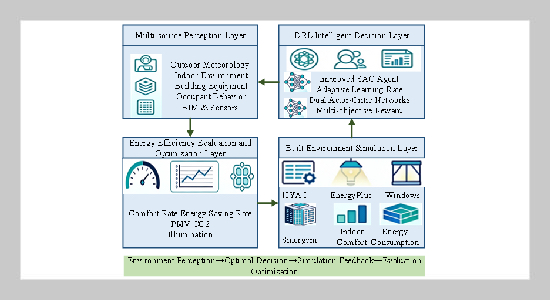
Proposed DRL-based intelligent built environment design and energy efficiency evaluation framework
Copyright The Author(s). This is an open access article distributed under the terms of the Creative Commons Attribution License (CC BY 4.0), which permits unrestricted use, distribution, and reproduction in any medium, provided the original author and source are cited.
Download Citation: BibTeX | http://dx.doi.org/10.6180/jase.202610_33.051
Built environment design and energy efficiency optimization face inherent challenges of high-dimensional nonlinear coupling, dynamic environmental disturbances, and conflicting objectives between occupant comfort and building energy consumption. Traditional model-driven design and energy evaluation methods rely on simplified physical models and static parameter calibration, which fail to adapt to real-time fluctuations of indoor and outdoor environmental parameters, resulting in suboptimal design schemes and low energy utilization efficiency. To address these gaps, this paper proposes a novel intelligent environmental design and energy efficiency evaluation framework based on improved deep reinforcement learning (DRL), aiming to realize autonomous optimal decision-making for built environment design and dynamic quantitative evaluation of energy efficiency. A multi-objective composite reward function integrating thermal comfort, air quality, visual environment, and building energy consumption is constructed to solve the multi-constraint optimization problem of built environments. Meanwhile, a dual-network improved Soft Actor-Critic algorithm with adaptive learning rate adjustment is designed to enhance the environmental exploration ability and policy convergence stability of the agent, overcoming the defects of traditional DRL algorithms such as slow convergence and easy local optimum in complex building scenarios. Combined with building information modeling and multi sensor perception technology, a full-process closed-loop framework of environment perception, intelligent design decision-making, energy efficiency evaluation, and scheme optimization is established. Comparative experiments based on the Sinergym building energy simulation platform and actual building measurement data show that the proposed method reduces building comprehensive energy consumption by18.7%-24.3%compared with traditional model predictive control and static design methods, while improving indoor environmental
comfort compliance rate by 15.2%. The proposed DRL framework exhibits strong robustness and generalization ability under variable climate conditions and occupant behavior disturbances, which provides an efficient and intelligent technical solution for optimal design and precise energy efficiency evaluation of modern green built environments.
Keywords: Deep Reinforcement Learning; Built Environment; Intelligent Environmental Design; Energy Efficiency Evaluation; Multi-objective Optimization; Building Energy Conservation
- [1] R. Komurlu, D. Kalkan Ceceloglu, and D. Arditi, (2024) “Exploring the barriers to managing green building construction projects and proposed solutions” Sustainability 16(13): 5374. DOI: 10.3390/su16135374.
- [2] L. Chen, Y. Hu, R. Wang, X. Li, Z. Chen, J. Hua, A. I. Osman, M. Farghali, L. Huang, J. Li, et al., (2024) “Green building practices to integrate renewable energy in the construction sector: a review” Environmental Chemistry Letters 22(2): 751–784. DOI: 10.1007/s10311-023-01675-2.
- [3] E. Attaianese, M. Barilà, and M. Perillo, (2025) “Exploring Neuroscientific Approaches to Architecture: Design Strategies of the Built Environment for Improving Human Performance” Buildings 15(19): 3524. DOI: 10.3390/buildings15193524.
- [4] H. Li, P. Gao, X. Chen, H. Guo, and D. Yang, (2025) “Rare event probability evaluation for static and dynamic structures based on direct probability integral method” Computers & Structures 310: 107704. DOI: 10.1016/j.compstruc.2025.107704.
- [5] S. Yin, L. Wang, M. Shafiq, L. Teng, A. A. Laghari, and M. F. Khan, (2023) “G2Grad-CAMRL: An object detection and interpretation model based on gradient-weighted class activation mapping and reinforcement learning in remote sensing images” IEEE Journal of Selected Topics in Applied Earth Observations and Remote Sensing 16: 3583–3598. DOI: 10.1109/JSTARS.2023.3241405.
- [6] S. Yin, L. Wang, A. A. Laghari, L. Teng, G. Srivastava, A. Almadhor, and T. R. Gadekallu, (2026) “FGM-MLSD: A Fuzzy Region Competition and Gaussian Mixture Segment Model Via Modified Line Segment Detector Model for Airport Object Saliency Detection in Remote Sensing Images” IEEE Transactions on Fuzzy Systems 34(4): 1175–118. DOI: 10.1109/TFUZZ.2026.3650858.
- [7] J. Wang, M. Jung, S. Yin, and H. Li, (2025) “Adaptive Multi-Scale Gated Convolution and Context-Aware Attention Network for Accurate Small Object Detection [J]” International Journal of Computational Methods and Experimental Measurements 13(3): 576–587. DOI: 10.56578/ijcmem130308.
- [8] T. Daixin, X. Hongwei, Y. Huijuan, Y. Hao, and H. Wen, (2022) “Optimization of group control strategy and analysis of energy saving in refrigeration plant” Energy and Built Environment 3(4): 525–535. DOI: 10.1016/j.enbenv.2021.05.006.
- [9] C.-F. Chien, J.-T. Peng, and H.-C. Yu, (2016) “Building energy saving performance indices for cleaner semiconductor manufacturing and an empirical study” Computers & Industrial Engineering 99: 448–457. DOI: 10.1016/j.cie.2015.11.004.
- [10] E. Zerdali, M. Rivera, and P. Wheeler, (2024) “A review on weighting factor design of finite control set model predictive control strategies for ac electric drives” IEEE Transactions on Power Electronics 39(8): 9967–9981. DOI: 10.1109/TPEL.2024.3370550.
- [11] A. Khlifi, M. Othmani, and M. Kherallah, (2025) “A novel approach to autonomous driving using double deep q-network-bsed deep reinforcement learning” World Electric Vehicle Journal 16(3): 138. DOI: 10.3390/wevj16030138.
- [12] Z. Wang, S. Song, and S. Cheng, (2025) “Path planning of mobile robot based on improved double deep Q-network algorithm” Frontiers in Neurorobotics 19: 1512953. DOI: 10.3389/fnbot.2025.1512953.
- [13] M. Marwan, A. Ait Temghart, and M. Lazaar, (2026) “A game-theoretic analysis of cybersecurity, performance, and pricing for resource sharing in federated cloud data centers” Cluster Computing 29(5): 318. DOI: 10.1007/s10586-026-06215-5.
- [14] S. Zhang and Z. Lin, (2020) “Extending predicted mean vote using adaptive approach” Building and Environment 171: 106665. DOI: 10.1016/j.buildenv.2020.106665.
- [15] S. Zhang, Y. Cheng, Z. Fang, and Z. Lin, (2019) “Improved algorithm for adaptive coefficient of adaptive Predicted Mean Vote (aPMV)” Building and Environment 163: 106318. DOI: 10.1016/j.buildenv.2019.106318.
- [16] C. Wu, X. Zhang, Y. Li, Z. Chen, and Z. Zhang, (2025) “Cross-Building Energy Consumption Forecasting with Deep Transfer Learning” Journal of Building Engineering: 114695. DOI: 10.1016/j.jobe.2025.114695.