




Public Teaching Department, Cangzhou Preschool Teachers College, Cangzhou City, Hebei Province, 061000, China
Received: January 25, 2026
Accepted: June 4, 2026
Publication Date: July 18, 2026
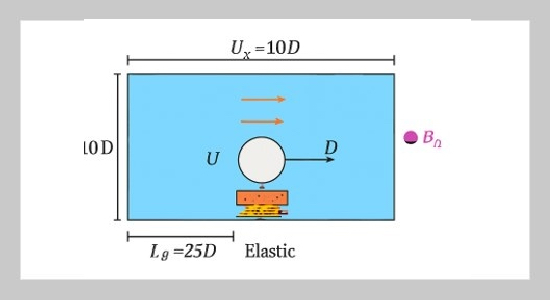
Schematic of the computational domain, boundary conditions, and coordinate system
Copyright The Author(s). This is an open access article distributed under the terms of the Creative Commons Attribution License (CC BY 4.0), which permits unrestricted use, distribution, and reproduction in any medium, provided the original author and source are cited.
Download Citation: BibTeX | http://dx.doi.org/10.6180/jase.202610_33.046
This study numerically investigates magnetic suppression of two-degree-of-freedom vortex-induced vibrations of an elastically mounted circular cylinder in laminar cross-flow. The imposed field is axial with respect to the cylinder axis and is modeled through a Lorentz-force source term under the low magnetic Reynolds number approximation. Unlike previous studies that mainly established the general damping effect of electro magnetic forcing on vortex shedding, the present work focuses on how the same axial MHD control parameter modifies the coupled wake–structure dynamics in different VIV regimes. Simulations are performed at Re=150 for reduced velocities spanning the pre-lock-in, peak lock-in, and lower-branch regimes, while the Stuart number is varied to quantify the strength of electromagnetic forcing. The results show that the suppression mechanism is regime-dependent. At low reduced velocity, the magnetic field attenuates the response while shifting the dominant vibration frequency, indicating partial detuning. Near peak lock-in, the dominant frequency remains nearly unchanged, while the vibration amplitude and coherent vortex shedding are strongly reduced, indicating wake-damping-dominated suppression. In the lower branch, effective attenuation occurs at lower Stuart numbers, accompanied by a modified spectral response. These findings provide a regime resolved interpretation of axial-field MHD control of 2DOF-VIV and identify the Stuart-number thresholds required for effective vibration attenuation in conducting-fluid applications. The findings provide mechanistic insight into axial-field MHD suppression of 2DOF-VIV in the laminar, quasi-static MHD regime; however, direct extension to high-Reynolds-number industrial flows or highly conducting liquid-metal systems requires three-dimensional modeling, fully coupled electromagnetic effects when Rm is not small, and experimental validation.
Keywords: Vortex-induced vibration; Magnetohydrodynamics; Circular cylinder; Cross-flow; Axial magnetic field; Vibration suppression; Stuart number.
- [1] M. Nasrabadi, A. V. Sevbitov, V. A. Maleki, N. Akbar, and I. Javanshir, (2022) “Passive fluid-induced vibration control of viscoelastic cylinder using nonlinear energy sink” Marine Structures 81: 103116. DOI: 10.1016/j.marstruc.2021.103116.
- [2] M. Fallah and V. A. Maleki, (2021) “Piezoelectric energy harvesting using a porous beam under fluid-induced vibrations” Amirkabir Journal of Mechanical Engineering 53: 4633–4648. DOI: 10.22060/mej.2021.18200.6780.
- [3] M. Rezaee and V. A. Maleki, (2024) “On the complex mode shapes and natural frequencies of clamped-clamped fluid-conveying pipe” Applied Ocean Research 150: 104113. DOI: 10.1016/j.apor.2024.104113.
- [4] M. Hoseinzadeh, R. Pilafkan, and V. A. Maleki, (2023) “Size-dependent linear and nonlinear vibration of functionally graded CNT reinforced imperfect microplates submerged in fluid medium” Ocean Engineering 268: 113257. DOI: 10.1016/j.oceaneng.2022.113257.
- [5] M. Rezaee, R. Fathi, and V. A. Maleki, (2025) “Dynamic analysis and uncertainty modeling of viscoelastic beam response to fluid stimulation: insights into nonlin-ear effects and velocity uncertainties” Applied Ocean Research 157: 104487. DOI: 10.1016/j.apor.2025.104487.
- [6] L. Ziyodulloyeva, K. R. Tulkinovich, Z. Shavkat, D. Normat, and K. S. Prakash, (2025) “Coupled Acoustic–Optical Wave Propagation Theory for RIS-Enabled Underwater Networks” National Journal of Antennas and Propagation 7: 148–157. DOI: 10.31838/NJAP/07.03.19.
- [7] M. Rezaee, V. A. Maleki, and R. Fathi, (2026) “Stability and Vibration Analysis of Viscoelastic Fluid-Conveying Pipes under Uncertain Fluctuating Flow Velocity” Results in Engineering: 110437. DOI: 10.1016/j.rineng.2026.110437.
- [8] W.-h. Xu and Y.-x. Ma, (2024) “A review on vibration control of multiple cylinders subjected to flow-induced vibrations” China Ocean Engineering 38: 183–197. DOI: 10.1007/s13344-024-0016-z.
- [9] S. F. Amirov, A. K. Sulliev, A. A. Shoimkulov, and E. Abdullaev, (2025) “Inductive transducers for measuring vibrations” Vibroengineering Procedia 60: 444–449. DOI: 10.21595/vp.2025.25681?urlappend=%3Futm_source%3Dresearchgate.net%26utm_medium%3Darticle.
- [10] H. Tian, (2023) “Size-dependent dynamic behavior of axially moving graphene nanosheets using nonlocal first-order shear deformation theory” Advances in Engineering and Intelligence Systems 2: 41–50. DOI: 10.22034/aeis.2023.385639.1080.
- [11] H. Jiang, X. Ju, M. Zhao, T. Zhou, S. Draper, H. An, P. Watson, Z. Lei, and L. Wang, (2024) “Large-eddy simulation of vortex-induced vibration of a circular cylinder at Reynolds number 10 000” Physics of Fluids 36: DOI: 10.1063/5.0219933.
- [12] J. Zokirov, D. Kholmurodova, S. Asilova, M. Abdullayeva, G. Aziza, R. Khakimov, S. Yusufov, and F. Jumaniyazov, (2025) “A Novel Approach to Optimized Frequency Load Shedding in Microgrids with Wind Power Integration using ANFIS Networks” Journal of Operation and Automation in Power Engineering 13: 89–100. DOI: 10.22098/joape.2025.18921.2472.
- [13] Y.-F. Mei, C. Zheng, N. Aubry, M.-G. Li, W.-T. Wu, and X. Liu, (2021) “Active control for enhancing vortex induced vibration of a circular cylinder based on deep reinforcement learning” Physics of Fluids 33: DOI: 10.1063/5.0063988.
- [14] T. Salahuddin, M. Awais, M. Khan, and A. Sottarov, (2025) “Numerical analysis of entropy optimization and viscous nanofluid over a nonlinear parabolic stretching surface” International Journal of Thermofluids: 101400. DOI: 10.1016/j.ijft.2025.101400.
- [15] L. Xingxing, (2024) “Distribution generation network arrangement by capacitor placement and sizing in renewable energy sources with uncertainties based on self-adaption Kho-Kho optimizer” Journal of Artificial Intelligence and System Modelling 2: 50–67. DOI: 10.22034/jaism.2024.472210.1050.
- [16] W.-L. Chen, Y. Huang, C. Chen, H. Yu, and D. Gao, (2022) “Review of active control of circular cylinder flow” Ocean Engineering 258: 111840. DOI: 10.1016/j.oceaneng.2022.111840.
- [17] E. Kholiyarov and M. Ernazarov. “Determination of Relaxation and Flow Coefficients During Filtration of a Homogeneous Liquid in Fractured-Porous Media”. In: International Conference on Actual Problems of Applied Mathematics and Computer Science. Springer, 2022, 54–67. DOI: 10.1007/978-3-031-34127-4_6.
- [18] P. Mohtat and A. Ekmekci, (2024) “The effect of end conditions on the body motion and near-wake flow structure of a circular cylinder under vortex-induced vibration” Journal of Fluid Mechanics 997: A22. DOI: 10.1017/jfm.2024.747.
- [19] K. Sudarmozhi, A. B. M. Ali, R. Raghavendran, K. Kurbonov, G. Kaur, M. Ismoilov, and M. I. Khan, (2026) “Exploring Maxwell Fluid Behavior: A Systematic Review of Methods, Geometries, and Applications” South African Journal of Chemical Engineering: 100884. DOI: 10.1016/j.sajce.2026.100884.
- [20] M. Rezaee, N. Sharafkhani, and M. T. S. Tabar, (2018) “Dynamic behavior of a micro-beam subjected to voltage and fluid flow as a micro vortex generator” Amirkabir Journal of Mechanical Engineering 52: 2231–2242. DOI: 10.22060/mej.2018.14469.5881.
- [21] W. Tian, C. Zhang, Z. Mao, B. Li, T. Zhang, and B. Song, (2024) “Numerical investigation on the suppression of vortex-induced vibration system by assembling different rotors based on quasi-active control method” Ocean Engineering 311: 119015. DOI: 10.1016/j.oceaneng.2024.119015.
- [22] E. Taheri, M. Zhao, and H. Wu, (2023) “The enhancement of flow induced vibration of a circular cylinder using a rotating control rod” Physics of Fluids 35: DOI: 10.1063/5.0146552.
- [23] Q. Guo, L. Gao, S. Cao, and H. Jiang, (2025) “Closed-loop control for suppressing the vortex-induced vibration of a pipeline by the eigensystem realization algorithm” Physics of Fluids 37: DOI: 10.1063/5.0255183.
- [24] M. Esmaeili, H. F. Vayqan, and A. H. Rabiee, (2025) “Impact of temperature-induced buoyancy on the 2DOF-VIV of a heated/cooled cylinder” Arabian Journal for Science and Engineering 50: 2807–2822. DOI: 10.1007/s13369-024-09262-5.
- [25] C. Wang, H. Tang, S. Yu, and F. Duan, (2016) “Active control of vortex-induced vibrations of a circular cylinder using windward-suction-leeward-blowing actuation” Physics of Fluids 28: DOI: 10.1063/1.4947246.
- [26] S. Iqbal, U. Riaz, S. Islam, K. Kurbonov, M. I. Khan, and N. B. Khedher, (2025) “Analysis of Hilfer type coupled implicit ( , )-order differential equations with Riemann–Liouville fractional integrable conditions via Topological degree method” Results in Control and Optimization: 100613. DOI: 10.1016/j.rico.2025.100613.
- [27] I. Korkischko and J. R. Meneghini, (2012) “Suppression of vortex-induced vibration using moving surface boundary-layer control” Journal of Fluids and Structures 34: 259–270. DOI: 10.1016/j.jfluidstructs.2012.05.010.
- [28] B. Zhang, T. Long, W. Wang, R. Shi, and N. Ye, (2023) “Vortex-Induced vibration suppression for a cylinder with random grooves inspired by rough tree bark” Physics of Fluids 35: DOI: 10.1063/5.0152120.
- [29] M. Esmaeili and A. H. Rabiee, (2021) “Active feedback VIV control of sprung circular cylinder using TDE-iPID control strategy at moderate Reynolds numbers” International Journal of Mechanical Sciences 202: 106515. DOI: 10.1016/j.ijmecsci.2021.106515.
- [30] G. Artana, R. Sosa, E. Moreau, and G. Touchard, (2003) “Control of the near-wake flow around a circular cylinder with electrohydrodynamic actuators” Experiments in Fluids 35: 580–588. DOI: 10.1007/s00348-003-0704-z.
- [31] A. Rafiei-Siahestalkhi, N. Amanifard, H. M. Deylami, and F. Dolati, (2022) “Numerical investigation of electrohydrodynamic forced convection heat transfer from a circular cylinder” Heat Transfer Engineering 43: 638–654. DOI: 10.1080/01457632.2021.1896837.
- [32] H. Pang, Y. You, and K. Chen, (2024) “Numerical study on the electromagnetic force control of the flow based on an advanced parallel adaptive technology” Ships and Offshore Structures 19: 1134–1145. DOI: 10.1080/17445302.2023.2228632.
- [33] R. Pilafkan and V. A. Maleki, (2026) “A Unified Three-Dimensional Meshless Analysis of Vibration and Thermal Buckling of Variable-Thickness Cylindrical Shells” Results in Engineering: 109384. DOI: 10.1016/j.rineng.2026.109384.
- [34] J. H. Lee, J. H. Son, and I. S. Park, (2020) “Magnetohydrodynamics around a cylindrical wire carrying electric currents” Journal of Mechanical Science and Technology 34: 1567–1579. DOI: 10.1007/s12206-020-0319-9.
- [35] Y. Amini, S. Akhavan, and E. Izadpanah, (2020) “Vortex-induced vibration of a cylinder in pulsating nanofluid flow: Y. Amini et al.” Journal of Thermal Analysis and Calorimetry 140: 2143–2158. DOI: 10.1007/s10973-019-08980-5.