



Mingrui Wang1, Zeyu Ping1, and Xin Li1,2
1Kaifeng University, Kaifeng 475004, China
2Kaifeng Fermented Food Engineering Technology Research Center, Kaifeng 475004, China
Received: January 26, 2026
Accepted: June 10, 2026
Publication Date: July 10, 2026
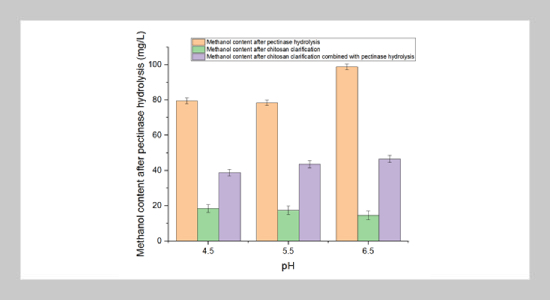
Methanol content before and after clarification of honeydew juice with chitosan
Copyright The Author(s). This is an open access article distributed under the terms of the Creative Commons Attribution License (CC BY 4.0), which permits unrestricted use, distribution, and reproduction in any medium, provided the original author and source are cited.
Download Citation: BibTeX | http://dx.doi.org/10.6180/jase.202610_33.042
Objective: In the process of clarifying Honeydew juice with chitosan, the change of methanol content in Honeydew juice was mainly investigated. Methods: The effects of chitosan addition amount, initial pH value of clarification, clarification time and clarification temperature on the clarification effect and methanol production of Honeydew juice were investigated by single factor and orthogonal test with the light transmittance and methanol production as indicators. Results: The order of influencing factors on methanol production of honeydew juice after clarification was as follows: initial pH>temperature>chitosan addition>clarification time. The minimum amount of methanol production of Honeydew juice and the best clarification conditions were 0.04 g/100 mL chitosan addition, pH=5.5, temperature 35°C, clarification for 30 minutes. Under this process condition, the methanol content is 28.6 mg/L, and the light transmittance can reach 96.35%. Conclusion: Chitosan can significantly reduce the methanol content in Honeydew juice.
Keywords: Chitosan, Pectinase; Clarification; Methanol content
- [1] M. of Health of the People’s Republic of China. National Food Safety Standard-Distilled Wines and Mixed Wines: GB 2757—2012. Beijing, 2013.
- [2] X. D. Wang. “Study on the brewing technology of low-methanol fermented persimmon wine”. (phdthesis). Xianyang, China: Northwest AF University, 2017.
- [3] H. R. Holegar, G. J. Suresha, A. K. Vandana, and S. L. Jagadeesh, (2016) “Influence of Pectinase Enzymatic Maceration on quality of Jamun (Syzygium cumini L.) wine” International Journal Advance Research 4(11): 976–981. DOI: 10.21474/ijar01/2171.
- [4] S. X. Dai, (2017) “Study on the clarification effect of chitosan on Xinli No. 7 pear juice” Food Research and Development 38(2): 157–159, 195. DOI: 10.3969/j.issn.1005-6521.2017.02.032.
- [5] S. Huang, W. H. Zhou, Y. H. Lu, Y. H. Bi, C. Y. Wang, Q. Y. Bai, W. Q. Yin, and Y. Q. Zhong, (2020) “Optimization of ultrasound-assisted attapulgite-chitosan clarification process for ginger juice by response surface methodology” Science and Technology of Food Industry 41(2): 140–145. DOI: 10.13386/j.issn1002-0306.2019070307.
- [6] S. S. Vaghani, M. M. Patel, and C. S. Satish, (2012) “Synthesis and characterization of pH-sensitive hydrogel composed of carboxymethyl chitosan for colon targeted delivery of ornidazole” Carbohydrate Research 347(1): 76–82. DOI: 10.1016/j.carres.2011.11.015.
- [7] O. Gyliene, R. Rekertas, and M. Šalkauskas, (2002) “Removal of free and complexed heavy-metal ions by sorbents produced from fly (Musca domestica) larva shells” Water Research 36(16): 4128–4136. DOI: 10.1016/S0043-1354(02)00125-2.
- [8] W. C. Lee, S. A. L. M. A. H. Yusof, N. S. A. Hamid, and B. S. Baharin, (2006) “Optimizing conditions for enzymatic clarification of banana juice using response surface methodology (RSM)” Journal of Food Engineering 73(1): 55–63. DOI: 10.1016/j.jfoodeng.2005.01.012.
- [9] H. N. Sin, S. Yusof, N. S. A. Hamid, and R. A. Rahman, (2006) “Optimization of enzymatic clarification of sapodilla juice using response surface methodology” Journal of Food Engineering 73(4): 313–319. DOI: 10.1016/j.jfoodeng.2005.01.013.
- [10] A. Wu, J. Lv, C. Ju, Y. Wang, Y. Zhu, and J. Chen, (2022) “Optimized clarification Technology of Bayberry Juice by chitosan/sodium alginate and changes in quality characteristics during clarification” Foods 11(5): 671. DOI: 10.3390/foods11050671.
- [11] R. Yavaşer and A. A. Karagözler, (2020) “Covalent immobilization of papain onto poly (hydroxyethyl methacrylate)-chitosan cryogels for apple juice clarification” Food Science and Technology International 26(7): 629–641. DOI: 10.1177/1082013220976098.
- [12] S. Matsuhashi and T. Kume, (1997) “Enhancement of antimicrobial activity of chitosan by irradiation” Journal of the Science of Food and Agriculture 73(2): 237–241. DOI: 10.1002/(SICI)1097-0010(199706)73:2<237::AID-JSFA730>3.0.CO;2-2.
- [13] R. C. C. Domingues, S. B. F. Junior, R. B. Silva, V. L. Cardoso, and M. H. M. Reis, (2012) “Clarification of passion fruit juice with chitosan: Effects of coagulation process variables and comparison with centrifugation and enzymatic treatments” Process Biochemistry 47(3): 467–471. DOI: 10.1016/S0032-9592(11)00298-5.
- [14] I. G. Sandri, R. C. Fontana, D. M. Barfknecht, and M. M. da Silveira, (2011) “Clarification of fruit juices by fungal pectinases” LWT-Food Science and Technology 44(10): 2217–2222. DOI: 10.1016/j.lwt.2011.04.013.
- [15] W. X. Yao. “Study on the control of methanol production in pear wine produced by solid-state fermentation”. (mathesis). Shandong Agricultural University, 2016.
- [16] Y. Shi. “Study on optimization of production technology for low-methanol purple sweet potato wine”. (mathesis). Hunan Agricultural University, 2013.
- [17] Y. Han and J. Du, (2022) “Relationship of the methanol production, pectin and pectinase activity during apple wine fermentation and aging” Food Research International 159: 111645. DOI: 10.1016/j.foodres.2022.111645.
- [18] T. Lee and Y. H. Chang, (2020) “Structural, physico-chemical, and in-vitro release properties of hydrogel beads produced by oligochitosan and de-esterified pectin from yuzu (Citrus junos) peel as a quercetin delivery system for colon target” Food Hydrocolloids 108: 106086. DOI: 10.1016/j.foodhyd.2020.106086.