


Shuo Tian, Hongmei Li, and Yufei Chen
Department of Economics, Qinhuangdao Vocational and Technical College, Qinhuangdao Hebei, 066000
Received: March 27, 2026
Accepted: May 27, 2026
Publication Date: July 12, 2026
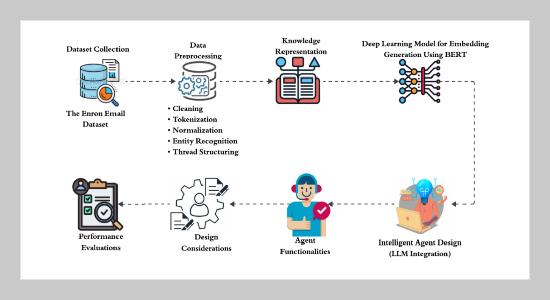
Architectural of Proposed Framework of the Intelligent Agent
Copyright The Author(s). This is an open access article distributed under the terms of the Creative Commons Attribution License (CC BY 4.0), which permits unrestricted use, distribution, and reproduction in any medium, provided the original author and source are cited.
Download Citation: BibTeX | http://dx.doi.org/10.6180/jase.202610_33.039
This paper presents an intelligent agent for enterprise knowledge management, combining Large Language Models (LLMs), retrieval-augmented generation (RAG), and semantic embeddings to address challenges in unstructured communication data. The system integrates preprocessing, embedding generation, retrieval, summarization, question answering, and recommendations using the Enron Email Dataset. Evaluation results show high BERTScore (0.9275) for summarization with good semantic coherence despite low lexical similarity (low ROUGEscores). Retrieval performance includes Precision @k = 0.65, Recall @k = 0.9286, and nDCG@k =0.9544, with strong contextual relevance. The model also demonstrates robust hallucination mitigation, with low hallucination rates (0.10) and high factual consistency. Scalability tests show a mean latency of 1.96 seconds and memory usage of 7.55 GB. Overall, the agent proves to be an effective solution for reducing information overload, enhancing decision-making, and preserving organizational memory
Keywords: Enterprise Knowledge Management, Retrieval-Augmented Generation (RAG), Semantic Embeddings, Summarization, Hallucination Mitigation
- [1] A. Veglis, T. Saridou, K. Panagiotidis, C. Karypidou, and E. Kotenidis, (2022) “Applications of Big Data in Media Organizations” Social Sciences 11(9): 414. DOI: 10.3390/socsci11090414.
- [2] F. Alfawaire and T. Atan, (2021) “The Effect of Strategic Human Resource and Knowledge Management on Sustainable Competitive Advantages at Jordanian Universities: The Mediating Role of Organizational Innovation” Sustainability 13(15): 8445. DOI: 10.3390/su13158445.
- [3] E. Autio, R. Mudambi, and Y. Yoo, (2021) “Digitalization and Globalization in a Turbulent World: Centrifugal and Centripetal Forces” Global Strategy Journal 11(1): 3–16. DOI: 10.1002/gsj.1396.
- [4] M. Aslam et al., (2022) “Getting Smarter about Smart Cities: Improving Data Security and Privacy through Compliance” Sensors 22(23): 9338. DOI: 10.3390/s22239338.
- [5] G. Zhang, C. Lu, and Q. Luo, (2025) “Application of Large Language Models in the AECO Industry” Buildings 15(11): 1944. DOI: 10.3390/buildings15111944.
- [6] H. Li, R. Yang, S. Xu, Y. Xiao, and H. Zhao, (2024) “Intelligent Checking Method for Construction Schemes via Fusion of Knowledge Graph and Large Language Models” Buildings 14(8): 2502. DOI: 10.3390/buildings14082502.
- [7] H. R. Kirk, B. Vidgen, P. Röttger, and S. A. Hale, (2024) “The Benefits, Risks and Bounds of Personalizing the Alignment of Large Language Models to Individuals” Nature Machine Intelligence 6(4): 383–392. DOI: 10.1038/s42256-024-00820-y.
- [8] J. Chen, Z. Liu, X. Huang, C. Wu, Q. Liu, G. Jiang, Y. Pu, Y. Lei, X. Chen, X. Wang, and K. Zheng, (2024) “When large language models meet personalization: Perspectives of challenges and opportunities” World Wide Web 27(4): 42. DOI: 10.1007/s11280-024-01276-1.
- [9] S. Ross, F. Martinez, S. Houde, M. Muller, and J. Weisz. “The programmer’s assistant: Conversational interaction with a large language model for software development”. In: Proceedings of the 28th International Conference on Intelligent User Interfaces. 2023, 491–514. DOI: 10.1145/3581641.3584037.
- [10] J. Mökander, J. Schuett, H. Kirk, and L. Floridi, (2024) “Auditing large language models: a three-layered approach” AI and Ethics 4(4): 1085–1115. DOI: 10.1007/s43681-023-00289-2.
- [11] A. Kasirzadeh and I. Gabriel, (2023) “In conversation with artificial intelligence: aligning language models with human values” Philosophy & Technology 36(2): 27. DOI: 10.1007/s13347-023-00606-x.
- [12] D. Anisuzzaman, J. Malins, P. Friedman, and Z. Attia, (2025) “Fine-tuning large language models for specialized use cases” Mayo Clinic Proceedings: Digital Health 3(1): 100184. DOI: 10.1016/j.mcpdig.2024.11.005.
- [13] Y. Zhang and Y. Hao, (2024) “Traditional Chinese medicine knowledge graph construction based on large language models” Electronics 13(7): 1395. DOI: 10.3390/electronics13071395.
- [14] D. Guo, H. Chen, R. Wu, and Y. Wang, (2023) “AIGC challenges and opportunities related to public safety: A case study of ChatGPT” Journal of Safety Science and Resilience 4(4): 329–339. DOI: 10.1016/j.jnlssr.2023.08.001.