




Jinsheng Wang1,2,3, Bo Liao1,3, Fangxiang Wu4, Zhihao Jiang5,6, and Fei Tian7
1School of Mathematics and Statistics, Hainan Normal University, Hainan Haikou 571158, China
2Scientific Computing and Applied Mathematics Laboratory, Haikou University of Economics, Hainan Haikou 571127, China
3Key Laboratory of Data Science and Intelligence Education, Hainan Normal University, Ministry of Education, Hainan Haikou
571158, China
4Division of Biomedical Engineering and Department of Mechanical Engineering, University of Saskatchewan, Saskatoon
SKS7N5A9, Canada
5Public Teaching Department, Hainan Vocational University of Science and Technology, Hainan Haikou 571126, China
6Faculty of Computer Science and Information Technology, University Putra Malaysia, Malaysia
7School of Financial Management, Hainan College of Econmics and Business, Hainan Haikou 571127, China
Received: January 1, 2026
Accepted: April 19, 2026
Publication Date: July 3, 2026
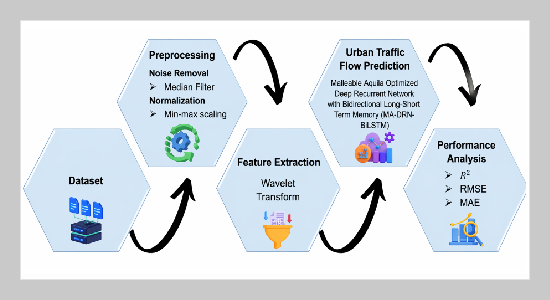
Overall flow of MA-DRN-BiLSTM approach
Copyright The Author(s). This is an open access article distributed under the terms of the Creative Commons Attribution License (CC BY 4.0), which permits unrestricted use, distribution, and reproduction in any medium, provided the original author and source are cited.
Download Citation: BibTeX | http://dx.doi.org/10.6180/jase.202610_33.031
Traffic flow (TF) forecasting plays a crucial role in modern urban transportation systems by enabling congestion mitigation and efficient traffic management. With the rapid growth of intelligent transportation systems, robust prediction models are required to process large-scale traffic data in real time. This study presents an enhanced urban traffic forecasting model based on Deep Recurrent Networks (DRN) integrated with Bidirectional Long
ShortTerm Memory (BiLSTM) networks to effectively capture temporal dependencies and spatial correlations in traffic data. Traffic datasets collected from sensors at major intersections include vehicle counts, speed, and congestion information across peak and off-peak periods. Noise reduction is performed using median filtering, followed by Min-Max normalization. Wavelet transform-based feature extraction captures multi-resolution traffic patterns. The proposed Malleable Aquila Optimized DRN-BiLSTM model achieves superior performance, attaining an R2 of 0.97 , RMSE of 12.14, and MAE of 10.04, demonstrating its effectiveness for shortterm urban traffic forecasting and planning.
Keywords: Urban Traffic Flow, Intelligent Transportation Systems, Malleable Aquila Optimized-DRN with BiLSTM, Traffic Management, Predictive Model
- [1] W. Shu, K. Cai, and N. N. Xiong, (2021) “A short-term traffic flow prediction model based on an improved gated recurrent unit neural network” IEEE Transactions on Intelligent Transportation Systems 23(9): 16654–16665. DOI: 10.1109/TITS.2021.3094659.
- [2] K. Meduri, G. S. Nadella, H. Gonaygunta, and S. S. Meduri, (2023) “Developing a fog computing–based AI framework for real-time traffic management and optimization” International Journal of Sustainable Development in Computer Science 5(4): 1–24.
- [3] A. Boukerche, Y. Tao, and P. Sun, (2020) “Artificial intelligence-based vehicular traffic flow prediction methods for supporting intelligent transportation systems” Computer Networks 182: 107484. DOI: 10.1016/j.comnet.2020.107484.
- [4] J. Culita, S. I. Caramihai, I. Dumitrache, M. A. Moisescu, and I. S. Sacala, (2020) “A hybrid approach for urban traffic prediction and control in smart cities” Sensors 20(24): 7209. DOI: 10.3390/s20247209.
- [5] S. Shafiei, A. S. Mihaita, H. Nguyen, C. Bentley, and C. Cai, (2020) “Short-term traffic prediction under non-recurrent incident conditions integrating data-driven models and traffic simulation” Proceedings of the Transportation Research Board Annual Meeting: 1–10.
- [6] A. Almeida, S. Brás, I. Oliveira, and S. Sargento, (2022) “Vehicular traffic flow prediction using deployed traffic counters in a city” Future Generation Computer Systems 128: 429–442. DOI: 10.1016/j.future.2021.10.022.
- [7] H. Ulvi, M. A. Yerlikaya, and K. Yildiz, (2024) “Urban traffic mobility optimization model: A novel mathematical approach for predictive urban traffic analysis” Applied Sciences 14(13): 5873. DOI: 10.3390/app14135873.
- [8] M. Sreelekha and M. Midhunchakkaravarthy, (2024) “Intelligent transportation system for sustainable and efficient urban mobility: Machine learning approach for traffic flow prediction” Lecture Notes in Computer Science: 399–412. DOI: 10.1007/978-981-97-1488-9_30.
- [9] S. Lu, Q. Zhang, G. Chen, and D. Seng, (2021) “A combined method for short-term traffic flow prediction based on recurrent neural networks” Alexandria Engineering Journal 60(1): 87–94. DOI: 10.1016/j.aej.2020.06.008.
- [10] A. M. Nagy and V. Simon, (2021) “Improving traffic prediction using congestion propagation patterns in smart cities” Advanced Engineering Informatics 50: 101343. DOI: 10.1016/j.aei.2021.101343.
- [11] D. Liu and J. Liu, (2019) “Intelligent planning of rain water drainage system in new urban areas considering the planning of road network” Journal of Applied Science and Engineering 22(2): 315–328. DOI: 10.6180/jase.201906_22(2).0013.
- [12] X. Yuan, J. Chen, and J. e. a. Yang, (2022) “FedSTN: Graph representation–driven federated learning for edge computing–enabled urban traffic flow prediction” IEEE Transactions on Intelligent Transportation Systems 24(8): 8738–8748. DOI: 10.1109/TITS.2022.3157056.
- [13] C. Tang, J. Sun, Y. Sun, M. Peng, and N. Gan, (2020) “A general traffic flow prediction approach based on spatiotemporal graph attention” IEEE Access 8: 153731–153741. DOI: 10.1109/ACCESS.2020.3018452.
- [14] C. Chen, Y. Liu, L. Chen, and C. Zhang, (2022) “Bidirectional spatiotemporal adaptive transformer for urban traffic flow forecasting” IEEE Transactions on Neural Networks and Learning Systems 34(10): 6913–6925. DOI: 10.1109/TNNLS.2022.3183903.
- [15] A. Navarro-Espinoza, O. R. López-Bonilla, and E. E. a. García-Guerrero, (2022) “Traffic flow prediction for smart traffic lights using machine learning algorithms” Technologies 10(1): 5. DOI: 10.3390/technologies10010005.
- [16] C. Chen, Z. Liu, S. Wan, J. Luan, and Q. Pei, (2020) “Traffic flow prediction based on deep learning in internet of vehicles” IEEE Transactions on Intelligent Transportation Systems 22(6): 3776–3789. DOI: 10.1109/TITS.2020.3025856.
- [17] K. Wang, C. Ma, and Y. e. a. Qiao, (2021) “A hybrid deep learning model with 1D CNN–LSTM–attention networks for short-term traffic flow prediction” Physica A 583: 126293. DOI: 10.1016/j.physa.2021.126293.
- [18] H. Peng, H. Wang, and B. e. a. Du, (2020) “Spatiotemporal incidence dynamic graph neural networks for traffic flow forecasting” Information Sciences 521: 277–290. DOI: 10.1016/j.ins.2020.01.043.
- [19] B. Vijayalakshmi, K. Ramar, and N. Z. e. a. Jhanjhi, (2021) “An attention-based deep learning model for traffic flow prediction using spatiotemporal features toward sustainable smart cities” International Journal of Communication Systems 34(3): e4609. DOI: 10.1002/dac.4609.
- [20] H. Qiu, Q. Zheng, M. Msahli, G. Memmi, M. Qiu, and J. Lu, (2020) “Topological graph convolutional network–based urban traffic flow and density prediction” IEEE Transactions on Intelligent Transportation Systems 22(7): 4560–4569. DOI: 10.1109/TITS.2020.3032882.
- [21] S. Du, T. Li, X. Gong, and S. J. Horng, (2020) “A hybrid method for traffic flow forecasting using multimodal deep learning” International Journal of Computational Intelligence Systems 13(1): 85–97. DOI: 10.2991/ijcis.d.200120.001.
- [22] A. Ali, Y. Zhu, and M. Zakarya, (2021) “Exploiting dynamic spatiotemporal correlations for citywide traffic flow prediction using attention-based neural networks” Information Sciences 577: 852–870. DOI: 10.1016/j.ins.2021.08.042.
- [23] X. Zhang, S. Wen, L. Yan, J. Feng, and Y. Xia, (2024) “A hybrid convolutional spatiotemporal recurrent network for traffic flow prediction” The Computer Journal 67(1): 236–252. DOI: 10.1093/comjnl/bxac171.
- [24] X. Kong, W. Xing, X. Wei, P. Bao, J. Zhang, and W. Lu, (2020) “STGAT: Spatiotemporal graph attention networks for traffic flow forecasting” IEEE Access 8: 134363–134372. DOI: 10.1109/ACCESS.2020.3011186.
- [25] M. Lv, Z. Hong, L. Chen, T. Chen, T. Zhu, and S. Ji, (2020) “Temporal multigraph convolutional network for traffic flow prediction” IEEE Transactions on Intelligent Transportation Systems 22(6): 3337–3348. DOI: 10.1109/TITS.2020.2983763.
- [26] A. Essien, I. Petrounias, P. Sampaio, and S. Sampaio, (2021) “A deep-learning model for urban traffic flow prediction with traffic events mined from Twitter” World Wide Web 24(4): 1345–1368. DOI: 10.1007/s11280-020-00800-3.
- [27] C. Ma, G. Dai, and J. Zhou, (2021) “Short-term traffic flow prediction for urban road sections based on time series analysis and LSTM-BiLSTM method” IEEE Transactions on Intelligent Transportation Systems 23(6): 5615–5624. DOI: 10.1109/TITS.2021.3055258.
- [28] A. Sadeghi-Niaraki, P. Mirshafiei, M. Shakeri, and S. M. Choi, (2020) “Short-term traffic flow prediction using modified Elman recurrent neural network optimized through a genetic algorithm” IEEE Access 8: 217526–217540. DOI: 10.1109/ACCESS.2020.3039410.