



Department of Civil Engineering, Faculty of Engineering, Islamic University of Madinah, Prince Naif Ibn Abdulaziz, Al Jamiah,
Medina 42351, Kingdom of Saudi Arabia
Received: October 28, 2025
Accepted: March 19, 2026
Publication Date: June 29, 2026
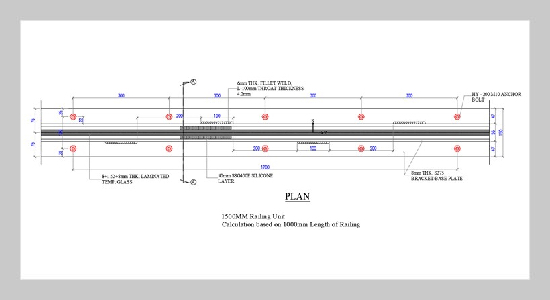
Use HIT-HY 200-R + HIS-RN M10 Anchor bolts (each at 300 mm spacing on both sides).
Copyright The Author(s). This is an open access article distributed under the terms of the Creative Commons Attribution License (CC BY 4.0), which permits unrestricted use, distribution, and reproduction in any medium, provided the original author and source are cited.
Download Citation: BibTeX | http://dx.doi.org/10.6180/jase.202610_33.023
This study presents a sustainability-driven structural design and analysis of a laminated tempered glass handrail system exposed to wind loads in a 30-storey high-rise environment. Unlike conventional line-load-based approaches, the proposed nature-responsive design uses wind pressure as the governing load, aligning structural behavior directly with environmental actions. The system employs recyclable materials such as tempered glass and stainless steel, and utilizes modular mechanical anchorage supported by long-life structural silicone bonding. Finite element analysis using SAP2000 predicted a maximum glass stress of 37.8 MPa and a peak deflection of 14.7 mm, both within allowable limits (72.3 MPa; span/60). The anchorage, welding, and sealant designs were validated against relevant Eurocode and ASTM standards to ensure safety and durability under cyclic wind actions. Sustainability assessment indicates reduced maintenance needs, extended service life, and material recyclability compared to conventional opaque or metallic balustrades. This nature-aligned structural system demonstrates how transparency, mechanical efficiency, and environmental adaptability can be harmonized for resilient high-rise architecture in wind-prone regions.
Keywords: Structural Glass, Laminated glass handrail, Wind load design, Balcony safety, High-rise buildings, SAP2000 analysis, Anchor bolt design, Fillet weld design, Tempered Glass
- [1] C. Schittich, G. Staib, D. Balkow, M. Schuler, and W. Sobek. Glass Construction Manual. München: Birkhäuser, 2007. DOI: 10 . 11129 / detail . 9783034615549.
- [2] C. W. Sinton. “Glass and Energy”. In: Encyclopedia of Energy. Ed. by C. J. Cleveland. New York: Elsevier, 2004, 1–10. DOI: 10.1016/B0-12-176480-X/00374-0.
- [3] J. Belis, C. Louter, J. H. Nielsen, and J. Schneider. “Architectural Glass”. In: Springer Handbook of Glass. Springer International Publishing, 2019, 1781–1819. DOI: 10.1007/978-3-319-93728-1_52.
- [4] S. R. Ledbetter, A. R. Walker, and A. P. Keiller, (2006) “Structural Use of Glass” Journal of Architectural Engineering 12(3): 137–149. DOI: 10.1061/(ASCE)1076-0431(2006)12:3(137).
- [5] N. Ghabra, L. Rodrigues, and P. Oldfield, (2017) “The impact of the building envelope on the energy efficiency of residential tall buildings in Saudi Arabia” International Journal of Low-Carbon Technologies 12(4): 411–419. DOI: 10.1093/ijlct/ctx005.
- [6] E. Gavanski and G. A. Kopp, (2011) “Glass Breakage Tests under Fluctuating Wind Loads” Journal of Architectural Engineering 17(1): 34–41. DOI: 10.1061/(ASCE)AE.1943-5568.0000028.
- [7] M. T. Naqash, A. Formisano, and E. Noroozinejad Farsangi, (2022) “Using a Full-Scale Mock-Up of Skylight to Evaluate Its Performance Following Standards Criteria” Arabian Journal for Science and Engineering 47(10): 13407–13420. DOI: 10.1007/s13369-022-06817-2.
- [8] M. T. Naqash and A. Formisano, (2025) “Glass panels supported by spider fittings: advantages, challenges, and applications in modern masonry façades” International Journal of Masonry Research and Innovation 10(6): 584–601. DOI: 10.1504/IJMRI.2025.149796.
- [9] M. T. Naqash and E. Noroozinejad Farsangi, (2025) “Performance-driven choice of steel vs aluminum curtain walls: a scenario-based comparison” Building Materials and Structures 68: 2500006T. DOI: 10.5937/GRMK2500006T.
- [10] H. A. Elgohary, (2023) “Supplementary Span-to-Depth Ratio Expressions for One-Way Slab Complying with ACI-318 and SBC-304 Deflection Limits” Journal of Umm Al-Qura University for Engineering and Architecture 14: DOI: 10.1007/s43995-023-00015-3.
- [11] G. Mamaeva and H. Elgohary, (2020) “Experimental Estimation of Period of Vibration for Multistory RC Frame Buildings” Mansoura Engineering Journal 32: DOI: 10.21608/bfemu.2020.128774.
- [12] British Standards Institution. BS 6180:2011 Barriers in and About Buildings – Code of Practice. Confirmed June 2016. 2011. URL: https://www.thenbs.com/PublicationIndex/documents/details?Pub=BSI&DocID=29687.
- [13] European Committee for Standardization. EN 1991-1-4: Eurocode 1 – Actions on Structures – Part 1-4: Wind Actions. 2002.
- [14] Standards Australia. AS 1288:2021 Glass in Buildings – Selection and Installation. Supersedes AS 1288:2006. 2021. URL: https://www.agwa.com.au/AGWA/Media/Articles/20210629-TFS-RevisionAS1288.aspx.
- [15] ASTM International. ASTM E1300-12a: Standard Practice for Determining Load Resistance of Glass in Buildings. 2012. URL: https://store.astm.org/e1300-12a.html.
- [16] Q. S. Li, X. Li, and P. W. Chan, (2021) “Impact of a Fifty-Year-Recurrence Super Typhoon on Skyscrapers in Hong Kong: Large-Scale Field Monitoring Study” Journal of Structural Engineering: DOI: 10.1061/(ASCE)ST.1943-541X.0002930.
- [17] E. Iizumi and G. A. Kopp. “Full-scale tests of glass plate under fluctuating wind loads”. In: 2009. URL: https://api.semanticscholar.org/CorpusID:198182644.
- [18] A. J. Nizich and L. Galuppi, (2022) “Cantilevered Laminated Glass Balustrades: The Conjugate Beam Effective Thickness Method – Part II: Comparison and Application” Glass Structures and Engineering: DOI: 10.1007/s40940-021-00165-7.
- [19] T. Spyra and T. Herrmann. “A Simplified Design Method for All-Glass Balustrades”. In: Challenging Glass Conference Proceedings. 6. Challenging Glass Conference Proceedings, 2018. DOI: 10.7480/cgc.6.2186.
- [20] L. Peng, J. P. Liu, Y. Wang, et al., (2018) “Wind Weakening in a Dense High-Rise City Due to Over Nearly Five Decades of Urbanization” Building and Environment: DOI: 10.1016/j.buildenv.2018.04.037.
- [21] The Economist. In Hong Kong, Common Sense Keeps Lives Safe in a Typhoon. 2018. URL: https://www.economist.com/international/2018/09/20/inhong-kong-common-sense-keeps-lives-safe-in-atyphoon.
- [22] QC’s Building Services. Balustrades – Information. 2025. URL: https://www.qcsbuildingservices.com.au/information/balustrades/.
- [23] M. T. Naqash, A. Formisano, and G. De Matteis, (2016) “Design and Performance Testing of a Skylight in Qatar” Key Engineering Materials 710: 262–266. DOI: 10.4028/www.scientific.net/KEM.710.262.
- [24] M. T. Naqash, S. Khoso, and E. N. Farsangi, (2024) “Wind-Induced Structural Response of Skylights: A Eurocode-Based Assessment” Practice Periodical on Structural Design and Construction 29(1): 04023062. DOI: 10.1061/PPSCFX.SCENG-1381.
- [25] A. Formisano and M. T. Naqash. “Numerical Studies on Innovative Prestressed Aluminium Alloy Profiles for Curtain Wall Systems”. In: Proceedings of the 11th International Conference on Behaviour of Steel Structures in Seismic Areas. Springer Nature Switzerland, 2024, 863–871. DOI: 10.1007/978-3-031-62888-7_75.
- [26] M. T. Naqash et al., (2021) “Assessment of rigid steel frames: Ductility versus damageability” Journal of Applied Science and Engineering 24(6): 915–926. DOI: 10.6180/jase.202112_24(6).0012.
- [27] M. T. Naqash, A. Formisano, and G. De Matteis, (2016) “Aluminium Framing Members in Facades” Key Engineering Materials 710: 327–331. DOI: 10.4028/www.scientific.net/KEM.710.327.
- [28] Hilti Corporation. Hilti Software for Anchor Design: Hilti PROFIS for Anchor, Anchor Channel and Anchor Selector App. 2025. URL: https://www.hilti.sa/content/hilti/META/SA/en/business/business/engineering/software/anchor-design-software.html.
- [29] Glass in building – Determination of the load resistance of glass panes by calculation and testing. CEN (European Committee for Standardization), 2013. URL: https://standards.iteh.ai/catalog/standards/cen/d6dba213-4788-4675-a9bb-ecbd53642e31/pren-16612.
- [30] Structural use of steelwork in building – Code of practice for design. Rolled and welded sections. British Standards Institution (BSI), 2001. URL: https://knowledge.bsigroup.com/products/structural-use-of-steelwork-in-building-code-of-practice-for-design-rolled-and-welded-sections.
- [31] Loading for buildings – Code of practice for dead and imposed loads. British Standards Institution (BSI), 1996. URL: https://knowledge.bsigroup.com/products/loading-for-buildings-code-of-practice-for-dead-and-imposed-loads.
- [32] European Committee for Standardization. EN 1993-1-8: Eurocode 3 – Design of Steel Structures – Part 1-8: Design of Joints. 2005. URL: https://eurocodes.jrc.ec.europa.eu/EN-Eurocodes/eurocode-3-design-steel-structures.
- [33] Glass in building – Determination of the load resistance of glass panes by calculation and testing. Slovenian Institute for Standardization (SIST), 2013. URL: https://standards.iteh.ai/catalog/standards/cen/d6dba213-4788-4675-a9bb-ecbd53642e31/pren-16612.
- [34] J. Klein, M. E. Ahern, and R. Poston. “Novel Solution for Strengthening Handrail Anchorage”. In: 2019. URL: https://api.semanticscholar.org/CorpusID:214675994.
- [35] Hilti Group. Chemical Anchors – Injectable Mortars and Capsule Anchors for Concrete and Masonry; Technical Data and ETA Reports for Chemical Anchors. 2025. URL: https://www.hilti.sa/c/CLS_FASTENER_7135/CLS_CHEMICAL_ANCHORS_7135.
- [36] T. N. Muhammad, F. Antonio, and N. F. Ehsan, (2021) “Structural assessment of glass used in façade industry” Structures 33: 4817–4827. DOI: https://doi.org/10.1016/j.istruc.2021.07.059.
- [37] G. Brandonisio and M. T. Naqash, (2024) “Validation of numerical results of complex seismic analysis through simple analytics” Journal of Umm Al-Qura University for Engineering and Architecture 15: 93–111. DOI: 10.1007/s43995-023-00045-x.
- [38] M. T. Naqash, A. E. Alluqmani, and Q. U. Farooq, (2024) “A comparative analysis of design and analysis methods for steel connections: contrasting American and European perspectives” Journal of Umm Al-Qura University for Engineering and Architecture 15: 14–30. DOI: 10.1007/s43995-023-00037-x.
- [39] A. Jóźwik, (2022) “Introduction to Structural Design of Glass According to Current European Standards” Archives of Civil Engineering: DOI: 10.24425/ace.2022.140634.