


Received: April 1, 2026
Accepted: April 17, 2026
Publication Date: June 27, 2026
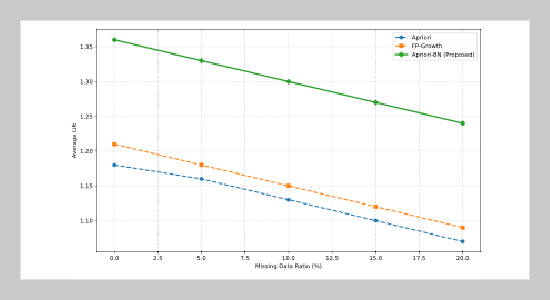
Effect of Data Sparsity on Average Lift
Copyright The Author(s). This is an open access article distributed under the terms of the Creative Commons Attribution License (CC BY 4.0), which permits unrestricted use, distribution, and reproduction in any medium, provided the original author and source are cited.
Download Citation: BibTeX | http://dx.doi.org/10.6180/jase.202610_33.022
This paper proposes an Apriori-Bayesian Network hybrid model for mining association rules in teaching evaluation data. A total of 5,200 teaching evaluation records were cleaned, discretized, and transformed into transaction data. Apriori was first used to generate frequent itemsets under sensitivity-tested support and onfidence thresholds, and Bayesian network inference was then introduced to reduce redundant rules and improve rule interpretability. Experimental results show that the proposed model achieves higher rule quality than Apriori, FP-Growth, Eclat, and genetic association rule mining. The average rule redundancy is reduced by 18.7%, and the key rules obtain lift values greater than 1.30, indicating strong positive associations. The model also supports rule-based warning, performance prediction, and teaching quality diagnosis in a B/S management system. The results demonstrate that the proposed method is effective for teaching data mining and decision support.
Keywords: Data mining; Association rules; Teaching quality; Bayesian network
- [1] H. Yu, (2021) “Online Teaching Quality Evaluation Based on Emotion Recognition and Improved AprioriTid Algorithm” Journal of Intelligent & Fuzzy Systems 40: 7037–7047. DOI: 10.3233/JIFS-189534.
- [2] D. T. K. Ng, J. K. L. Leung, K. W. S. Chu, and M. S. Qiao, (2021) “AI Literacy: Definition, Teaching, Evaluation and Ethical Issues” Proceedings of the Association for Information Science and Technology 58(1): 504–509. DOI: 10.1002/pra2.487.
- [3] A. Onan, (2021) “Sentiment Analysis on Massive Open Online Course Evaluations: A Text Mining and Deep Learning Approach” Computer Applications in Engineering Education 29(3): 572–589. DOI: 10.1002/cae.22253.
- [4] P. Gao, J. Li, and S. Liu, (2021) “An Introduction to Key Technology in Artificial Intelligence and Big Data Driven e-Learning and e-Education” Mobile Networks and Applications 26(5): 2123–2126. DOI: 10.1007/s11036-021-01777-7.
- [5] M. Saini, E. Sengupta, M. Singh, H. Singh, and J. Singh, (2023) “Sustainable Development Goal for Quality Education (SDG 4): A Study on SDG 4 to Extract the Pattern of Association Among the Indicators of SDG 4 Employing a Genetic Algorithm” Education and Information Technologies 28(2): 2031–2069. DOI: 10.1007/s10639-022-11265-4.
- [6] D. Shin and J. Shim, (2021) “A Systematic Review on Data Mining for Mathematics and Science Education” International Journal of Science and Mathematics Education 19(4): 639–659. DOI: 10.1007/s10763-020-10085-7.
- [7] X. Huang, J. Zhao, J. Fu, and X. Zhang, (2021) “Effectiveness of Ideological and Political Education Reform in Universities Based on Data Mining Artificial Intelligence Technology” Journal of Intelligent & Fuzzy Systems 40(2): 3743–3754. DOI: 10.3233/JIFS-189408.
- [8] A. Khan and S. K. Ghosh, (2021) “Student Performance Analysis and Prediction in Classroom Learning: A Review of Educational Data Mining Studies” Education and Information Technologies 26(1): 205–240. DOI: 10.1007/s10639-020-10230-3.
- [9] N. A. Y. Abdelbaset R. Almasri and S. S. Abu-Naser, (2022) “Instructor Performance Modeling for Predicting Student Satisfaction Using Machine Learning: Preliminary Results” Journal of Theoretical and Applied Information Technology 100(19): 5481–5496.
- [10] C. Fang, (2021) “Intelligent Online English Teaching System Based on SVM Algorithm and Complex Network” Journal of Intelligent & Fuzzy Systems 40(2): 2709–2719. DOI: 10.3233/JIFS-189313.
- [11] A. K. Zoromski, S. W. Evans, J. S. Owens, A. Holdaway, and A. S. Royo Romero, (2021) “Middle School Teachers’ Perceptions of and Use of Classroom Management Strategies and Associations with Student Behavior” Journal of Emotional and Behavioral Disorders 29(4): 199–212. DOI: 10.1177/1063426620957624.
- [12] P. Guleria and M. Sood, (2023) “Explainable AI and Machine Learning: Performance Evaluation and Explainability of Classifiers on Educational Data Mining Inspired Career Counseling” Education and Information Technologies 28(1): 1081–1116. DOI: 10.1007/s10639-022-11221-2.
- [13] Y. A. Ünvan, (2021) “Market Basket Analysis with Association Rules” Communications in Statistics—Theory and Methods 50(7): 1615–1628. DOI: 10.1080/03610926.2020.1716255.
- [14] A. Jaiswal and C. J. Arun, (2021) “Potential of Artificial Intelligence for Transformation of the Education System in India” International Journal of Education and Development using Information and Communication Technology 17(1): 142–158.
- [15] S. L. Campbell, (2023) “Ratings in Black and White: A QuantCrit Examination of Race and Gender in Teacher Evaluation Reform” Race Ethnicity and Education 26(7): 815–833. DOI: 10.1080/13613324.2020.1842345.
- [16] G. A. Mehmet Kokoç and M. N. Hasnine, (2021) “Unfolding Students’ Online Assignment Submission Behavioral Patterns Using Temporal Learning Analytics” Educational Technology & Society 24(1): 223–235. DOI: 10.30191/ETS.202101_24(1).0017.
- [17] E. M. H. Saeed and B. A. Hammood, (2021) “Survey Fuzzy Logic and Apriori Algorithms Employed for e-Learning Environment” Turkish Journal of Computer and Mathematics Education 12(8): 60–69.
- [18] T. Buser, C. L. Batz-Barbarich, and A. J. K. Hayter, (2022) “Evaluation of Women in Economics: Evidence of Gender Bias Following Behavioral Role Violations” Sex Roles 86(11–12): 695–710. DOI: 10.1007/s11199-022-01299-w.
- [19] Z. Berezvai, G. D. Lukáts, and R. Molontay, (2021) “Can Professors Buy Better Evaluation with Lenient Grading? The Effect of Grade Inflation on Student Evaluation of Teaching” Assessment & Evaluation in Higher Education 46(5): 793–808. DOI: 10.1080/02602938.2020.1821866.
- [20] S. Hussain and M. Q. Khan, (2023) “Student-Performulator: Predicting Students’ Academic Performance at Secondary and Intermediate Level Using Machine Learning” Annals of Data Science 10(3): 637–655. DOI: 10.1007/s40745-021-00341-0.
- [21] S. Link, M. Mehrzad, and M. Rahimi, (2022) “Impact of Automated Writing Evaluation on Teacher Feedback, Student Revision, and Writing Improvement” Computer Assisted Language Learning 35(4): 605–634. DOI: 10.1080/09588221.2020.1743323.
- [22] D. A. E. van Aalst, G. Huitsing, T. Mainhard, A. H. N. Cillessen, and R. Veenstra, (2021) “Testing How Teachers’ Self-Efficacy and Student–Teacher Relationships Moderate the Association Between Bullying, Victimization, and Student Self-Esteem” European Journal of Developmental Psychology 18(6): 928–947. DOI: 10.1080/17405629.2021.1912728.
- [23] H. El Mrabet and A. Ait Moussa, (2023) “A Framework for Predicting Academic Orientation Using Supervised Machine Learning” Journal of Ambient Intelligence and Humanized Computing 14(12): 1653–1649. DOI: 10.1007/s12652-022-03909-7.
- [24] A. Ahadi, A. Singh, M. Bower, and M. Garrett, (2022) “Text Mining in Education—A Bibliometrics-Based Systematic Review” Education Sciences 12(3): 210. DOI: 10.3390/educsci12030210.
- [25] A. Bhutoria, (2022) “Personalized Education and Artificial Intelligence in the United States, China, and India: A Systematic Review Using a Human-in-the-Loop Model” Computers and Education: Artificial Intelligence 3: 100068. DOI: 10.1016/j.caeai.2022.100068.
- [26] C. Hou, J. Ai, Y. Lin, C. Guan, J. Li, and W. Zhu, (2022) “Evaluation of Online Teaching Quality Based on Facial Expression Recognition” Future Internet 14(6): 177. DOI: 10.3390/fi14060177.