




Big Data Accounting Institute, Henan Industry and Trade Vocational College, Zhengzhou 450000, China
Received: March 22, 2026
Accepted: June 23, 2026
Publication Date: June 27, 2026
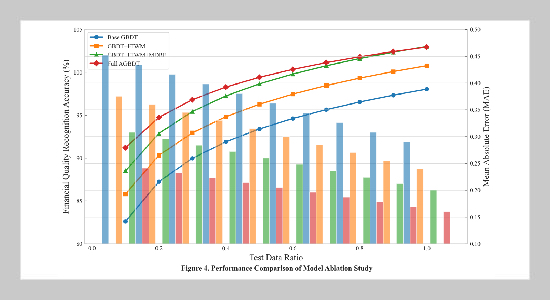
Performance Comparison of Model Ablation Experiment.
Copyright The Author(s). This is an open access article distributed under the terms of the Creative Commons Attribution License (CC BY 4.0), which permits unrestricted use, distribution, and reproduction in any medium, provided the original author and source are cited.
Download Citation: BibTeX | http://dx.doi.org/10.6180/jase.202610_33.021
Against the backdrop of global digital transformation of corporate finance, the mismatch between traditional financial reporting systems and complex dynamic business environments has become increasingly prominent, with problems such as financial information distortion, weak risk early warning capabilities, and the disconnection between financial information quality and decision value creation becoming key bottlenecks restricting high-quality development of enterprises. With the deep development of the digital economy, the digital transformation of enterprise financial activities is accelerating. How to rely on big data analysis technology to solve the industry pain points of distorted financial report information and insufficient decision support capabilities has become a core issue in the field of enterprise financial management and corporate governance. This study is based on the theory of information asymmetry and the financial quality evaluation system, and constructs a four-dimensional quantitative model for financial report quality, depicting the evolutionary relationship between the authenticity, compliance, and value relevance of financial information; Subsequently, an improved adaptive gradient boosting decision tree (AGBDT) algorithm was introduced to construct a big data analysis driven financial report quality optimization and decision support framework. The model integrates historical financial information weighting mechanism, multi-objective decision return function, and adaptive learning rate optimization strategy, achieving joint optimization of financial report quality improvement, decision risk control, and enterprise value growth. The empirical results show that the proposed model achieved the lowest average absolute error of 0.21 in financial quality identification and the highest accuracy of 96.3% in financial fraud identification on the Shanghai and Shenzhen A-share listed company datasets and the New Third Board enterprise datasets. The effectiveness of decision support was improved by 32.7% compared to traditional models, and the overall performance was significantly better than the four comparative models. In extreme market volatility and industry heterogeneity scenarios, this can still control the deviation of financial report distortion warning within 8.5%, while achieving optimization of business decision-making under low risk. This study provides an efficient and scalable technological path for the construction of digital financial management systems in enterprises, which is applicable to various scenarios such as information disclosure management of listed companies, financial control of group enterprises, and value analysis of investment institutions.
Keywords: Big data analysis; Financial report quality; Financial information quality; Decision support; Adaptive gradient boosting decision tree; Financial risk early warning
- [1] M. M. H. Emon, G. M. M. N. Rabbani, and A. Nath, (2023) “Challenges and opportunities in the implementation of big data analytics in management information systems in Bangladesh” Acta Informatica Malaysia 7(2): 122–130. DOI: 10.26480/aim.02.2023.122.130.
- [2] M. Al-Okaily and A. Al-Okaily, (2025) “Financial data modeling: an analysis of factors influencing big data analytics-driven financial decision quality” Journal of Modelling in Management 20(2): 301–321. DOI: 10.1108/JM2-08-2023-0212.
- [3] S. Zhang, (2025) “A big data-driven approach to financial analysis and decision support system design” Informatica 49(11): DOI: 10.31449/inf.v49i11.5016.
- [4] I. Saleh, Y. Marei, M. Ayoush, and M. M. Abu Afifa, (2023) “Big data analytics and financial reporting quality: qualitative evidence from Canada” Journal of Financial Reporting and Accounting 21(1): 83–104. DOI: 10.1108/JFRA-04-2022-0114.
- [5] D. Tong and G. Tian, (2023) “Intelligent financial decision support system based on big data” Journal of Intelligent Systems 32(1): 20220320. DOI: 10.1515/jisys-2022-0320.
- [6] A. Megeid and N. Sobhy, (2022) “The role of big data analytics in supply chain “3fs”: financial reporting, financial decision making and financial performance “an applied study”” 26(2): 207–268. DOI: 10.21608/ajac.26.2.196046.
- [7] N. Elgendy, A. Elragal, and T. Päivärinta, (2022) “DECAS: a modern data-driven decision theory for big data and analytics” Journal of Decision Systems 31(4): 337–373. DOI: 10.1080/12460125.2022.2079004.
- [8] S. Ren, (2022) “Optimization of enterprise financial management and decision-making systems based on big data” Journal of Mathematics 2022(1): 1708506. DOI: 10.1155/2022/1708506.
- [9] A. C. Ikegwu, H. F. Nweke, C. V. Anikwe, U. R. Alo, and O. R. Okonkwo, (2022) “Big data analytics for data-driven industry: a review of data sources, tools, challenges, solutions, and research directions” Cluster Computing 25(5): 3343–3387. DOI: 10.1007/s10586-022-03579-7.
- [10] S. Chatterjee, R. Chaudhuri, S. Gupta, U. Sivarajah, and S. Bag, (2023) “Assessing the impact of big data analytics on decision-making processes, forecasting, and performance of a firm” Technological Forecasting and Social Change 196: 122824. DOI: 10.1016/j.techfore.2023.122824.
- [11] N. Li, (2025) “Big data-driven enterprise management and market decision-making framework” Service Oriented Computing and Applications: 1–12. DOI: 10.1007/s11761-025-00408-9.
- [12] N. Noor, F. Arzu, S. E. Y. Qadeem, M. E. Siddique, A. Safi, and A. Qamer, (2025) “A Big Data–Driven Optimization Framework for Enterprise Financial Management: Enhancing Predictive Decision-Making, Risk Control, and Computational Efficiency” The Asian Bulletin of Big Data Management 5(4): 190–217. DOI: 10.54216/ABBDM.050403.
- [13] H. Demirkan and D. Delen, (2013) “Leveraging the capabilities of service-oriented decision support systems: Putting analytics and big data in cloud” Decision Support Systems 55(1): 412–421. DOI: 10.1016/j.dss.2013.01.005.
- [14] T. Chen and C. Guestrin. “Xgboost: A scalable tree boosting system”. In: Proceedings of the 22nd ACM SIGKDD International Conference on Knowledge Discovery and Data Mining. 2016, 785–794. DOI: 10.1145 / 2939672.2939785.
- [15] D. Dandolo, C. Masiero, M. Carletti, D. Dalle Pezze, and G. A. Susto, (2023) “AcME—Accelerated model-agnostic explanations: Fast whitening of the machine-learning black box” Expert Systems with Applications 214: 119115. DOI: 10.1016/j.eswa.2022.119115.
- [16] A. Mashrur, W. Luo, N. Zaidi, and A. Robles-Kelly, (2020) “Machine Learning for Financial Risk Management: A Survey” IEEE Access 8: 203203–203223. DOI: 10.1109/ACCESS.2020.3036322.
- [17] A. Ali, S. Abd Razak, S. H. Othman, T. A. E. Eisa, A. Al-Dhaqm, M. Nasser, T. Elhassan, H. Elshafie, and A. Saif, (2022) “Financial fraud detection based on machine learning: a systematic literature review” Applied Sciences 12(19): 9637. DOI: 10.3390/app12199637.
- [18] H. O. Bello, A. B. Ige, and M. N. Ameyaw, (2024) “Adaptive machine learning models: concepts for real-time financial fraud prevention in dynamic environments” World Journal of Advanced Engineering Technology and Sciences 12(02): 021–034. DOI: 10.30574/wjaets.2024.12.2.0266.
- [19] H. Zhang, Z. Zang, H. Zhu, M. I. Uddin, and M. A. Amin, (2022) “Big data-assisted social media analytics for business model for business decision making system competitive analysis” Information Processing & Management 59(1): 102762. DOI: 10.1016/j.ipm.2021.102762.
- [20] S. Chatterjee, R. Chaudhuri, S. Gupta, U. Sivarajah, and S. Bag, (2023) “Assessing the impact of big data analytics on decision-making processes, forecasting, and performance of a firm” Technological Forecasting and Social Change 196: 122824. DOI: 10.1016/j.techfore.2023.122824.