




Lecturer, School of Journalism and Communication Shenyang Normal University, Shenyang 110000, China
Received: February 26, 2026
Accepted: April 17, 2026
Publication Date: June 27, 2026
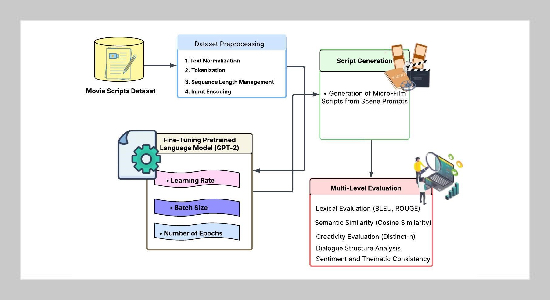
Proposed Workflow for GPT-2–Based Micro-Film Script Generation.
Copyright The Author(s). This is an open access article distributed under the terms of the Creative Commons Attribution License (CC BY 4.0), which permits unrestricted use, distribution, and reproduction in any medium, provided the original author and source are cited.
Download Citation: BibTeX | http://dx.doi.org/10.6180/jase.202610_33.020
With the rise of short stories in the digital medium, there has been a growth of interest in developing intelligent, scalable systems that generate micro-film scripts. This paper introduces an Artificial Intelligence-assisted automated framework to generate micro-film scripts, and to analyze their narrative structure and content using a Fine-tuned GPT-2 Transformer Model. Movie scripts are pre-processed to normalize, tokenize by sub-words, and segment the text into fixed-length sequences to develop “screenplay” specific narrative patterns. The model is then further trained using the AdamW Optimiser with a learning rate of 5E-5, a batch size of 8 and training over 3 epochs; additionally, micro-film scripts will be generated using Nucleus Sampling (top-p = 0.9), and Temperature Scaling (temperature = 0.8). An extensive evaluation framework has been used to evaluate the outputs of the proposed framework via BLEU, ROUGE, Distinct-N, Semantic Similarity, Narrative Coherence, and Sentiment Consistency metrics. The experimental evaluations showed a proposed framework generated high semantic similarity (0.93), strong lexical diversity (Dist-2 = 0.83), and stable sentiment consistency (0.555) indicating a proposed framework generated fluent, creative scripts. However, global narrative coherence was evidenced to be only moderate (0.264); therefore, the proposed framework could provide a reproducible and scalable solution to allow for automated micro-film script creation and use in creative, educational and commercial industries.
Keywords: Micro-films; Short dramas; documentaries; And other film and television genres; AI-Assisted Script Generation
- [1] R. Luo, R. Huang, Y. Wang, and L. Ru, (2024) “Digital Storytelling as a New Narrative Technique in Short Videos Telling China Stories” Advances in Journalism and Communication 12(2): 246–257. DOI: 10.4236/ajc.2024.122013.
- [2] A. Ocal, (2025) “Cinematic Narratives as Socio-Technical Systems: Emotion Mining and Script–Audience Emotional Fidelity” Systems 13(11): 994. DOI: 10.3390/systems13110994.
- [3] A. Vázquez, A. López Zorrilla, J. M. Olaso, and M. I. Torres, (2023) “Dialogue Management and Language Generation for a Robust Conversational Virtual Coach: Validation and User Study” Sensors 23(3): 1423. DOI: 10.3390/s23031423.
- [4] Y. Zhu, R. Song, J.-Y. Nie, P. Du, Z. Dou, and J. Zhou, (2022) “Leveraging Narrative to Generate Movie Script” ACM Transactions on Information Systems 40(4): 86:1–86:32. DOI: 10.1145/3507356.
- [5] Z. Zhang and Z. Hua, (2025) “Balancing Revenue Streams in Online Video Platforms: The Impact of Original Content Provision on Business Model Selection” Journal of Theoretical and Applied Electronic Commerce Research 20(2): 98. DOI: 10.3390/jtaer20020098.
- [6] S. Indra, M. A. I. Yassin, S. A. Shekh Alsagoff, and R. Bidin, (2023) “New Journalism in Documentary Script Writing” International Journal of Academic Research in Business and Social Sciences 13(3): 767–779. DOI: 10.6007/IJARBSS/v13-i3/16335.
- [7] W. Hanmei, (2024) “Deep Learning-Based Analysis of Emotional and Content Relevance Between Bullet Screens and Subtitles as Movie Narrative Medium” SAGE Open 14(3): 21582440241280840. DOI: 10.1177/21582440241280840.
- [8] D. T. K. Ng, W. Luo, H. M. Y. Chan, and S. K. W. Chu, (2022) “Using Digital Story Writing as a Pedagogy to Develop AI Literacy Among Primary Students” Computers and Education: Artificial Intelligence 3: 100054. DOI: 10.1016/j.caeai.2022.100054.
- [9] A. Bucaioni, F. Di Silvestro, I. Singh, M. Saadatmand, and H. Muccini, (2022) “Model-Based Generation of Test Scripts Across Product Variants: An Experience Report from the Railway Industry” Journal of Software: Evolution and Process 34(11): e2498. DOI: 10.1002/smr.2498.
- [10] S. Cake, (2025) “Artificial Intelligence as a Collaborative Tool for Script Development” Media Practice and Education 26(3): 302–317. DOI: 10.1080/25741136.2025.2454074.
- [11] N. A. Arjomand, (2024) “Empirical Fiction: Composite Character Narratives in Analytical Sociology” The American Sociologist 55(4): 436–472. DOI: 10.1007/s12108-022-09546-z.
- [12] M. Skowron, M. Trapp, S. Payr, and R. Trappl, (2016) “Automatic Identification of Character Types from Film Dialogs” Applied Artificial Intelligence 30(10): 942–973. DOI: 10.1080/08839514.2017.1289311.
- [13] S. Ge, (2025) “The Impact of AI Algorithm Optimization on Content Quality Enhancement in Short Video and Micro-Film Production” International Journal of Advanced Applied Science Research 4(8): 113–118.
- [14] H. Fan, (2024) “The Art and Challenge of Micro Film Creation” Studies in Art and Architecture 3(2): 51–56.
- [15] H. Zhan, (2024) “Aesthetic Characteristics and Creative Practice of Micro-Films from the Perspective of Directors” Frontiers in Art Research 6(11): DOI: 10.25236/FAR.2024.061103.
- [16] Z. Shi and L. Li, (2024) “A Study on the Aesthetic Characteristics of Documentary Films in the Internet Communication Environment” Advances in Education, Humanities and Social Sciences Research 9(1): 64. DOI: 10.56028/aehssr.9.1.64.2024.
- [17] L. Kong, (2023) “When State-Endorsed Cinema Meets Marvel: A Study of Wolf Warrior II’s Global Superhero Vernacular” Arts 12(6): 252. DOI: 10.3390 / arts12060252.
- [18] J. Yuan, (2023) “Application of Micro Film Advertising Communication Under New Media Form” Frontiers in Social Sciences and Technology 5(15): DOI: 10.25236/FSST.2023.051513.
- [19] G. Li, (2025) “Analysis of New Trends in Microdramas: On the Example of Social Media Drama Shorts in China and US” Perspectives on Communication 1(3): 1–11. DOI: 10.63808/pcm.v1i3.251.
- [20] M. J. Roshan, A. S. B. A. Rashid, M. A. B. Hezmi, M. N. Nejabi, S. N. B. Jusoh, S. Tamassoki, and R. Razali, (2022) “Evaluation of Cement Stabilised Residual Soil on Macro-and Micro-Scale for Road Construction” Journal of Engineering and Applied Science 69(1): 109. DOI: 10.1186/s44147-022-00165-6.
- [21] Z. Jia and S. B. Mohamed, (2023) “Navigating the Tides of Media Convergence: Shanxi Radio and Television Station’s Transformation Amidst the Digital Tsunami” International Journal of Academic Research in Business and Social Sciences 13(4): 1289–1298. DOI: 10.6007 / IJARBSS/v13-i4/16757.
- [22] J. Zschocke, (2022) “Towards a Multimethod Approach for Film Geography: A Case Study of Los Angeles’ Nate Starkman Building” GeoJournal 87(1): 85–93. DOI: 10.1007/s10708-022-10660-1.
- [23] C. Luo, N. A. M. Hasan, A. M. Z. Ahmad, and G. Lei, (2025) “Influence of Short Video Content on Consumers Purchase Intentions on Social Media Platforms with Trust as a Mediator” Scientific Reports 15(1): 16605. DOI: 10.1038/s41598-025-94994-z.
- [24] R. Zainal and M. A. M. Desa, (2025) “The Benefit of Using Emotion in 3D Animation Film: Pre-Production Stage” PaperAsia 41(1b): 255–270. DOI: 10.59953 / paperasia.v41i1b.162.
- [25] G. B. Takala, (2023) “The Interactive Creativity of the Digital Era: Exploring How Media Art Redefines the Relationship Between Audience and Artwork” Studies in Art and Architecture 2(3): 28–44.
- [26] I. Mousa. README.md · IsmaelMousa/movies at main. Accessed: 2026-01-09. 2026.