




Basori1, Ruliyanta2, Maman Kartaman Ajiriyanto3, Juan Carlos Sihotang3, Yusuf Gigih Wicaksono3, Sigit Dwi Yudanto4, Evi Ulina Margareta Situmorang5, Daniel Edbert6, Cahaya Rosyidan7, Dwi Nanto8, and Ferry Budhi Susetyo9
1Department of Mechanical Engineering, Universitas Nasional, Jakarta, 12520, Indonesia
2Department of Electrical Engineering, Universitas Nasional, Jakarta, 12520, Indonesia
3Research Center for Nuclear Material and Radioactive Waste Technology, National Research and Innovation Agency, Tangerang Selatan, Banten, 15314, Indonesia
4Research Center for Metallurgy, National Research and Innovation Agency, Tangerang Selatan, Banten, 15314, Indonesia
5Department of Physiology School of Medicine and Health Sciences, Atma Jaya Catholic University of Indonesia, Jakarta, 14440, Indonesia
6Department of Microbiology School of Medicine and Health Sciences Atma Jaya Catholic University of Indonesia, Jakarta, 14440, Indonesia
7Department of Petroleum Engineering, Universitas Trisakti, Jakarta, 11440, Indonesia
8Department of Physics Education, UIN Syarif Hidayatullah, Jakarta, 15412, Indonesia
9Department of Mechanical Engineering, Universitas Negeri Jakarta, Jakarta, 13220, Indonesia
Received: December 13, 2025
Accepted: April 29, 2026
Publication Date: June 27, 2026
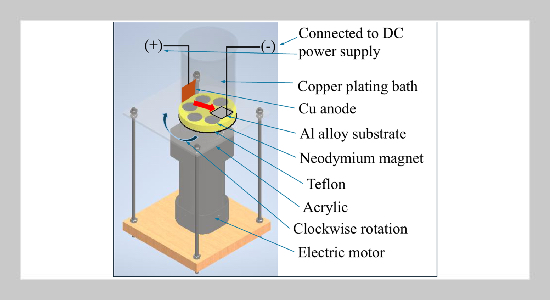
Rotating magnetic influence apparatus [12]
Copyright The Author(s). This is an open access article distributed under the terms of the Creative Commons Attribution License (CC BY 4.0), which permits unrestricted use, distribution, and reproduction in any medium, provided the original author and source are cited.
Download Citation: BibTeX | http://dx.doi.org/10.6180/jase.202610_33.018
Copper (Cu) coatings enhance the corrosion resistance, hardness, and antibacterial properties of aluminum (Al). To further optimize these traits, this study electroplated Cu onto an Al alloy under a rotating neodymium magnet at various speeds. The resulting pure, face-centered cubic (FCC) Cu films were comprehensively characterized. Results indicated that increasing the magnetic rotation speed decreased the deposition rate, current efficiency, and crystallite size, while simultaneously increasing the film’s hardness, grain size, and corrosion potential. Ultimately, a magnetic rotation of 250 rpm proved optimal, producing a compact Cu film with maximum hardness, corrosion resistance, and bacterial inhibition.
Keywords: surface morphology, crystallographic orientation, sodium chloride, Vickers, gram-positive bacteria
- [1] D. Y. Pimenov, M. Kiran, N. Khanna, G. Pintaude, M. C. Vasco, L. R. R. da Silva, and K. Giasin, (2023) “Review of improvement of machinability and surface integrity in machining on aluminum alloys” The International Journal of Advanced Manufacturing Technology 129: 4743–4779. DOI: 10.1007/s00170-023-12630-4.
- [2] C.-R. Song, B.-X. Dong, S.-Y. Zhang, H.-Y. Yang, L. Liu, J. Kang, J. Meng, C.-J. Luo, C.-G. Wang, K. Cao, J. Qiao, S.-L. Shu, M. Zhu, F. Qiu, and Q.-C. Jiang, (2024) “Recent progress of Al–Mg alloys: Forming and preparation process, microstructure manipulation and application” Journal of Materials Research and Technology 31: 3255–3286. DOI: 10.1016/j.jmrt.2024.07.051.
- [3] A. Augustin, P. Huilgol, K. R. Udupa, and U. Bhat K, (2016) “Effect of current density during electrodeposition on microstructure and hardness of textured Cu coating in the application of antimicrobial Al touch surface” Journal of the Mechanical Behavior of Biomedical Materials 63: 352–360. DOI: 10.1016/j.jmbbm.2016.07.013.
- [4] J. H. Reed, A. E. Gonsalves, J. K. Román, J. Oh, H. Cha, C. E. Dana, M. Toc, S. Hong, J. B. Hoffman, J. E. Andrade, K. D. Jo, M. Alleyne, N. Miljkovic, and D. M. Cropek, (2019) “Ultrascalable Multifunctional Nanoengineered Copper and Aluminum for Antiadhesion and Bactericidal Applications” ACS Applied Bio Materials 2: 2726–2737. DOI: 10.1021/acsabm.8b00765.
- [5] N. Hutasoit, S. H. Topa, M. A. Javed, R. A. Rahman Rashid, E. Palombo, and S. Palanisamy, (2021) “Antibacterial Efficacy of Cold-Sprayed Copper Coatings against Gram-Positive Staphylococcus aureus and Gram-Negative Escherichia coli” Materials 14: 6744. DOI: 10.3390/ma14226744.
- [6] A. Lelevic and F. C. Walsh, (2019) “Electrodeposition of Ni P alloy coatings: A review” Surface and Coatings Technology 369: 198–220. DOI: 10.1016/j.surfcoat.2019.03.055.
- [7] H. A. Murdoch, D. Yin, E. Hernández-Rivera, and A. K. Giri, (2018) “Effect of applied magnetic field on microstructure of electrodeposited copper” Electrochemistry Communications 97: 11–15. DOI: 10.1016/j.elecom.2018.09.013.
- [8] X. Fu, C. Zhan, R. Zhang, B. Wang, H. Sun, and J. Sun, (2022) “Effect of temperature on mechanism and kinetics of electrochemical nucleation of copper in ChCl-based deep eutectic solvents” Journal of Solid State Electrochemistry 26: 2713–2722. DOI: 10.1007/s10008-022-05282-z.
- [9] B. Soegijono, F. B. Susetyo, Yusmaniar, and M. C. Fajrah, (2020) “Electrodeposition of Paramagnetic Copper Film under Magnetic Field on Paramagnetic Aluminum Alloy Substrates” e-Journal of Surface Science and Nanotechnology 18: 281–288. DOI: 10.1380/ejssnt.2020.281.
- [10] Y. Mo, C. Shen, and D. Zhu, (2022) “Study of Copper Electrodeposition at a Very Low Temperature near the Freezing Point of Electrolyte” Micromachines 13: 2222. DOI: 10.3390/mi13122225.
- [11] Q. Long, Y. Zhong, and J. Wu, (2020) “Research Progress of Magnetic Field Techniques for Electrodeposition of Coating” International Journal of Electrochemical Science 15: 8026–8040. DOI: 10.20964/2020.08.40.
- [12] B. Basori, Ruliyanta, M. K. Ajiriyanto, R. Kriswarini, H. Hardiyanti, C. Rosyidan, S. D. Yudanto, E. U. M. Situmorang, D. Edbert, D. Nanto, and F. B. Susetyo, (2025) “Rotating speed and magnetic pole dependency assisted on copper deposition onto aluminum alloy substrate for bacterial eradication application” Communications in Science and Technology 10: 17–28. DOI: 10.21924/cst.10.1.2025.1547.
- [13] B.-N. Park, Y.-S. Sohn, and S.-Y. Choi, (2008) “Effects of a magnetic field on the copper metallization using the electroplating process” Microelectronic Engineering 85: 308–314. DOI: 10.1016/j.mee.2007.06.018.
- [14] M. F. Alebrahim, I. Khattab, and A. O. Sharif, (2015) “Electrodeposition of copper from a copper sulfate solution using a packed-bed continuous-recirculation flow reactor at high applied electric current” Egyptian Journal of Petroleum 24: 325–331. DOI: 10.1016/j.ejpe.2015.07.009.
- [15] H. Guo, H.-J. Kim, and S.-Y. Kim, (2022) “Research on Hydrogen Production by Water Electrolysis Using a Rotating Magnetic Field” Energies 16: 86. DOI: 10.3390/en16010086.
- [16] G. Yamaguchi and H. Mimura, (2020) “Effect of Electrodeposition Conditions on Surface Roughness of Copper Electroformed Replicas” International Journal of Electrical Machining 25: 33. DOI: 10.2526/ijem.25.33.
- [17] F. da Silva, N. Cinca, S. Dosta, I. Cano, J. Guilemany, C. Caires, A. Lima, C. Silva, S. Oliveira, A. Caires, and A. Benedetti, (2019) “Corrosion resistance and antibacterial properties of copper coating deposited by cold gas spray” Surface and Coatings Technology 361: 292–301. DOI: 10.1016/j.surfcoat.2019.01.029.
- [18] S. Aghamiri, N. Oono, S. Ukai, R. Kasada, H. Noto, Y. Hishinuma, and T. Muroga, (2018) “Microstructure and mechanical properties of mechanically alloyed ODS copper alloy for fusion material application” Nuclear Materials and Energy 15: 17–22. DOI: 10.1016/j.nme.2018.05.019.
- [19] A. Azam, A. S. Ahmed, M. Oves, M. Khan, and A. Memic, (2012) “Size-dependent antimicrobial properties of CuO nanoparticles against Gram-positive and -negative bacterial strains” International Journal of Nanomedicine 7: 3527–3535. DOI: 10.2147/ijn.s29020.
- [20] S. Syamsuir, F. B. Susetyo, B. Soegijono, S. D. Yudanto, B. Basori, M. K. Ajiriyanto, D. Edbert, E. U. M. Situmorang, D. Nanto, and C. Rosyidan, (2023) “Rotating-Magnetic-Field-Assisted Electrodeposition of Copper for Ambulance Medical Equipment” Automotive Experiences 6: 290–302. DOI: 10.31603/ae.9067.
- [21] I. Mogi, R. Morimoto, R. Aogaki, and K. Takahashi, (2019) “Surface Chirality in Rotational Magnetoelectrodeposition of Copper Films” Magnetochemistry 5: 53. DOI: 10.3390/magnetochemistry5030053.
- [22] I. Mogi, R. Morimoto, R. Aogaki, and K. Watanabe, (2013) “Surface chirality induced by rotational electrodeposition in magnetic fields” Scientific Reports 3: 2574. DOI: 10.1038/srep02574.
- [23] Y. Liu, B. Zheng, T. Zhang, Y. Chen, J. Liu, Z. Wang, and X. Gong, (2022) “Magnetic field intensified electrodeposition of low-concentration copper ions in aqueous solution” Electrochimica Acta 432: 141201. DOI: 10.1016/j.electacta.2022.141201.
- [24] D. in, H. A. Murdoch, B. Chad Hornbuckle, E. Hernández-Rivera, and M. K. Dunstan, (2019) “Investigation of anomalous copper hydride phase during magnetic field-assisted electrodeposition of copper” Electrochemistry Communications 98: 96–100. DOI: 10.1016/j.elecom.2018.11.018.
- [25] B. H. Toby and R. B. Von Dreele, (2013) “GSAS-II: the genesis of a modern open-source all purpose crystallography software package” Journal of Applied Crystallography 46: 544–549. DOI: 10.1107/s0021889813003531.
- [26] R. SEAKR, (2017) “Microstructure and crystallographic characteristics of nanocrystalline copper prepared from acetate solutions by electrodeposition technique” Transactions of Nonferrous Metals Society of China 27: 1423–1430. DOI: 10.1016/S1003-6326(17)60164-x.
- [27] M. Zielinski, (2016) “Positive and Negative Aspects of Electrode Reactions of Hydrogen Evolution and the Influence of a Constant Magnetic Field” Journal of Advanced Chemical Engineering 4: 1000106. DOI: 10.4172/2090-4568.1000106.
- [28] Y.-J. Chen, Y.-H. Li, and C.-Y. Chen, (2022) “Studying the Effect of Electrode Material and Magnetic Field on Hydrogen Production Efficiency” Magnetochemistry 8: 53. DOI: 10.3390/magnetochemistry8050053.
- [29] V. Grozovski, S. Vesztergom, G. G. Láng, and P. Broekmann, (2017) “Electrochemical Hydrogen Evolution: H+ or H2O Reduction? A Rotating Disk Electrode Study” Journal of The Electrochemical Society 164: E3171–E3178. DOI: 10.1149/2.0191711jes.
- [30] H. Matsushima, A. Bund, W. Plieth, S. Kikuchi, and Y. Fukunaka, (2007) “Copper electrodeposition in a magnetic field” Electrochimica Acta 53: 161–166. DOI: 10.1016/j.electacta.2007.01.043.
- [31] I. Mladenović, J. Lamovec, D. Vasiljević Radović, V. Radojević, and N. D. Nikolić, (2022) “Influence of intensity of ultrasound on morphology and hardness of copper coatings obtained by electrodeposition” Journal of Electrochemical Science and Engineering 12: 603–615. DOI: 10.5599/jese.1290.
- [32] M. Xia, L. Lai, M. Fu, Y. Wu, S. Chen, and G. Liu, (2025) “Electrodeposition of antibacterial, anti-corrosion copper nanopillars arrays with heat conductive properties for marine environments” Journal of Materials Science & Technology 232: 89–102. DOI: 10.1016/j.jmst.2024.12.087.
- [33] C. Wu, X. Ren, L. Xie, W. Wu, Z. Liu, W. Zhai, and J. Wang, (2025) “Grain refining in copper foil induced by ultrasonic field during the electrodeposition process” Ultrasonics Sonochemistry 121: 107526. DOI: 10.1016/j.ultsonch.2025.107526.
- [34] R. Phul, C. Kaur, U. Farooq, and T. Ahmad, (2018) “Ascorbic acid assisted synthesis, characterization and catalytic application of copper nanoparticles” Material Science & Engineering International Journal 2: 90–94. DOI: 10.15406/mseij.2018.02.00040.
- [35] M. Sadawy, S. M. Fayed, M. Tayea, and I. El-Batanony, (2024) “Microstructure, corrosion and electrochemical properties of Cu/SiC composites in 3.5 wt% NaCl solution” Metals and Materials International 30(3): 568–584. DOI: 10.1007/s12540-023-01521-8.
- [36] L. Samura, M. Maulani, C. Rosyidan, K. F. Hartono, S. Prakoso, E. U. M. Situmorang, D. Edbert, B. Soegijono, M. Y. Hasbi, and F. B. Susetyo, (2024) “Effect of Zinc Addition in Copper to Structure, Hardness, Corrosion, and Antibacterial Activity” Journal of Applied Engineering and Technological Science 6: 465–479. DOI: 10.37385/jaets.v6i1.6098.
- [37] C. P. daRosa, E. Iglesia, and R. Maboudian, (2009) “Copper deposition onto silicon by galvanic displacement: Effect of Cu complex formation in NH4F solutions” Electrochimica Acta 54: 3270–3277. DOI: 10.1016/j.electacta.2008.12.037.
- [38] Ž. Z. Tasić, M. B. P. Mihajlović, M. B. Radovanović, and M. M. Antonijević, (2018) “Electrochemical investigations of copper corrosion inhibition by azithromycin in 0.9% NaCl” Journal of Molecular Liquids 265: 687–692. DOI: 10.1016/j.molliq.2018.03.116.
- [39] G.-Y. Kim, J. Jang, J.-H. Woo, S. Yoon, and J.-S. Kim, (2023) “Electrochemical and surface investigations of copper corrosion in dilute oxychloride solution” Nuclear Engineering and Technology 55(8): 2742–2746. DOI: 10.1016/j.net.2023.05.021.
- [40] M. Ibrahim and R. Bakdash, (2015) “New non-cyanide acidic copper electroplating bath based on glutamate complexing agent” Surface and Coatings Technology 282: 139–148. DOI: 10.1016/j.surfcoat.2015.10.024.
- [41] A. Fattahi and M. Bahrololoom, (2015) “Investigating the effect of magnetic field on pulse electrodeposition of magnetic and non-magnetic nanostructured metals” Surface and Coatings Technology 261: 426–435. DOI: 10.1016/j.surfcoat.2014.10.013.
- [42] A. Wagih and M. Shaat, (2019) “The dependence of accumulative roll bonded copper mechanical properties on grain sub-division, stacking faults, and lattice strains” Materials Science and Engineering: A 756: 190–197. DOI: 10.1016/j.msea.2019.04.061.
- [43] J. Fabian, G. Morton, S. Sharma, B. Duffy, and S. Warren, (2025) “Effect of electrodeposition time on physical characteristics and antibacterial activity of copper-incorporated TiO2 nanotubes” RSC Advances 15: 142–156. DOI: 10.1039/d4ra05266h.
- [44] V. Champagne, K. Sundberg, and D. Helfritch, (2019) “Kinetically Deposited Copper Antimicrobial Surfaces” Coatings 9: 257. DOI: 10.3390/coatings9040257.
- [45] V. K. Champagne and D. J. Helfritch, (2013) “A demonstration of the antimicrobial effectiveness of various copper surfaces” Journal of Biological Engineering 7: 8. DOI: 10.1186/1754-1611-7-8.
- [46] K. Sundberg, Y. Wang, B. Mishra, A. Carl, R. Grimm, A. Te, L. Lozeau, B. Sousa, R. Sisson, and D. Cote, (2019) “The Effect of Corrosion on Conventional and Nanomaterial Copper Cold Spray Surfaces for Antimicrobial Applications” Biomedical Journal of Scientific & Technical Research 22: 16753–16763. DOI: 10.26717/bjstr.2019.22.003768.
- [47] G. Kasi, N. Stalin, P. Rachtanapun, K. Jantanasakulwong, J. N. Halder, S. Phongthai, P. Worajittiphon, J. Seo, and S. Thanakkasaranee, (2025) “Effect of Calcination Temperatures on Crystallite Size, Particle Size, and Antimicrobial Activity of Synthesized MgO and Its Cytotoxicity” International Journal of Molecular Sciences 26: 4868. DOI: 10.3390/ijms26104868.