




1College of Finance and Commerce, Minxi Vocational & Technical College, Longyan 364021, Fujian, China.
2College of Information Technology and Engineering, Ningde Vocational and Technical College, Ningde 355099, Fujian, China.
Received: April 6, 2026
Accepted: May 15, 2026
Publication Date: June 27, 2026
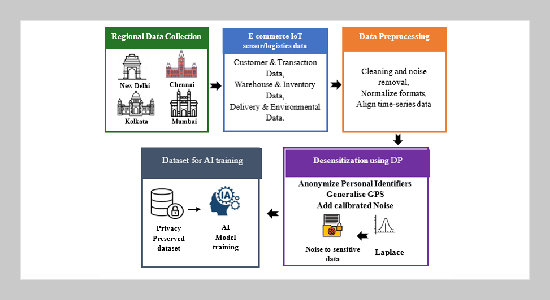
Privacy-Preserving Data Preparation for Regional E-commerce IoT Data
Copyright The Author(s). This is an open access article distributed under the terms of the Creative Commons Attribution License (CC BY 4.0), which permits unrestricted use, distribution, and reproduction in any medium, provided the original author and source are cited.
Download Citation: BibTeX | http://dx.doi.org/10.6180/jase.202610_33.017
Recent developments in e-commerce highlight the importance of AI models, particularly LSTM, for improving sales forecasting and capturing regional patterns. However, challenges remain in handling sensitive customer data, enabling secure cross-regional learning, and addressing regional variability. This study proposes a secure and scalable regional e-commerce forecasting framework integrating Differential Privacy (DP) and Secure Multi
Party Computation (SMPC). The proposed approach achieves strong performance (MAE=0.691, RMSE=0.951, MAPE=0.519, R2=0.9663), ensuring accurate, scalable, and privacy-preserving forecasting.
Keywords: LSTM, Attention Mechanism, E-commerce Sales Forecasting, Regional Data, Sensor Data De-sensitization, Prediction Accuracy
- [1] L. Jian, S. Guo, and S. Yu, (2023) “Effect of Artificial Intelligence on the Development of China’s Wholesale and Retail Trade” Sustainability 15(13): 10524. DOI: 10.3390/su151310524.
- [2] H. Alserhan, R. Altarawneh, N. Alyami, Y. Al-sheyyab, R. Alrababah, and H. Alshamayleh, (2025) “The challenges and opportunities of implementing predictive analytics in marketing strategies and e-commerce personalisation techniques” Asia Pacific Management Review 30(4): 100409. DOI: 10.1016/j.apmrv.2025.100409.
- [3] M. Shili, S. Hammedi, and M. Elkhodr, (2025) “Spatial Intelligence in E-Commerce: Integrating Mobile Agents with GISs for a Dynamic Recommendation System” Algorithms 18(1): 28. DOI: 10.3390/a18010028.
- [4] X. Zhang and C. Guo, (2024) “Research on Multimodal Prediction of E-Commerce Customer Satisfaction Driven by Big Data” Applied Sciences 14(18): 8181. DOI: 10.3390/app14188181.
- [5] Y. M. Tang, K. Y. Chau, Y. Lau, and Z. Zheng, (2023) “Data-Intensive Inventory Forecasting with Artificial Intelligence Models for Cross-Border E-Commerce Service Automation” Applied Sciences 13(5): 3051. DOI: 10.3390/app13053051.
- [6] H. Dong, D. Wang, and S. Bashar, (2026) “E-Commerce Supply Chain Resilience and Sustainability Through AI-Driven Demand Forecasting and Waste Reduction” Sustainability 18(1): 360. DOI: 10.3390/su18010360.
- [7] L. Ni, Z. Huang, and N. Fu, (2025) “A Stacking-Based Fusion Framework for Dynamic Demand Forecasting in E-Commerce” Mathematics 13(21): 3436. DOI: 10.3390/math13213436.
- [8] Y. Pei, J. Zhu, and J. Cao, (2025) “Intergenerational Differences in Impulse Purchasing in Live E-Commerce: A Multi-Dimensional Mechanism of the ASEAN Cross-Border Market” Journal of Theoretical and Applied Electronic Commerce Research 20(4): 268. DOI: 10.3390/jtaer20040268.
- [9] S. Bardak, (2026) “Predicting Smart Tablet Preferences in Turkish E-Commerce Platforms Using Artificial Neural Networks and Machine Learning Techniques” Applied Sciences 16(2): 832. DOI: 10.3390/app16020832.
- [10] F. C. Dumiter and K. B. Schebesch, (2025) “Using Artificial Intelligence to Determine the Impact of E-Commerce on the Digital Economy” Journal of Theoretical and Applied Electronic Commerce Research 20(3): 219. DOI: 10.3390/jtaer20030219.
- [11] Kaggle. Regional Data Collection. Accessed: 2026-03-16. 2026.
- [12] H. Hu, J. Cai, and C. Xu, (2026) “A Mathematical Framework for E-Commerce Sales Prediction Using Attention-Enhanced BiLSTM and Bayesian Optimization” Mathematical and Computational Applications 31(1): 17. DOI: 10.3390/mca31010017.
- [13] S. Yu, M. Guo, X. Chen, J. Qiu, and J. Sun, (2023) “Personalized Movie Recommendations Based on a Multi-Feature Attention Mechanism with Neural Networks” Mathematics 11(6): 1355. DOI: 10.3390/math11061355.
- [14] Z. Huang and J. Liu, (2024) “TransTLA: A Transfer Learning Approach with TCN-LSTM-Attention for Household Appliance Sales Forecasting in Small Towns” Applied Sciences 14(15): 6611. DOI: 10.3390/app14156611.