



School of Foreign Languages, Zhengzhou University of Science and Technology, Zhengzhou China
Received: April 14, 2026
Accepted: May 25, 2026
Publication Date: June 27, 2026
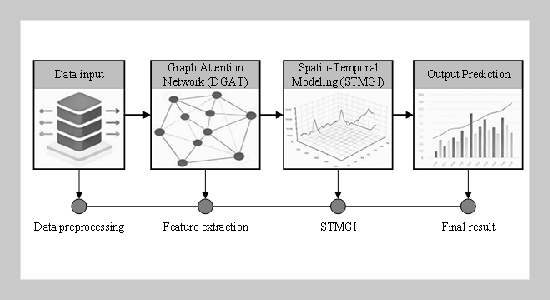
Proposed DGAT-STMGI
Copyright The Author(s). This is an open access article distributed under the terms of the Creative Commons Attribution License (CC BY 4.0), which permits unrestricted use, distribution, and reproduction in any medium, provided the original author and source are cited.
Download Citation: BibTeX | http://dx.doi.org/10.6180/jase.202610_33.016
With the proliferation of online English learning platforms, the information overload problem has become increasingly prominent, making personalized learning resource recommendation a critical research direction. Existing methods often fail to effectively model the complex topological correlations in English learning scenarios and cannot capture learners’ spatio-temporal interest evolution at multiple granularities. To address these issues, this paper proposes a Dual-Graph Attention Network-based Spatio-Temporal Multi-Granularity Interest (DGAT-STMGI) model for English learning resources recommendation. The model constructs two heterogeneous graphs: a Learning Resource Semantic Graph (LRSG) depicting knowledge correlations among resources and a Learner Behavior Interaction Graph (LBIG) representing dynamic interaction patterns between learners and resources. We design a dual-graph attention mechanism to adaptively aggregate semantic and behavioral features, enabling fine-grained feature fusion. Furthermore, we propose a spatio-temporal multi granularity interest encoding module that captures short-term, medium-term, and long-term interest dynamics across temporal scales while integrating spatial topological dependencies. Extensive experiments on two real-world English learning datasets demonstrate that DGAT-STMGI significantly outperforms state-of-the-art recommendation methods in terms of Recall, NDCG, and MAP metrics, with maximum improvements of 8.73%, 7.62%, and 6.94% respectively, validating its effectiveness and superiority.
Keywords: English learning resources recommendation; dual-graph attention network; spatio-temporal multi-granularity interest; heterogeneous graph neural network; personalized recommendation
- [1] Q. Huang and J. Chen, (2024) “Enhancing academic performance prediction with temporal graph networks for massive open online courses” Journal of Big Data 11(1): 52. DOI: 10.1186/s40537-024-00918-5.
- [2] M. Morales-Chan, H. R. Amado-Salvatierra, J. A. Medina, R. Barchino, R. Hernández-Rizzardini, and A. M. Teixeira, (2024) “Personalized feedback in massive open online courses: Harnessing the power of LangChain and OpenAI API” Electronics 13(10): 1960. DOI: 10.3390/electronics13101960.
- [3] A. F. Kineber, N. Elshaboury, S. Mostafa, A. A. Alasow, and M. Arashpour, (2024) “Influence of massive open online courses implementation on satisfaction and continuance intention of students” International Journal of Educational Management 38(4): 1241–1261. DOI: 10.1108/IJEM-08-2023-0411.
- [4] L. Wu, (2021) “Collaborative filtering recommendation algorithm for MOOC resources based on deep learning” Complexity 2021(1): 5555226. DOI: 10.1155/2021/5555226.
- [5] J. Shu, X. Shen, H. Liu, B. Yi, and Z. Zhang, (2018) “A content-based recommendation algorithm for learning resources” Multimedia Systems 24(2): 163–173. DOI: 10.1007/s00530-017-0539-8.
- [6] W. Chen, W. Ma, Y. Jiang, and X. Fan. “GADN: GCN-Based attentive decay network for course recommendation”. In: International conference on knowledge science, engineering and management. Springer. 2022, 529–541. DOI: 10.1007/978-3-031-10983-6_41.
- [7] I. U. Salsabila and A. T. Wibowo. “An Evaluation of the GRU4Rec Model for Sequential Recommendation in the Music Domain”. In: 2025 8th International Seminar on Research of Information Technology and Intelligent Systems (ISRITI). IEEE. 2025, 1018–1023. DOI: 10.1109/ISRITI68345.2025.11393365.
- [8] F. Sun, J. Liu, W. Ou, C. Pei, X. Lin, W. Ou, and P. Jiang. “BERT4Rec: Sequential recommendation with bidirectional encoder representations from transformer”. In: Proceedings of the 28th ACM international conference on information and knowledge management. 2019, 1441–1450. DOI: 10.1145/3357384.3357895.
- [9] F. Messaoudi and M. Loukili. “E-commerce personalized recommendations: a deep neural collaborative filtering approach”. In: Operations Research Forum. 5. 1. Springer. 2024, 5. DOI: 10.1007/s43069-023-00286-5.
- [10] M. Mouhiha, O. Ait Oualhaj, and A. Mabrouk. “Combining collaborative filtering and content based filtering for recommendation systems”. In: 2024 11th International Conference on Wireless Networks and Mobile Communications (WINCOM). IEEE. 2024, 1–6. DOI: 10.1109/WINCOM62286.2024.10658169.
- [11] J. Yu, L. Zhao, S. Yin, and M. Ivanović, (2024) “News recommendation model based on encoder graph neural network and bat optimization in online social multimedia art education” Computer Science and Information Systems 21(3): 989–1012. DOI: 10.2298/CSIS231225025Y.
- [12] Y. Jiang and S. Yin, (2023) “Heterogenous-view occluded expression data recognition based on cycle-consistent adversarial network and K-SVD dictionary learning under intelligent cooperative robot environment” Computer Science and Information Systems 20(4): 1869–1883. DOI: 10.2298/CSIS221228034J.
- [13] M. Pineda-Moncusí, F. Allery, A. Delmestri, T. Bolton, J. Nolan, J. H. Thygesen, A. Handy, A. Banerjee, S. Denaxas, C. Tomlinson, et al., (2024) “Ethnicity data resource in population-wide health records: completeness, coverage and granularity of diversity” Scientific data 11(1): 221. DOI: 10.1038/s41597-024-02958-1.
- [14] X. Liu, J. Tian, P. Duan, Q. Yu, G. Wang, and Y. Wang, (2024) “GrMoNAS: a granularity-based multi-objective NAS framework for efficient medical diagnosis” Computers in Biology and Medicine 171: 108118. DOI: 10.1016/j.compbiomed.2024.108118.
- [15] Y. Liu, S. Wen, Q. Wu, Y. Yi, Y. Wang, and X. Zhu, (2026) “Adaptive dynamic training heterogeneous graph attention neural network for microRNA-disease association prediction and analysis framework” Engineering Applications of Artificial Intelligence 176: 114812. DOI: 10.1016/j.engappai.2026.114812.
- [16] C. Wang and P. Yue, (2024) “Learning resource recommendation model based on collaborative knowledge graph attention networks” IEEE Access 12: 153232–153242. DOI: 10.1109/ACCESS.2024.3477740.
- [17] J. Chen, D. Meng, X. Gao, L. Zhang, and C. Kong. “AGNE: Attentional Graph Convolutional Network Embedding for Knowledge Concept Recommendation in MOOCs”. In: International Conference on Web Information Systems and Applications. Springer. 2024, 463–475. DOI: 10.1007/978-981-97-7707-5_38.
- [18] P. Boonmee, J. Namwong, P. Hiranpanit, P. Butsing, S. Kongyoung, C. Damrongrat, et al. “Text Segmentation Strategies for Low-Resource Language Documents: A Study on Thai Government Texts in RAG”. In: 2026 18th International Conference on Knowledge and Smart Technology (KST). IEEE. 2026, 219–224. DOI: 10.1109/KST67832.2026.11432385.
- [19] F. Faisal, (2025) “Recommendation Model for Learning Materials Using Graph Neural Networks Based on Conceptual Relationships and Difficulty Level of the Materials” RIGGS: Journal of Artificial Intelligence and Digital Business 4(3): 8313–8320. DOI: 10.31004/riggs.v4i3.3247.
- [20] W. F. Ramdana, S. Suakanto, A. Musnansyah, S. C. R. Rijadi, et al. “Smart Book Recommendation System with Item-Based Collaborative Filtering to Improve Resource Discovery: A Case Study in Bandung Library”. In: 2025 International Conference on ICT for Smart Society (ICISS). IEEE. 2025, 1–6. DOI: 10.1109/ICISS66954.2025.11389434.