




Jiangjiang Li1,2, Lijuan Feng1,2, Junyan Zhao1,2, and Jingfen Li1,2
1School of Electronics and Electrical Engineering, Zhengzhou University of Science and Technology, 450064, Zhengzhou, China
2Zhengzhou Intelligent Safety Control Engineering Research Center for Unmanned Aerial Vehicles
Received: March 26, 2026
Accepted: May 18, 2026
Publication Date: June 15, 2026
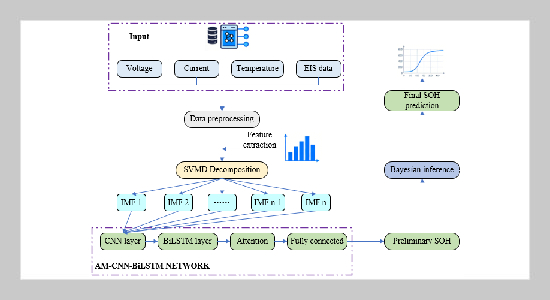
Proposed lithium battery SOH prediction model
Copyright The Author(s). This is an open access article distributed under the terms of the Creative Commons Attribution License (CC BY 4.0), which permits unrestricted use, distribution, and reproduction in any medium, provided the original author and source are cited.
Download Citation: BibTeX | http://dx.doi.org/10.6180/jase.202610_33.014
Precise estimation of lithium-ion battery State of Health (SOH) is essential for the safe and efficient operation of energy systems and electronic devices. However, nonlinear degradation, multimodal noise, and prediction uncertainty limit the accuracy and credibility of traditional models. To address this, we propose a novel SOH prediction model integrating multimodal signal decomposition and uncertainty quantification. First, Successive Variational Mode Decomposition (SVMD) separates degradation features from noise by decomposing multimodal monitoring signals (voltage, current, temperature, and EIS) into intrinsic modal functions (IMFs). Second, an AM-CNN-BiLSTM hybrid network extracts deep spatial-temporal features from the IMFs for preliminary SOH prediction. Third, an MCMC-based Bayesian inference framework quantifies prediction uncertainty (data noise, model parameters, and extraction errors), providing a probability distribution that improves overall model credibility. Validated on the NASA and Oxford datasets against traditional and advanced models (including Battery GPT), the proposed method outperformed comparisons, achieving an RMSE under 0.46%, a MAPE under 0.91%, and a determination coefficient above 0.991. Additionally, uncertainty quantification showed a prediction interval coverage probability (PICP) of 95.2% at a 95% confidence level. Ultimately, this model provides a high-precision, credible technical approach with strong engineering prospects for Battery Management Systems (BMS).
Keywords: Lithium battery; State of Health (SOH); Multimodal signal decomposition; Successive Variational Mode Decomposition (SVMD); Uncertainty quantification; Bayesian inference
- [1] A. Pazhouheshgar, P. N. Nowruzmahaleh, A. Shokrieh, A. Barati, I. Soluki, M. Shokrieh, Z. Wei, and T. Yao, (2026) “Mechanical characterization of flexible lithium-ion battery components: A multi-testing strategy” Journal of Energy Storage 156: 121599. DOI: 10.1016/j.est.2026.121599.
- [2] Y. Wu, X. Long, L. Li, L. Liu, Y. Wu, and Z. Zeng, (2026) “Construction of high-mass loading dry-pressed lithium-ion battery electrodes with excellent flexibility via one-dimensional carbon nanomaterials” Journal of Energy Storage 156: 121668. DOI: 10.1016/j.est.2026.121668.
- [3] J. Lu, R. Xiong, J. Tian, C. Wang, and F. Sun, (2023) “Deep learning to estimate lithium-ion battery state of health without additional degradation experiments” Nature Communications 14(1): 2760. DOI: 10.1038 / s41467-023-38458-w.
- [4] G. Nuroldayeva, Y. Serik, D. Adair, B. Uzakbaiuly, and Z. Bakenov, (2023) “State of health estimation methods for lithium-ion batteries” International Journal of Energy Research 2023(1): 4297545. DOI: 10.1155/2023/4297545.
- [5] Y. Li, S. Zhong, Q. Zhong, and K. Shi, (2019) “Lithium-ion battery state of health monitoring based on ensemble learning” IEEE access 7: 8754–8762. DOI: 10.1109/ACCESS.2019.2891063.
- [6] S. Amir, M. Gulzar, M. O. Tarar, I. H. Naqvi, N. A. Zaffar, and M. G. Pecht, (2022) “Dynamic equivalent circuit model to estimate state-of-health of lithium-ion batteries” IEEE Access 10: 18279–18288. DOI: 10.1109 / ACCESS.2022.3148528.
- [7] C. Li, L. Yang, Q. Li, Q. Zhang, Z. Zhou, Y. Meng, X. Zhao, L. Wang, S. Zhang, Y. Li, et al., (2024) “SOH estimation method for lithium-ion batteries based on an improved equivalent circuit model via electrochemical impedance spectroscopy” Journal of Energy Storage 86: 111167. DOI: 10.1016/j.est.2024.111167.
- [8] G. Sun, Y. Liu, and X. Liu, (2025) “A method for estimating lithium-ion battery state of health based on physics-informed machine learning” Journal of Power Sources 627: 235767. DOI: 10.1016/j.jpowsour.2024.235767.
- [9] S. Peng, Y. Sun, D. Lu, Q. Yu, J. Kan, and M. Pecht, (2023) “State of health estimation of lithium-ion batteries based on multi-health features extraction and improved long short-term memory neural network” Energy 282: 128956. DOI: 10.1016/j.energy.2023.128956.
- [10] Y. Tan and G. Zhao, (2019) “Transfer learning with long short-term memory network for state-of-health prediction of lithium-ion batteries” IEEE Transactions on Industrial Electronics 67(10): 8723–8731. DOI: 10.1109/TIE.2019.2946551.
- [11] Z. Zhang, H. Min, H. Guo, Y. Wu, S. Sun, J. Jiang, and H. Zhao, (2023) “State of health estimation method for lithium-ion batteries using incremental capacity and long short-term memory network” Journal of Energy Storage 64: 107063. DOI: 10.1016/j.est.2023.107063.
- [12] N. Xiang, T. Zhang, and Y. Liu, (2025) “State of health prediction for lithium-ion batteries using extended long short-term memory network and frequency enhanced channel attention mechanism with variational mode decomposition” Measurement 249: 117084. DOI: 10.1016/j.measurement.2025.117084.
- [13] L. Hu, W. Wang, and G. Ding, (2023) “RUL prediction for lithium-ion batteries based on variational mode decomposition and hybrid network model” Signal, Image and Video Processing 17(6): 3109–3117. DOI: 10.1007/s11760-023-02532-z.
- [14] Y. Liu, X. Hou, and Y. Xu, (2026) “Battery state-of-health prediction based on feature extraction and a variational mode decomposition–temporal convolutional network–bidirectional long short-term memory network–self-attention model” Journal of Energy Storage 156: 121629. DOI: 10.1016/j.est.2026.121629.
- [15] S. Yin, H. Li, M. Ivanović, T. Chen, and L. Teng, (2026) “FNNMFF: Crop pests and diseases detection based on fuzzy neural network and multilevel feature fusion in remote sensing images” Computer Science and Information Systems (00): 12–12. DOI: 10.2298/CSIS251109012Y.
- [16] S. Yin, L. Wang, T. Chen, H. Huang, J. Gao, J. Zhang, M. Liu, P. Li, and C. Xu, (2026) “LKAFormer: A lightweight kolmogorov-arnold transformer model for image semantic segmentation” ACM Transactions on Intelligent Systems and Technology 17(3): 1–24. DOI: 10.1145/3759254.
- [17] Y. Jiang and S. Yin, (2023) “Heterogenous-view occluded expression data recognition based on cycle-consistent adversarial network and K-SVD dictionary learning under intelligent cooperative robot environment” Computer Science and Information Systems 20(4): 1869–1883. DOI: 10.2298/CSIS221228034J.
- [18] J.-H. Kim, E. Kwak, J. Jeong, and K.-Y. Oh, (2023) “Physics-informed Markov chain model to identify degradation pathways of lithium-ion cells” IEEE Transactions on Transportation Electrification 10(2): 3468–3481. DOI: 10.1109/TTE.2023.3302043.
- [19] H. Xu, Y. Peng, and L. Su. “Health state estimation method of lithium ion battery based on NASA experimental data set”. In: IOP Conference Series: Materials Science and Engineering. 452. 3. IOP Publishing. 2018, 032067. DOI: 10.1088/1757-899X/452/3/032067.
- [20] M. A. Khan, S. Thatipamula, L. Tresca, L. Xu, A. Trewartha, and S. Onori, (2025) “High-power lithium-ion battery characterization dataset for stochastic battery modeling” Scientific Data 12(1): 1506. DOI: 10.1038/s41597-025-05725-y.
- [21] Q. Xing, X. Sun, Y. Fu, and K. Wang, (2025) “Lithium-ion battery health state estimation based on electrochemical impedance spectroscopy and CNN-BiLSTM-Attention” Ionics 31(2): 1389–1403. DOI: 10.1007/s11581-024-05982-8.
- [22] D. Zhou, Y. Sun, Q. Hu, Y. Shi, J. Yu, and J. Zhang, (2025) “Generative pre-trained transformers (GPT) for lithium-ion battery charging state prediction in battery swapping station” Sustainable Energy Technologies and Assessments 82: 104526. DOI: 10.1016/j.seta.2025.104526.