





Received: February 9, 2026
Accepted: May 13, 2026
Publication Date: June 15, 2026
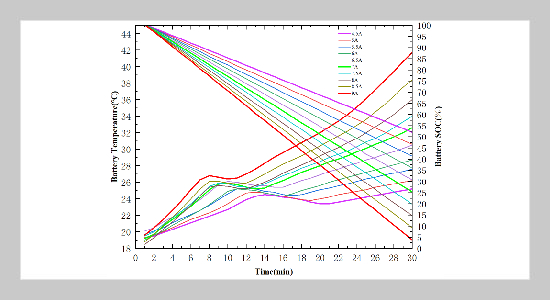
Battery Temperature–Current–SOC Coupling Relationship Diagram.
Copyright The Author(s). This is an open access article distributed under the terms of the Creative Commons Attribution License (CC BY 4.0), which permits unrestricted use, distribution, and reproduction in any medium, provided the original author and source are cited.
Download Citation: BibTeX | http://dx.doi.org/10.6180/jase.202610_33.010
In lithium-ion battery systems for UAVs, the ternary coupling relationship between temperature, State of Charge (SOC), and current exerts a decisive impact on battery performance and safety. Through multi-parameter collaborative experiments combined with thermodynamic modeling to analyze the system’s energy conversion and heat transfer processes, this study reveals the dynamic evolution laws of the coupling relationship. Experimental results indicate that distinct SOC intervals exhibit significantly differentiated coupling behaviors during constant current discharge. in the high SOC stage ( 80%−100% ), the three parameters show an approximately linear relationship. in the medium SOC stage ( 30%−80% ), due to the coupling of internal resistance with SOC and heat conduction effects, the temperature presents a non-monotonic “rise-fall-rise again” variation; in the low SOC stage (<30%), a positive feedback loop of “internal resistance-heat generation-temperature rise” is triggered by the strong coupling effect between internal resistance and electrode polarization. Although derived with heat capacity simplification and internal resistance approximation, the explicit solution of the thermal equation derived from thermodynamic modeling can although adopting heat capacity simplification and internal resistance approximation, and only applicable to constant current discharge conditions, can still be applied to battery BMS after engineering adaptation and a hierarchical early warning matrix integrating the current-SOC-temperature relationship is constructed, providing a theoretical and practical application basis for the intelligent thermal management of UAV batteries.
Keywords: Lithium-ion batteries for UAVs; Ternary coupling relationship; Thermodynamic modeling; Hierarchical early warning matrix
- [1] G. Chen, X. Xia, X. Zhao, X. Zeng, T. Ouyang, and H. Feng, (2025) “A balanced SOH-SOC control strategy for multiple battery energy storage units based on battery lifetime change laws” Electrical Engineering 107(6): 7725–7736. DOI: 10.1007/s00202-024-02944-1.
- [2] R.-P. Zhang, X.-G. Shi, D.-C. Wei, Y.-q. Wang, W. Yin, and Y. Cheng, (2025) “Multistage Variable Current Pulse Charging Strategy Based on Polarization Characteristics of Lithium-Ion Battery” IEEE Transactions on Energy Conversion 40(1): 422–436. DOI: 10.1109/TEC.2024.3446168.
- [3] W. Q. T. Poh, Y. Xu, W. Liu, and R. T. P. Tan, (2025) “Momentary informatics based data-driven estimation of lithium-ion battery health under dynamic discharging currents” Journal of Power Sources 629: 236041. DOI: 10.1016/j.jpowsour.2024.236041.
- [4] Y. Zhang, X. Lai, X. Zhang, Y. Fan, E. Cheng, Y. Zheng, X. Tang, B. Tang, and Z. Zhu, (2025) “Fusion of stress and electrical signals for high-accuracy joint estimation of SOC and SOH in lithium-ion batteries” Energy 331: 137063. DOI: 10.1016/j.energy.2025.137063.
- [5] X. Zhang, Y. Wang, and Z. Chen, (2023) “SoC-modified core temperature estimation of lithium-ion battery based on control-oriented electro-thermal model” IEEE transactions on power electronics 38(9): 11642–11651. DOI: 10.1109/TPEL.2023.3288539.
- [6] A. Tabine, A. Elachhab, S. Bouzaid, C. Ennawaoui, A. Hajjaji, et al., (2024) “A novel fitting polynomial approach for an accurate SOC estimation in Li-ion batteries considering temperature hysteresis” E-Prime-Advances in Electrical Engineering, Electronics and Energy 10: 100822. DOI: 10.1016/j.prime.2024.100822.
- [7] L. Jiang, Y. Huang, Y. Li, J. Yu, X. Qiao, C. Huang, and Y. Cao, (2020) “Optimization of variable-current charging strategy based on SOC segmentation for Li-ion battery” IEEE Transactions on Intelligent Transportation Systems 22(1): 622–629. DOI: 10.1109/TITS.2020.3006092.
- [8] J. Qu, Z. Jiang, and J. Zhang, (2022) “Investigation on lithium-ion battery degradation induced by combined effect of current rate and operating temperature during fast charging” Journal of Energy Storage 52: 104811. DOI: 10.1016/j.est.2022.104811.
- [9] I. Permana, A. P. Agharid, F. Wang, and S. H. Lin, (2023) “Performance investigation of thermal management system on battery energy storage cabinet” Thermal Science 27(6 Part A): 4389–4400. DOI: 10.2298/TSCI221227154P.
- [10] M. Yang, H. Shi, Y. Zhu, Y. Zou, L. Xiong, and Q. Huang, (2026) “A novel polynomial-activated neural network with locally weighted scatterplot smoothing for small-sample state-of-charge estimation in lithium-ion batteries” Journal of Energy Storage 149: 120325. DOI: 10.1016/j.est.2025.120325.
- [11] J. Lee, M. Lee, S. Cho, Y. Kim, J. Oh, and J. Kim, (2026) “Enhanced battery state of health estimation with long short-term memory employing analytic hierarchy process and the extraction of multi-criteria optimized impedance factors” Journal of Energy Storage 152: 120588. DOI: 10.1016/j.est.2026.120588.
- [12] L. Wang, J. Wu, C. Ma, X. Sun, L. Wang, and C. Liao, (2026) “Coupling Model and Early-Stage Internal Short Circuits Fault Diagnosis for Gel Electrolyte Lithium-Ion Batteries” Batteries 12(2): 45. DOI: 10.3390/batteries12020045.
- [13] A. Esmaeilzadeh, M. Silakhori, N. N. Nik Ghazali, H. S. C. Metselaar, A. Bin Mamat, M. S. Naghavi Sanjani, and S. Iranmanesh, (2020) “Thermal performance and numerical simulation of the 1-pyrene carboxylic-acid functionalized graphene nanofluids in a sintered wick heat pipe” Energies 13(24): 6542. DOI: 10.3390/en13246542.
- [14] S. Rangasamy, R. R. V. Raghavan, R. M. Elavarasan, and P. Kasinathan, (2023) “Energy analysis of flattened heat pipe with nanofluids for sustainable electronic cooling applications” Sustainability 15(6): 4716. DOI: 10.3390/su15064716.
- [15] W. Li, T. Yang, L. Chen, J. Shi, T. Zhang, C. Zeng, R. Liu, and S. Tang, (2025) “Thermal management study of cylindrical battery using novel thermally conductive anisotropic flexible phase change material” Case Studies in Thermal Engineering 73: 106508. DOI: 10.1016/j.csite.2025.106508.
- [16] P. K. Chittoor and B. Chokkalingam, (2023) “Wireless electrification system for photovoltaic powered autonomous drone charging” IEEE Transactions on Transportation Electrification 10(2): 3002–3011. DOI: 10.1109/TTE.2023.3305022.
- [17] P. K. Chittoor and C. Bharatiraja, (2023) “Building integrated photovoltaic powered wireless drone charging system” Solar Energy 252: 163–175. DOI: 10.1016/j.solener.2023.01.056.
- [18] A. Nair, C. Bharatiraja, S. Devakirubakaran, et al. “Pv-powered wireless drone charging station assisted with tracked-vision”. In: 2023 Second International Conference on Electrical, Electronics, Information and Communication Technologies (ICEEICT). IEEE. 2023, 1–5. DOI: 10.1109/ICEEICT56924.2023.10157708.
- [19] P. K. Chittoor and C. Bharatiraja, (2022) “Wireless-sensor communication based wireless-charging coil positioning system for UAVs with maximum power point tracking” IEEE Sensors Journal 22(8): 8175–8182. DOI: 10.1109/JSEN.2022.3156089.
- [20] P. K. Chittoor, B. Chokkalingam, and L. Mihet-Popa, (2021) “A review on UAV wireless charging: Fundamentals, applications, charging techniques and standards” IEEE access 9: 69235–69266. DOI: 10.1109/ACCESS.2021.3077041.
- [21] B. Sun, D. Song, H. Ruan, W. Zhang, and K. Zheng, (2023) “Parameter identification method of thermal model of lithium-ion battery based on self-generated heat and external heat transfer” Transactions of China Electrotechnical Society 39: 278–288. DOI: 10.19595/j.cnki.1000-6753.tces.222104.