




Delong Zhang1, Min Zhang2 and Yongbo Liu3
1School of Electric Automation, Weifang University of Science and Technology, Weifang 262700, P.R. China
2Department of Mechanical and Electronic Engineering, Shandong Management University, Ji’nan 250357, P.R. China
3Department of City Management, Hunan City University, Yiyang, Hunan 413000, P.R. China
Received: December 30, 2016
Accepted: October 28, 2018
Publication Date: June 20, 2026
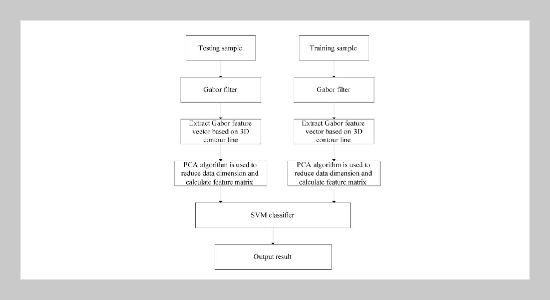
The proposed 3D face recognition.
Copyright The Author(s). This is an open access article distributed under the terms of the Creative Commons Attribution License (CC BY 4.0), which permits unrestricted use, distribution, and reproduction in any medium, provided the original author and source are cited.
Download Citation: BibTeX | http://dx.doi.org/10.6180/jase.201903_22(1).0016
Face recognition based on 2D face images is still challenged by the large change of illumination, pose and expression after more than 10 years’ research and its recognition rate is still far away from satisfaction under the change of the above three factors. Gabor wavelet and support vector machine
(SVM) are studied. Gabor wavelet has good biological neurons function, and good adaptive change to illumination. Furthermore, SVM can provide good classification effect. Gabor wavelet and SVM are combined with PCA to improve recognition rate of humanface. Besides, we put forward a kind of Gabor wavelet feature extraction method based on three-dimensional human face contour line. Five different types of human face recognition are used to verify the effectiveness of this algorithm. The experiment results show that the proposed scheme has higher recognition rate than several traditional schemes.
Keywords: Three Dimension Face Recognition, Gabor Wavelet, Support Vector Machine, Feature Extraction
- [1] Ahonen, T., A. Hadid, and M. Pietikainen (2006) Face description with local binary patterns: Application to face recognition, IEEE Trans. Pattern Anal. Mach. Intell. 28(12), 2037–2041. doi: 10.1109/TPAMI.2006.244
- [2] Choi, J. Y., W. D. Neve, K. N. Plataniotis, and Y. M. Ro (2011) Collaborative face recognition for improved face annotation in personal photo collections shared on online social networks, IEEE Trans. Multimedia 13(1), 14–28. doi: 10.1109/TMM.2010.2087320
- [3] Sun, Y., Y. Chen, X. Wang, and X. Tang (2014) Deep learning face representation by joint identification-verification, Proc. Adv. Neural Inf. Process. Syst. 1988–1996.
- [4] Arashloo, S. R., and J. Kittler (2014) Dynamic texture recognition using multiscale binarised statistical image features, IEEE Trans. Multimedia 16(8), 2099–2109. doi: 10.1109/TMM.2014.2362855
- [5] Ding, C., C. Xu, and D. Tao (2015) Multi-task pose-invariant face recognition, IEEE Trans. Image Process 24(3), 980–993. doi: 10.1109/TIP.2015.2390959
- [6] Hsieh, C. K., S. H. Lai, and Y. C. Chen (2009) Expression-invariant face recognition with constrained optical flow warping, IEEE Trans. Multimedia 11(4), 600–610. doi: 10.1109/TMM.2009.2017606
- [7] Paysan, P., R. Knothe, B. Amberg, S. Romdhani, and T. Vetter (2009) A 3D face model for pose and illumination invariant face recognition, Proc. IEEE Int. Conf. Adv. Video Signal Based Surveillance, 296–301. doi: 10.1109/AVSS.2009.58
- [8] Li, K. S., K. Li, and W. S. Zhang (2014) PCA face recognition algorithm based on improved BP neural network, Computer Applications and Software 31(1), 158–161.
- [9] Wu, D. (2015) Multiple Information Fusion Face Recognition Research Based on Key Feature Points, Harbin: Harbin University of Science and Technology.
- [10] Imtiaz, H., and S. A. Fattah (2012) A curvelet domain face recognition scheme based on local dominant feature extraction, ISRN Signal Process 12, 1–13. doi: 10.5402/2012/386505
- [11] Luan, F., L. Lin, and Y. Wang (2010) 4-step face authentication algorithm based on SVM, 2010 Third Int. Symp. Intell. Inf. Technol. Secure. Informatics 1(2), 534–538. doi: 10.1109/IITSI.2010.99
- [12] Veerabhadrappa, L. Rangarajan (2010) Diagonal lo-cality preserving projection as dimensionality reduction technique with application to face recognition, Image (Rochester N.Y.), 135–140.
- [13] Nair, A. R., B. C. Pilla, and E. George (2014) Multi feature face identification using hash table & binary tree classifier, International Journal of Advance Research in Computer Science and Management Studies 261–272.
- [14] Huang, H., H. Liu, and G. Liu (2012) Face recognition using pyramid histogram of oriented gradients and SVM, Int. J. Adv. Inf. Sci. Serv. Sci. 4(18), 1–8. doi: 10.4156/aiss.vol4.issue18.1
- [15] Lei, Y. J., B. Mohammed, and A. E. S. Amar (2013) An efficient 3D face recognition approach based on the fusion of novel local low-level features, Pattern Recognition 46(1), 24–37. doi: 10.1016/j.patcog.2012.06.023
- [16] Zeng, X. H., and X. W. Li (2014) Improving face recognition with linear discriminant regression classification based on fisher criterion, Computer Applications and Software 31(9), 184–186.
- [17] Li, Y. A., Y. J. Shen, G. D. Zhang, T. H. Yuan, X. J. Xiao, and H. L. Xu (2010) An efficient 3D face recognition method using geometric features, IEEE 2nd International Workshop on Intelligent Systems and Applications (ISA), 1–4. doi: 10.1109/IWISA.2010.5473292
- [18] Yashar, T., H. Ghassemian, and N. M. Mohammad (2012) 3D face recognition method using 2DPCA-Euclidean distance classification, ACEEE International Journal on Control System and Instrumentation 3(1), 1–5.
- [19] Lei, Y., M. Bennamoun, M. Hayat, and Y. Guo (2014) An efficient 3D face recognition approach using local geometrical signatures, Pattern Recognition 46(2), 509–524. doi: 10.1016/j.patcog.2013.07.018
- [20] Zhao, X., E. Dellandrea, L. Chen, and I. Kakadiaris (2011) Accurate land-marking of three-dimensional facial data in the presence of facial expressions and occlusions using a three-dimensional statistical facial feature model, IEEE Transactions on Systems Man and Cybernetics Part B: Cybernetics 41(5), 1417–1428. doi: 10.1109/TSMCB.2011.2148711
- [21] Jin, Y., Y. Z. Wang, Q. Q. Ruan, and X. Q. Wang (2011) A new scheme for 3D face recognition based on 2D gabor wavelet transform plus LBP, International Conference on Computer Science & Education, 860–865. doi: 10.1109/ICCSE.2011.6028773
- [22] Torkhani, G., A. Ladgham, A. Sakly, and M. N. Mansouri (2017) A 3D–2D face recognition method based on extended gabor wavelet combining curvature and edge detection, Signal Image & Video Processing 11(5), 1–8. doi: 10.1007/s11760-016-1046-7
- [23] Vinay, A., V. S. Shekhar, K. N. Balasubramanya Murthy, and S. Natarajan (2015) Face recognition using gabor wavelet features with PCA and KPCA – a comparative study,” Procedia Computer Science 57, 650– 659. doi: 10.1016/j.procs.2015.07.434
- [24] Kar, A., D. Bhattacharjee, D. K. Basu, M. Nasipuri, and M. Kundu (2013) Human face recognition using gabor based kernel entropy component analysis, International Journal of Computer Vision and Image Processing 2(3), 167–174.