




Qiufeng Fan1, Fanbo Hou1, and Feng Shi1
1School of Electronic Information Electrical Engineering, Anyang Institute of Technology Anyang 455000,China
Received: November 20, 2019
Accepted: March 31, 2020
Publication Date: May 10, 2026
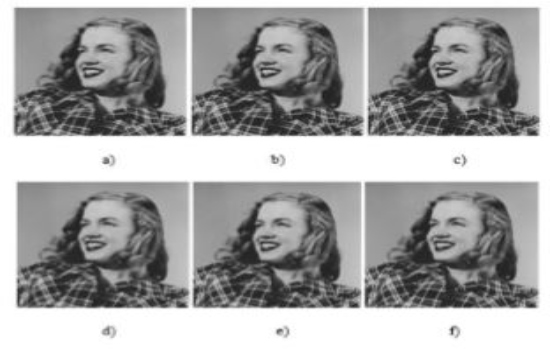
Image Marilyn denoising results and experiment contrast. (a) DMS; (b) NWT; (c) PNM; (d) EGL; (e) NLG; (f) Proposed.
Copyright The Author(s). This is an open access article distributed under the terms of the Creative Commons Attribution License (CC BY 4.0), which permits unrestricted use, distribution, and reproduction in any medium, provided the original author and source are cited.
Download Citation: BibTeX | http://dx.doi.org/10.6180/jase.202009_23(3).0019
In the process of image acquisition and transmission, the image will be polluted by noise. Therefore, we propose a bent identity-based convolutional neural network (BICNN) model. The model is a full convolu-tional network model with a depth of 30 layers, consisting of six feature extraction modules (FEM) and skip connection. Skip connection combines the output features of the first convolution layer with the output features of each FEM in series to guarantee the full extraction of image’s features. Then we adopt the residual learning to alleviate the gradient disappearance and improve the convergence speed so as to ensure that the nonlinear mapping acquired by the trained denoising model is image noise. Bent identity is selected as the activation function, which has soft saturation and the output mean is close to zero, which can enhance the robustness of the model against input noise and accelerate the convergence of the model. Our extensive experiments demonstrate that our BICNN model can not only exhibit high effec-tiveness in several general image denoising tasks, but also make it highly attractive for practical denoising applications.
Keywords: Image denoising; Bent identity activation function; convolutional neural network; FEM
- [1] Shoulin Yin, Ye Zhang, and Shahid Karim. Large Scale Remote Sensing Image Segmentation Based on Fuzzy Region Competition and Gaussian Mixture Model. IEEE Access, 6:26069–26080, may 2018.
- [2] Lin Teng, Hang Li, and Shoulin Yin. Modified pyramid dual tree direction filter-based image denoising via curvature scale and nonlocal mean multigrade remnant filter. International Journal of Communication Systems, 31(16), nov 2018.
- [3] Shoulin Yin and Jing Bi. Medical image annotation based on deep transfer learning. Journal of Applied Science and Engineering, 22(2):385–390, 2019.
- [4] Ayesha Saadia and Adnan Rashdi. Incorporating fractional calculus in echo-cardiographic image denoising. Computers and Electrical Engineering, 67:134–144, apr 2018.
- [5] Lin Teng and Hang Li. CSDK: A Chi-square distribution-Kernel method for image de-noising under the Internet of things big data environment. International Journal of Distributed Sensor Networks, 15(5), may 2019.
- [6] Kostadin Dabov, Alessandro Foi, and Karen Egiazarian. Video denoising by sparse 3D transform-domain collaborative filtering. In European Signal Processing Conference, pages 145–149, 2007.
- [7] Wensen Feng, Peng Qiao, and Yunjin Chen. Fast and Accurate Poisson Denoising with Trainable Nonlinear Diffusion. IEEE Transactions on Cybernetics, 48(6):17081719, jun 2018.
- [8] Kai Zhang, Wangmeng Zuo, Yunjin Chen, Deyu Meng, and Lei Zhang. Beyond a Gaussian denoiser: Residual learning of deep CNN for image denoising. IEEE Transactions on Image Processing, 26(7):3142–3155, jul 2017.
- [9] Kai Zhang, Wangmeng Zuo, and Lei Zhang. FFDNet: Toward a fast and flexible solution for CNN-Based image denoising. IEEE Transactions on Image Processing, 27(9):4608–4622, sep 2018.
- [10] Kenzo Isogawa, Takashi Ida, Taichiro Shiodera, and Tomoyuki Takeguchi. Deep shrinkage convolutional neural network for adaptive noise reduction. IEEE Signal Processing Letters, 25(2):224–228, feb 2018.
- [11] Shoulin Yin, Ye Zhang, and Shahid Karim. Region search based on hybrid convolutional neural network in optical remote sensing images. International Journal of Distributed Sensor Networks, 15(5), may 2019.
- [12] Boyang Chen, Xuan Feng, Ronghua Wu, Qiang Guo, Xi Wang, and Shiming Ge. Adaptive wavelet filter with edge compensation for remote sensing image denoising. IEEE Access, 7:91966–91979, 2019.
- [13] Hongqiang Ma, Shiping Ma, Yuelei Xu, and Mingming Zhu. Deep Marginalized Sparse Denoising AutoEncoder for Image Denoising. In Journal of Physics: Conference Series, volume 960, 2018.
- [14] Lu Jing-Yi, Lin Hong, Ye Dong, and Zhang Yan-Sheng. A New Wavelet Threshold Function and Denoising Application. Mathematical Problems in Engineering, 2016, 2016.
- [15] Fang Huang, Bo Lan, Jian Tao, Yinjie Chen, Xicheng Tan, Jie Feng, and Yan Ma. A Parallel Nonlocal Means Algorithm for Remote Sensing Image Denoising on an Intel Xeon Phi Platform. IEEE Access, 5:8559–8567, 2017.
- [16] Yibin Tang, Ying Chen, Ning Xu, Aimin Jiang, and Lin Zhou. Image denoising via sparse coding using eigenvectors of graph Laplacian. Digital Signal Processing: A Review Journal, 50:114–122, mar 2016.
- [17] Hongjun Li and Ching Y. Suen. A novel Non-local means image denoising method based on grey theory. Pattern Recognition, 49:237–248, jan 2016.