




V. Sathyendra Kumar1 and A. Muthukumaravel2
1Department of Master of Computer Applications, Annamacharya Institute of Technology and Sciences, Rajampet, India
2Faculty of Arts & Science, Bharath Institute of Higher Education Research, Chennai, India
Received: February 24, 2020
Accepted: April 30, 2020
Publication Date: May 10, 2026
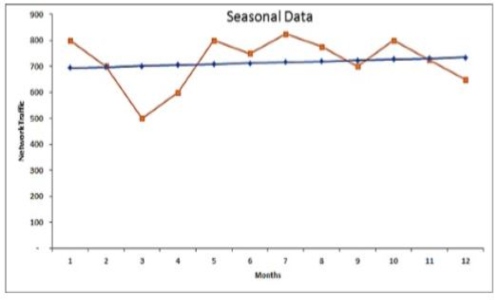
Seasonal Data of Users with Linear Trend.
Copyright The Author(s). This is an open access article distributed under the terms of the Creative Commons Attribution License (CC BY 4.0), which permits unrestricted use, distribution, and reproduction in any medium, provided the original author and source are cited.
Download Citation: BibTeX | http://dx.doi.org/10.6180/jase.202009_23(3).0011
Recently, the popularity of predictive analytics has grown in many areas. For mobile networks, it is the most critical technique that can offer the advantages of mobile network planning to operators for predicting the mobile traffic of each Long Term Evolution (LTE) market. It can help operators spend the least investment on new sites and new communities but can guarantee an excellent service experience for mobile broadband users. Mobility management essentially has two databases: one is the Home Location Register (HLR) and the other the Visitor Location Register (VLR) is. The mobile user can move to call tracking from anywhere in the network location registry. In mobile data networks, an essential factor is a demand for telecommunications containing the number of subscribers and the prices for the required service data. To understand what subscribers need to build customer satisfaction, this requirement needs to be precisely predicted. In this context, the approach to forecasting mobile telephony used in Indian telecommunications, in our view, does not fully take into account the demand for data already recorded on its core network. In this paper, we are analyzing the Seasonal Forecast Time series model (SFT). This approach is used in this paper to first analyze the transferred data traffic from the core network of the operator to find a suitable model describing the inherent characteristics of data traffic and the use of model for future predictive loading in VLR database.
Keywords: Mobile Data Traffic; Seasonality forecasting; Time series analysis; HLR-VLR databases
- [1] Yanhua Yu, Meina Song, Yu Fu, and Junde Song. Traffic prediction in 3G mobile networks based on multifractal exploration. Tsinghua Science and Technology, 18(4):398–405, 2013.
- [2] Mohammad Kawser. Downlink SNR to CQI Mapping for Different MultipleAntenna Techniques in LTE. International Journal of Information and Electronics Engineering, 2012.
- [3] K Penikousis. Wireless and Mobile Network Architectures. Computer Communications, 25(10):991–992, 2002.
- [4] Philipp Svoboda, Manfred Buerger, and Markus Rupp. Forecasting of traffic load in a live 3G packet switched core network. In Proceedings of the 6th International Symposium Communication Systems, Networks and Digital Signal Processing, CSNDSP 08, pages 433–437, 2008.
- [5] David Ruppert. The Elements of Statistical Learning: Data Mining, Inference, and Prediction. Journal of the American Statistical Association, 99(466):567–567, 2004.
- [6] Ernst&Young Global Limited. Global Telecommunication Study: Navigating the road to 2020. 2015.
- [7] Rob J Hyndman. Forecasting: principles and practice. Technical report, 2018.
- [8] Nilesh Subhash Nalawade and Minakshee M. Pawar. Forecasting telecommunications data with Autoregressive Integrated Moving Average models. In 2015 2nd International Conference on Recent Advances in Engineering and Computational Sciences, RAECS 2015, 2016.
- [9] Yi Bing Lin. Mobility management for cellular telephony networks. IEEE Parallel and Distributed Technology, 4(4):65–73, 1996.
- [10] Stephen M. Blust. IMT-advanced standards for mobile broadband communications. ITU News, (1):50–52, 2012.
- [11] Samuel Medhn, Bethelhem Seifu, Amel Salem, and Dereje Hailemariam. Mobile data traffic forecasting in UMTS networks based on SARIMA model: The case of Addis Ababa, Ethiopia. In 2017 IEEE AFRICON: Science, Technology and Innovation for Africa, AFRICON 2017, pages 285–290, 2017.
- [12] Arvid Baarnhielm. Multiple time-series forecasting on mobile network data using an RNN-RBM model. Technical report, 2017.
- [13] Francis Kwabena Oduro-gyimah and Kwame Osei Boateng. Analysis and modelling of telecommunications network traffic: a time series approach. International Journal of Technology and Entrepreneurship, 1(1), 2018.
- [14] Quang Thanh Tran, Li Hao, and Quang Khai Trinh. Cellular network traffic prediction using exponential smoothing methods. Journal of Information and Communication Technology, 18(1):1–18, 2019.
- [15] João A Bastos. Forecasting the capacity of mobile networks. Telecommunication Systems, 72(2):231–242, oct 2019.
- [16] Abdi R. Modarressi and Ronald A. Skoog. Signaling system No. 7: A tutorial. IEEE Communications Magazine, 28(7):19–20, 22, 1990.
- [17] J R M Hosking. Fractional differencing. Biometrika, 68, 165-176. Mathematical Reviews (MathSciNet): MR614953 Zentralblatt MATH, 464, 1981.