




Ying Jiang, Yuan Feng, Danni Lu, Lin Yang, Qun Zhang, Haiyan Yang, and Ning Li
Department of Neurology, Ruikang Hospital affiliated to Guangxi University of Chinese Medicine, Nanning, Guangxi, 530011, China
Received: August 22, 2024
Accepted: October 6, 2024
Publication Date: April 6, 2026
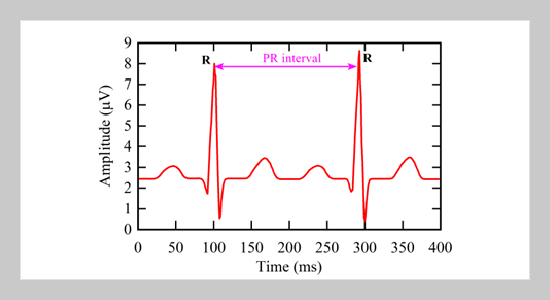
Analysis of PR Interval Variability Using Electrocardiogram (ECG) Data.
Copyright The Author(s). This is an open access article distributed under the terms of the Creative Commons Attribution License (CC BY 4.0), which permits unrestricted use, distribution, and reproduction in any medium, provided the original author and source are cited.
Download Citation: BibTeX | http://dx.doi.org/10.6180/jase.202508_28(8).0017
Since the increase in neuronal activity during an epileptic attack affects the voluntary nervous system, and the voluntary nervous system also affects the heart rate variability, it can be concluded that seizures can be predicted by monitoring heart rate variability. In this study, a new method for predicting epilepsy through the analysis of heart rate variability is proposed. In the proposed method, 12 features are extracted from the heart rate variability signal in time, frequency, time-frequency, and nonlinear domains to predict epileptic seizures. We used a multivariate statistical process control algorithm for abnormality detection. The presented algorithm was evaluated on a dataset consisting of 17 patients, where the obtained results show that the proposed method can predict epileptic attacks with an accuracy of 88.2%. From a practical point of view, due to the ease of obtaining the heart rate variability signal, the proposed algorithm is more promising than the algorithms that use brain signal processing to predict epilepsy.
Keywords: Disease diagnosis; Epilepsy; Heart rate; Signal processing; Multivariate statistical process
- [1] B. Wu, (1967) “Emotion Recognition Based On Electroencephalogram Signals Using Deep Learning Network” Journal of Applied Science and Engineering 27: DOI: https://doi.org/10.6180/jase.202401_27(1).0014.
- [2] D. Georgieva, J. Langley, K. Hartkopf, L. Hawk, A. Margolis, A. Struck, E. Felton, D. Hsu, and B. E. Gidal, (2023) “Real-world, long-term evaluation of the tolerability and therapy retention of Epidiolex®(cannabidiol) in patients with refractory epilepsy” Epilepsy & Behavior 141: 109159. DOI: https://doi.org/10.1016/j.yebeh.2023.109159.
- [3] M. Cheval, M. Houot, N. Chastan, W. Szurhaj, C. Marchal, H. Catenoix, L. Valton, M. Gavaret, B. Herlin, and A. Biraben, (2023) “Early identification of seizure freedom with medical treatment in patients with mesial temporal lobe epilepsy and hippocampal sclerosis” Journal of Neurology 270: 2715–2723. DOI: https://doi.org/10.1007/s00415-023-11603-7.
- [4] P. Kerezoudis, I. N. Tsayem, B. N. Lundstrom, and J. J. V. Gompel, (2022) “Systematic review and patientlevel meta-analysis of radiofrequency ablation for medically refractory epilepsy: Implications for clinical practice and research” Seizure 102: 113–119. DOI: https://doi.org/10.1016/j.seizure.2022.10.003.
- [5] X. Kong, J. Luo, and X. Feng, (2024) “An Overview of Conventional MSPC Methods” Process Monitoring and Fault Diagnosis Based on Multivariable Statistical Analysis: 9–25. DOI: https://doi.org/10.1007/978-981-99-8775-7_2.
- [6] K. Fujiwara, K. Ota, S. Saeda, T. Yamakawa, T. Kubo, A. Yamamoto, Y. Maruno, and M. Kano, (2024) “Heat illness detection with heart rate variability analysis and
anomaly detection algorithm” Biomedical Signal Processing and Control 87: 105520. DOI: https://doi.org/10.1016/j.bspc.2023.105520. - [7] Z. Matić, A. Kalauzi, M. Platiša, and T. Bojić. “Sensitivity Estimations in Favor of Using Inter-fractal Angle in Detrended Fluctuation Analysis”. In: IEEE, 2022, 1–2. DOI: 10.1109/ESGCO55423.2022.9931387.
- [8] P. Kumar, A. K. Das, V. Ranjan, and S. Halder. “Fractal Correlation of HRV for Postural Change in Young Males and Females”. In: IEEE, 2022, 1–5. DOI: 10.1109/MysuruCon55714.2022.9972604.
- [9] B. Rogers, M. Schaffarczyk, M. Clauß, L. Mourot, and T. Gronwald, (2022) “The movesense medical sensor chest belt device as single channel ECG for RR interval detection and HRV analysis during resting state and incremental exercise: A cross-sectional validation study” Sensors 22: 2032. DOI: https://doi.org/10.3390/s22052032.
- [10] R. Nomura and T. Yoshida, (2022) “A Missing RR Interval Complement Method Based on Respiratory Features” Advanced Biomedical Engineering 11: 237– 248. DOI: https://doi.org/10.14326/abe.11.237.
- [11] T. Ouypornkochagorn, (2019) “Misinterpretation of scalp voltage response in the application of electrical impedance tomography to the head” Journal of Applied Science and Engineering 22: 501–508. DOI: https ://doi.org/10.6180/jase.201909_22(3).0011.
- [12] N. Mahmoudi, M. K. Moridani, M. Khosroshahi, and S. T. Moghadam. Epileptic seizure prediction using geometrical features extracted from HRV signal. Springer, 2022, 487–500. DOI: https://doi.org/10.1007/978-981-16-9605-3_33.
- [13] R. Pernice, L. Faes, M. Feucht, F. Benninger, S. Mangione, and K. Schiecke, (2022) “Pairwise and higherorder measures of brain-heart interactions in children with temporal lobe epilepsy” Journal of Neural Engineering 19: 045002. DOI: 10.1088/1741-2552/ac7fba.
- [14] D. Zambrana-Vinaroz, J. M. Vicente-Samper, J. Manrique-Cordoba, and J. M. Sabater-Navarro, (2022) “Wearable epileptic seizure Prediction System based on machine learning techniques using ECG, PPG and EEG signals” Sensors 22: 9372. DOI: https://doi.org/10.3390/s22239372.
- [15] P. Yushkevich, Y. Gao, and G. Gerig. 2016 38th annual international conference of the IEEE engineering in medicine and biology society (EMBC). 2016. DOI: 10.1109/EMBC.2016.7590867.
- [16] S. Behbahani, N. J. Dabanloo, A. M. Nasrabadi, G. Attarodi, C. A. Teixeira, and A. Dourado. “Epileptic seizure behaviour from the perspective of heart rate variability”. In: 2012 Computing in Cardiology. IEEE, 2012, 117–120. DOI: 10.13140/RG.2.2.14051.81448.
- [17] K. R. dos Santos, M. A. de Abreu de Sousa, S. D. dos Santos, R. Pires, and S. Thome-Souza, (2022) “Differentiation between epileptic and psychogenic nonepileptic seizures in electroencephalogram using wavelets and support-vector machines” Applied Artificial Intelligence 36: 2008612. DOI: https://doi.org/10.1080/08839514.2021.2008612.
- [18] A. M. Anter, M. A. Elaziz, and Z. Zhang, (2022) “Realtime epileptic seizure recognition using Bayesian genetic whale optimizer and adaptive machine learning” Future Generation Computer Systems 127: 426–434. DOI: https://doi.org/10.1016/j.future.2021.09.032.
- [19] Y. Zhang, Y. Guo, P. Yang, W. Chen, and B. Lo, (2019) “Epilepsy seizure prediction on EEG using common spatial pattern and convolutional neural network” IEEE Journal of Biomedical and Health Informatics 24: 465–474. DOI: 10.1109/JBHI.2019.2933046.
- [20] C. Ufongene, R. E. Atrache, T. Loddenkemper, and C. Meisel, (2020) “Electrocardiographic changes associated with epilepsy beyond heart rate and their utilization in future seizure detection and forecasting methods” Clinical Neurophysiology 131: 866–879. DOI: https://doi.org/10.1016/j.clinph.2020.01.007.
- [21] D. Nabil, R. Benali, and F. B. Reguig, (2020) “Epileptic seizure recognition using EEG wavelet decomposition based on nonlinear and statistical features with support vector machine classification” Biomedical Engineering/Biomedizinische Technik 65: 133–148. DOI: https://doi.org/10.1515/bmt-2018-0246.
- [22] S. Huang, (2021) “Analysis of psychological teaching assisted by artificial intelligence in sports training courses” Journal of Applied Science and Engineering 24: 743–748. DOI: https://doi.org/10.6180/jase.202110_24(5).0008.
- [23] A. S. Zandi, R. Tafreshi, M. Javidan, and G. A. Dumont, (2013) “Predicting epileptic seizures in scalp EEG based on a variational Bayesian Gaussian mixture model of zero-crossing intervals” IEEE Transactions on Biomedical Engineering 60: 1401–1413. DOI: 10.1109/TBME.2012.2237399.