




Noman Ashraf, Ummikalsom Abidin, and Mazlan Abdul Wahid
School of Mechanical Engineering, Faculty of Engineering, Universiti Teknologi Malaysia, 81310 Johor Bahru, Johor, Malaysia
Received: April 06, 2026
Accepted: September 29, 2026
Publication Date: October 26, 2026
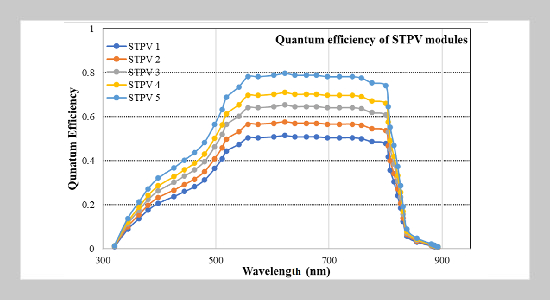
External quantum efficiency (EQE) of the selected STPV modules
Copyright The Author(s). This is an open access article distributed under the terms of the Creative Commons Attribution License (CC BY 4.0), which permits unrestricted use, distribution, and reproduction in any medium, provided the original author and source are cited.
Download Citation: BibTeX | http://dx.doi.org/10.6180/jase.202701_36.040
One promising method for smoothly integrating solar energy generation systems into the built environment is building-integrated photovoltaics, or BIPV. Among the various BIPV technologies, the integration of CdTe-based semi-transparent thin-film photovoltaic modules into window glazing systems has great potential. However, the angle loss phenomenon poses a significant challenge and affects the performance of these systems. Understanding and mitigating angular losses is crucial for optimizing the energy generation capacity of CdTe-based semi-transparent thin film PV modules integrated into window glazing systems. The current research investigates the angle loss for the thin film semi-transparent photovoltaic module (STPV) applied to the glazing systems. The analysis considered all four geographic directions (north, south, east and west) to determine the angular loss with varying module transparency. The characteristics of the STPV module were evaluated experimentally and simulations were carried out using Design Builder software. The study found that the angle loss at the considered latitude is up to 8.7%. The analysis shows that the angle loss is noticeable at an angle of incidence (AOI) greater than 70°[cite: 16]. When looking at the transparency of the STPV module, it was found that the angular loss varies by about 25%.
Keywords: Glazing systems, STPV, BiPV, CdTe-based semi-transparent modules, angular loss, thin-film photovoltaic
- [1] D. E. Attoye, K. A. T. Aoul, and A. Hassan, (2017) “A Review on Building Integrated Photovoltaic Façade Customization Potentials” Sustainability (Switzerland) 9(12): 2287. DOI: 10.3390/su9122287.
- [2] F. Frontini, P. Bonomo, D. Moser, and L. Maturi. “Building Integrated Photovoltaic Facades: Challenges, Opportunities and Innovations”. In: Rethinking Building Skins. Elsevier, 2022, 201-229. DOI: 10.1016/B978-0-12-822477-9.00012-7.
- [3] Y. A. Marei, M. Emam, M. E. A. E. Ahmed, A. A. A. Attia, and M. A. Abdelrahman, (2024) “Thermal and Optical Investigations of Various Transparent Wall Configurations and Building Integrated Photovoltaic for Energy Savings in Buildings” Energy Conversion and Management 299: 117817. DOI: 10.1016/j.enconman.2023.117817.
- [4] P. Kumar, S. You, and A. Vomiero, (2023) “Recent Progress in Materials and Device Design for Semitransparent Photovoltaic Technologies” Advanced Energy Materials 13(39): 2301555. DOI: 10.1002/aenm.202301555.
- [5] W. Zhang, L. Lu, J. Peng, and A. Song, (2016) “Comparison of the Overall Energy Performance of Semi-Transparent Photovoltaic Windows and Common Energy-Efficient Windows in Hong Kong” Energy and Buildings 128: 511-518. DOI: 10.1016/j.enbuild.2016.07.016.
- [6] S. Barman, A. Chowdhury, S. Mathur, and J. Mathur, (2018) “Assessment of the Efficiency of Window Integrated CdTe Based Semi-Transparent Photovoltaic Module” Sustainable Cities and Society 37(2017): 250-262. DOI: 10.1016/j.scs.2017.09.036.
- [7] Y. T. Chae, J. Kim, H. Park, and B. Shin, (2014) “Building Energy Performance Evaluation of Building Integrated Photovoltaic (BIPV) Window with Semi-Transparent Solar Cells” Applied Energy 129: 217-227. DOI: 10.1016/j.apenergy.2014.04.106.
- [8] J. M. Ball, S. D. Stranks, M. T. Hörantner, S. Hüttner, W. Zhang, E. J. W. Crossland, I. Ramirez, M. Riede, M. B. Johnston, R. H. Friend, and H. J. Snaith, (2015) “Optical Properties and Limiting Photocurrent of Thin-Film Perovskite Solar Cells” Energy and Environmental Science 8(2): 602-609. DOI: 10.1039/c4ee03224a.
- [9] M. Shahrestani, R. Yao, E. Essah, L. Shao, A. C. Oliveira, A. Hepbasli, E. Biyik, T. d. Caño, E. Rico, and J. L. Lechón, (2017) “Experimental and Numerical Studies to Assess the Energy Performance of Naturally Ventilated PV Façade Systems” Solar Energy 147: 37-51. DOI: 10.1016/j.solener.2017.02.034.
- [10] R. A. Agathokleous and S. A. Kalogirou, (2018) “Part II: Thermal Analysis of Naturally Ventilated BIPV System: Modeling and Simulation” Solar Energy 169(2017): 682-691. DOI: 10.1016/j.solener.2018.02.057.
- [11] A. Waqas and J. Ji, (2017) “Thermal Management of Conventional PV Panel Using PCM with Movable Shutters – A Numerical Study” Solar Energy 158: 797-807. DOI: 10.1016/j.solener.2017.10.050.
- [12] K. Kant, R. Pitchumani, A. Shukla, and A. Sharma, (2019) “Analysis and Design of Air Ventilated Building Integrated Photovoltaic (BIPV) System Incorporating Phase Change Materials” Energy Conversion and Management 196: 149-164. DOI: 10.1016/j.enconman.2019.05.073.
- [13] P. K. Ng, N. Mithraratne, and H. W. Kua, (2013) “Energy Analysis of Semi-Transparent BIPV in Singapore Buildings” Energy and Buildings 66: 274-281. DOI: 10.1016/j.enbuild.2013.07.029.
- [14] Y. Cheng, M. Gao, J. Dong, J. Jia, X. Zhao, and G. Li, (2018) “Investigation on the Daylight and Overall Energy Performance of Semi-Transparent Photovoltaic Facades in Cold Climatic Regions of China” Applied Energy 232: 517-526. DOI: 10.1016/j.apenergy.2018.10.006.
- [15] A. L. S. Chan, (2019) “Effect of Adjacent Shading on the Energy and Environmental Performance of Photovoltaic Glazing System in Building Application” Energy 187: 115939. DOI: 10.1016/j.energy.2019.115939.
- [16] A. Vulkan, I. Kloog, M. Dorman, and E. Erell, (2018) “Modeling the Potential for PV Installation in Residential Buildings in Dense Urban Areas” Energy and Buildings 169: 97-109. DOI: 10.1016/j.enbuild.2018.03.052.
- [17] I. Lahmar, N. Zemmouri, A. Cannavale, and F. Martellotta. “Investigating the Impact of Electrochromic Glazing on Energy Performance in Hot Arid Climate Using Parametric Design”. In: IOP Conference Series: Materials Science and Engineering. 609. 6. 2019. DOI: 10.1088/1757-899X/609/6/062027.
- [18] J. Peng, D. C. Curcija, L. Lu, S. E. Selkowitz, H. Yang, and W. Zhang, (2016) “Numerical Investigation of the Energy Saving Potential of a Semi-Transparent Photovoltaic Double-Skin Facade in a Cool-Summer Mediterranean Climate” Applied Energy 165: 345-356. DOI: 10.1016/j.apenergy.2015.12.074.
- [19] S. Yadav, S. K. Panda, and M. Tripathy, (2018) “Performance of Building Integrated Photovoltaic Thermal System with PV Module Installed at Optimum Tilt Angle and Influenced by Shadow” Renewable Energy 127: 11-23. DOI: 10.1016/j.renene.2018.04.030.
- [20] A. Riaz, R. Liang, C. Zhou, and J. Zhang, (2020) “A Review on the Application of Photovoltaic Thermal Systems for Building Façades” Building Services Engineering Research and Technology 41(1): 86-107. DOI: 10.1177/0143624419845117.
- [21] X. Li, J. Peng, N. Li, Y. Wu, Y. Fang, T. Li, M. Wang, and C. Wang, (2019) “Optimal Design of Photovoltaic Shading Systems for Multi-Story Buildings” Journal of Cleaner Production 220: 1024-1038. DOI: 10.1016/j.jclepro.2019.01.246.
- [22] C. Cornaro, G. Basciano, V. A. Puggioni, and M. Pierro, (2017) “Energy Saving Assessment of Semi-Transparent Photovoltaic Modules Integrated into NZEB” Buildings 7(1): DOI: 10.3390/buildings7010009.
- [23] T. Y. Y. Fung and H. Yang, (2008) “Study on Thermal Performance of Semi-Transparent Building-Integrated Photovoltaic Glazings” Energy and Buildings 40(3): 341-350. DOI: 10.1016/j.enbuild.2007.03.002.
- [24] N. Lindsay, Q. Libois, J. Badosa, A. Migan-Dubois, and V. Bourdin, (2020) “Errors in PV Power Modelling Due to the Lack of Spectral and Angular Details of Solar Irradiance Inputs” Solar Energy 197: 266-278. DOI: 10.1016/j.solener.2019.12.042.
- [25] Y. S. Khoo, J. P. Singh, T. M. Walsh, and A. G. Aberle, (2014) “Comparison of Angular Reflectance Losses be-tween PV Modules with Planar and Textured Glass under Singapore Outdoor Conditions” IEEE Journal of Photovoltaics 4(1): 362-367. DOI: 10.1109/JPHOTOV.2013.2284544.
- [26] S. Barman, A. Chowdhury, S. Mathur, and J. Mathur, (2021) “Angular Loss of Window Integrated Thin Film Semi-Transparent Photovoltaic Module” Journal of Building Engineering 40: 102353. DOI: 10.1016/j.jobe.2021.102353.
- [27] N. Martin and J. M. Ruiz, (2001) “Calculation of the PV Modules Angular Losses under Field Conditions by Means of an Analytical Model” Solar Energy Materials and Solar Cells 70(1): 25-38. DOI: 10.1016/S0927-0248(00)00408-6.
- [28] N. Martin and J. M. Ruiz, (2013) “Corrigendum to ‘Calculation of the PV Modules Angular Losses under Field Conditions by Means of an Analytical Model [Sol. Energy Mater. Sol. Cells 70 (1) (2001) 25-38] (S0927024800004086) (10.1016/S0927-0248(00)00408-6))” Solar Energy Materials and Solar Cells 110: 154. DOI: 10.1016/j.solmat.2012.11.002.
- [29] N. Martín and J. M. Ruiz, (2005) “Annual Angular Reflection Losses in PV Modules” Progress in Photovoltaics: Research and Applications 13(1): 75-84. DOI: 10.1002/pip.585.
- [30] S. D. Cusworth and J. M. Senior, (1986) “Angular Tilt Misalignment Loss at a GRIN Rod Lens Coupler” Applied Optics 25(11): 1775. DOI: 10.1364/ao.25.001775.
- [31] A. Helgesson, B. Karlsson, and P. Nostell, (2001) “Angular Dependent Optical Properties from Outdoor Measurements of Solar Glazings” Solar Energy 69: 93-102. DOI: 10.1016/S0038-092X(01)00061-5.
- [32] J. J. H. Videira, E. Bilotti, and A. J. Chatten, (2016) “Cylindrical Array Luminescent Solar Concentrators: Performance Boosts by Geometric Effects” Optics Express 24(14): A1188. DOI: 10.1364/oe.24.0a1188.
- [33] D. L. King, W. E. Boyson, and J. A. Kratochvil. Photovoltaic Array Performance Model. Tech. rep. Sandia Report No. 2004-3535. Sandia National Laboratories, 2004, 1-19. DOI: 10.2172/919131.
- [34] J. Peng, D. C. Curcija, A. Thanachareonkit, E. S. Lee, H. Goudey, and S. E. Selkowitz, (2019) “Study on the Overall Energy Performance of a Novel C-Si Based Semitransparent Solar Photovoltaic Window” Applied Energy 242: 854-872. DOI: 10.1016/j.apenergy.2019.03.107.
- [35] A. Mesloub, G. A. Albaqawy, and M. Z. Kandar, (2020) “The Optimum Performance of Building Integrated Photovoltaic (BIPV) Windows under a Semi-Arid Climate in Algerian Office Buildings” Sustainability (Switzerland) 12(4): 1654. DOI: 10.3390/su12041654.
- [36] A. K. Mohammad, A. Garrod, and A. Ghosh, (2023) “Do Building Integrated Photovoltaic (BIPV) Windows Propose a Promising Solution for the Transition toward Zero Energy Buildings? A Review” Journal of Building Engineering 79: 107950. DOI: 10.1016/j.jobe.2023.107950.
- [37] B. Joseph, B. Kichonge, and T. Pogrebnaya, (2019) “Semi-Transparent Building Integrated Photovoltaic Solar Glazing: Investigations of Electrical and Optical Performances for Window Applications in Tropical Region” Journal of Energy 2019(1): 1-10. DOI: 10.1155/2019/6096481.
- [38] International Glazing Database (IGDB). URL: https://windows.lbl.gov/igdb-downloads (visited on 09/30/2026).
- [39] I. Iqbal and M. S. Al-Homoud, (2007) “Parametric Analysis of Alternative Energy Conservation Measures in an Office Building in Hot and Humid Climate” Building and Environment 42(5): 2166-2177. DOI: 10.1016/j.buildenv.2006.04.011.
- [40] W. Zhang and L. Lu, (2019) “Overall Energy Assessment of Semi-Transparent Photovoltaic Insulated Glass Units for Building Integration under Different Climate Conditions” Renewable Energy 134: 818-827. DOI: 10.1016/j.renene.2018.11.043.
- [41] The Saudi Code for Energy Conservation-Nonresidential Building (SBC 601). URL: https://www.sbc.gov.sa/en/BC/Pages/BuildingCode/BCDetails.aspx?codeld=601&year=2024 (visited on 09/30/2026).
- [42] H. Z. Al Garni, A. Awasthi, and D. Wright, (2019) “Optimal Orientation Angles for Maximizing Energy Yield for Solar PV in Saudi Arabia” Renewable Energy 133: 538-550. DOI: 10.1016/j.renene.2018.10.048.
- [43] K. Sedraoui, M. A. M. Ramli, I. M. Mehedi, M. Hasbi, and A. Hiendro, (2017) “Optimum Orientation and Tilt Angle for Estimating Performance of Photovoltaic Modules in Western Region of Saudi Arabia” Journal of Renewable and Sustainable Energy 9(2): DOI: 10.1063/1.4979138.
- [44] J. G. Bessa, P. J. Pérez-Higueras, E. F. Fernández, and D. L. Talavera, (2026) “Assessment of Cost-Competitiveness of Semi-Transparent Photovoltaic Systems” Renewable Energy 258(6): 125003. DOI: 10.1016/j.renene.2025.125003.