




1School of Digital Bussiness, Zhejiang Business College, Hangzhou 310053, China
2School of Ocean Engineering, Jiangsu Ocean University, Lianyungang 222000, China
Received: July 14, 2026
Accepted: August 31, 2026
Publication Date: October 17, 2026
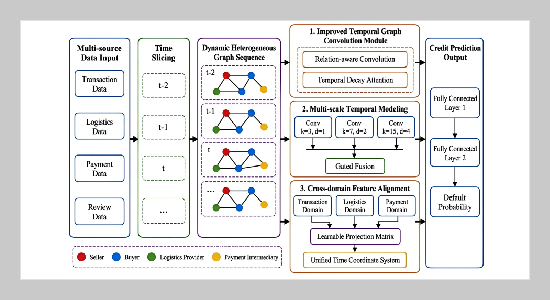
ITGCN overall framework
Copyright The Author(s). This is an open access article distributed under the terms of the Creative Commons Attribution License (CC BY 4.0), which permits unrestricted use, distribution, and reproduction in any medium, provided the original author and source are cited.
Download Citation: BibTeX | http://dx.doi.org/10.6180/jase.202701_36.033
Cross-border e-commerce requires dynamic, heterogeneous credit evaluation, but static models fail to capture temporal and network interactions. This paper proposes an Improved Temporal Graph Convolutional Network (ITGCN) for dynamic credit assessment. ITGCN constructs a dynamic heterogeneous graph integrating sellers, buyers, logistics, and payment nodes, with a relationship-aware graph convolution operator and a temporal decay attention mechanism to model heterogeneous dependencies. A multi-scale time series module captures both short-term fluctuations and long-term credit trends, while a cross-domain feature alignment strategy handles inconsistencies in multi-source data granularities. The experimental results on two public fraud detection datasets show that the ITGCN achieves an AUC of 0.938 (D1) and 0.934 (D2), outperforming CARE-GNN by 1.8 per cent and 2.1 per cent, and an F1 score of 0.876 and 0.871, representing improvements of 2.2 per cent and 2.6 per cent. Ablation and robustness tests confirm its effectiveness and resilience[cite: 81]. ITGCN offers a reliable solution for cross-border credit assessment.
Keywords: time series graph convolutional network; dynamic credit evaluation; cross-border e-commerce; heterogeneous graph; multi-scale time series modeling
- [1] G. A. of Customs of the People’s Republic of China, (2026) “China’s Cross-Border E-Commerce Imports and Exports in 2025”: URL: http://dzs.customs.gov.cn/customs/2026-06/16/article_2026061616113889190.html.
- [2] S. Zandi, K. Korangi, M. Óskarsdóttir, C. Mues, and C. Bravo, (2025) “Attention-based dynamic multilayer graph neural networks for loan default prediction” European Journal of Operational Research 321(2): 586-599. DOI: https://doi.org/10.1016/j.ejor.2024.09.025.
- [3] Y. Qi, Y. Liu, Y. Tang, X. Chen, X. Zheng, Q. He, and X. Ao, (2025) “Dynamic Graph Learning with Static Relations for Credit Risk Assessment” Proceedings of the AAAI Conference on Artificial Intelligence 39(12): 13133-13141. DOI: https://doi.org/10.1609/aaai.v39i12.33433.
- [4] D. Yu and B. Xiang, (2025) “Customized integrated decision model for CBEC enterprise credit evaluation: The fusion of multi-source features and machine learning” Electronic Markets 35(1): 45. DOI: https://doi.org/10.1007/s12525-025-00793-9.
- [5] Y. Jiang and P. Du, (2025) “Cross-border e-commerce credit risk early warning model based on deep learning” International Journal of Reasoning-based Intelligent Systems 17(10): 1-9. DOI: https://doi.org/10.1504/IJRIS.2025.148174.
- [6] D. Yu and A. Fang, (2026) “Achieving credit risk prediction framework for Chinese CBECES: a hybrid CNN-BiLSTM-AM approach” Electronic Commerce Research 26: 2681-2704. DOI: https://doi.org/10.1007/s10660-025-10025-z.
- [7] S. Lessmann, B. Baesens, H.-V. Seow, and L. C. Thomas, (2015) “Benchmarking state-of-the-art classification algorithms for credit scoring: An update of research” European Journal of Operational Research 247(1): 124-136. DOI: https://doi.org/10.1016/j.ejor.2015.05.030.
- [8] Y. Liu, S. Liu, and Y. Lu, (2025) “Supply chain financial risk assessment: A modified graph attention neural network” Finance Research Letters 86: 108285. DOI: https://doi.org/10.1016/j.frl.2025.108285.
- [9] H. Kim, J. Choi, and J. J. Whang, (2023) “Dynamic Relation-Attentive Graph Neural Networks for Fraud Detection” 2023 IEEE International Conference on Data Mining Workshops (ICDMW): 1092-1096. DOI: https://doi.org/10.1109/ICDMW60847.2023.00143.
- [10] T. N. Kipf and M. Welling, (2017) “Semi-Supervised Classification with Graph Convolutional Networks” arXiv preprint: DOI: https://doi.org/10.48550/arXiv.1609.02907.
- [11] P. Veličković, G. Cucurull, A. Casanova, A. Romero, P. Liò, and Y. Bengio, (2018) “Graph Attention Networks” arXiv preprint: DOI: https://doi.org/10.48550/arXiv.1710.10903.
- [12] J. Wang, G. Liu, X. Xu, and X. Xing, (2024) “Credit risk prediction for small and medium enterprises utilizing adjacent enterprise data and a relational graph attention network” Journal of Management Science and Engineering 9(2): 177-192. DOI: https://doi.org/10.1016/j.jmse.2023.11.005.
- [13] Z. Shao, X. Wang, E. Ji, S. Chen, and J. Wang, (2025) “GNN-EADD: Graph Neural Network-Based E-Commerce Anomaly Detection via Dual-Stage Learning” IEEE Access 13: 8963-8976. DOI: https://doi.org/10.1109/ACCESS.2025.3526239.
- [14] L. Song, Z. Ma, Z. Li, and X. Shang, (2024) “Review on Temporal Graph Neural Networks for Financial Risk Prediction” Journal of Software 35(8): 3897-3922. DOI: https://doi.org/10.13328/j.cnki.jos.007087.
- [15] Z. Wu, S. Pan, G. Long, J. Jiang, and C. Zhang, (2019) “Graph WaveNet for Deep Spatial-Temporal Graph Modeling” Proceedings of the 28th International Joint Conference on Artificial Intelligence (IJCAI): 1907-1913. DOI: https://doi.org/10.24963/ijcai.2019/264.
- [16] L. Feng, Z. Bai, and Y. Wang, (2025) “Dual-channel E-commerce fraud detection method integrating user behavior and review relationships” Journal of Zhejiang University (Engineering Science) 59(10): 2164-2174. DOI: https://doi.org/10.3785/j.issn.1008-973X.2025.10.017.
- [17] D. Wang, Z. Zhang, J. Zhou, P. Cui, J. Fang, Q. Jia, Y. Fang, and Y. Qi, (2021) “Temporal-Aware Graph Neural Network for Credit Risk Prediction” Proceedings of the 2021 SIAM International Conference on Data Mining (SDM): 702-710. DOI: https://doi.org/10.1137/1.9781611976700.79.
- [18] B. P. Jeyaraman, B. T. Dai, and Y. Fang, (2024) “Temporal Relational Graph Convolutional Network Approach to Financial Performance Prediction” Machine Learning and Knowledge Extraction 6(4): 2303-2320. DOI: https://doi.org/10.3390/make6040113.
- [19] X. Wang, W. Lin, J. Zhao, and Z. Liu, (2026) “AdaFuse: memory-augmented adaptive fusion for few-shot fraud detection in heterogeneous graphs” Annals of Operations Research 361(1): 437-463. DOI: https://doi.org/10.1007/s10479-026-07043-x.
- [20] K. Bentaleb, M. B. Houad, and M. Mestari, (2024) “A Graph Neural Network for Comparing the Propagation of Stock Market Shocks” IEEE Access 12: 158611-158626. DOI: https://doi.org/10.1109/ACCESS.2024.3487766.
- [21] X. Zhang, Y. Tu, M. H. Haney, and H. Cheng, (2024) “Buyers’ Negative Ratings and Textual Comments on eBay: Reasons for Posting Ratings and Factors in Denouncing Sellers” Journal of Theoretical and Applied Electronic Commerce Research 19(3): 1717-1733. DOI: https://doi.org/10.3390/jtaer19030084.
- [22] X. Wang, J. Guo, X. Luo, and H. Yu, (2024) “DyHDGE: Dynamic heterogeneous transaction graph embedding for safety-centric fraud detection in financial scenarios” Journal of Safety Science and Resilience 5(4): 486-497. DOI: https://doi.org/10.1016/j.jnlssr.2024.05.005.
- [23] X. Mo, R. Tang, and H. Liu, (2023) “A relation-aware heterogeneous graph convolutional network for relationship prediction” Information Sciences 623: 311-323. DOI: https://doi.org/10.1016/j.ins.2022.12.059.
- [24] F. Wang and E. Damiani, (2026) “Time-aware and transition-semantic graph neural networks for interpretable predictive business process monitoring” Expert Systems with Applications 301: 130320. DOI: https://doi.org/10.1016/j.eswa.2025.130320.
- [25] Z. Zhang, X. Ao, C. J. Tessone, G. Liu, M. Zhou, and R. Mao, (2025) “Multiplex graph fusion network with reinforcement structure learning for fraud detection in online e-commerce platforms” Expert Systems with Applications 262: 125598. DOI: https://doi.org/10.1016/j.eswa.2024.125598.
- [26] R. Chen, Y. Xie, M. Liao, J. Hu, and X. Liu, (2025) “Identifying Fraudulent Users in E-commerce Applications through Spatiotemporal Fusion and Selective Aggregation” ACM Transactions on Privacy and Security 29(1): 1-27. DOI: https://doi.org/10.1145/3772076.
- [27] N. Suhadolnik, J. Ueyama, and S. Da Silva, (2023) “Machine Learning for Enhanced Credit Risk Assessment: An Empirical Approach” Journal of Risk and Financial Management 16(12): 496. DOI: https://doi.org/10.3390/jrfm16120496.
- [28] L. Zhao, Y. Song, C. Zhang, Y. Liu, P. Wang, T. Lin, M. Deng, and H. Li, (2020) “T-GCN: A Temporal Graph Convolutional Network for Traffic Prediction” IEEE Transactions on Intelligent Transportation Systems 21(9): 3848-3858. DOI: https://doi.org/10.1109/TITS.2019.2935152.
- [29] B. Yu, H. Yin, and Z. Zhu, (2018) “Spatio-Temporal Graph Convolutional Networks: A Deep Learning Framework for Traffic Forecasting” Proceedings of the 27th International Joint Conference on Artificial Intelligence (IJCAI): 3634-3640. DOI: https://doi.org/10.24963/ijcai.2018/505.
- [30] M. Schlichtkrull, T. N. Kipf, P. Bloem, R. van den Berg, I. Titov, and M. Welling, (2018) “Modeling Relational Data with Graph Convolutional Networks” The Semantic Web-ESWC 2018, Lecture Notes in Computer Science 10843: 593-607. DOI: https://doi.org/10.1007/978-3-319-93417-4_38.
- [31] Z. Hu, Y. Dong, K. Wang, and Y. Sun, (2020) “Heterogeneous Graph Transformer” Proceedings of The Web Conference 2020 (WWW ’20): 2704-2710. DOI: https://doi.org/10.1145/3366423.3380027.
- [32] Y. Dou, Z. Liu, L. Sun, Y. Deng, H. Peng, and P. S. Yu, (2020) “Enhancing Graph Neural Network-based Fraud Detectors against Camouflaged Fraudsters” Proceedings of the 29th ACM International Conference on Information and Knowledge Management (CIKM): 315-324. DOI: https://doi.org/10.1145/3340531.3411903.