




Xielin Shen1, Yipeng Wang1, Xiaomei Pan1, Bo Yuan1, Lei Wang2,3, and Chaofei Gao2,3
1Quanzhou Power Supply Company, State Grid Fujian Electric Power Co., Ltd., Quanzhou, 362064, China
2College of Automation (College of Artificial Intelligence), Beijing Information Science & Technology University, Beijing, 100192, China
3Beijing Key Laboratory of Low-Carbon and Flexible Urban Power Supply Technology and Equipment, Beijing, 100192, China
Received: August 01, 2026
Accepted: August 25, 2026
Publication Date: October 17, 2026
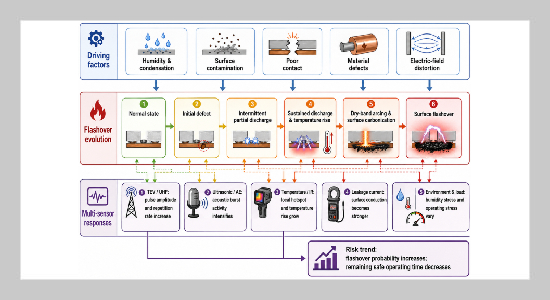
Flashover evolution mechanism and multi-sensor responses of the contact box in 10 kV switchgear.
Copyright The Author(s). This is an open access article distributed under the terms of the Creative Commons Attribution License (CC BY 4.0), which permits unrestricted use, distribution, and reproduction in any medium, provided the original author and source are cited.
Download Citation: BibTeX | http://dx.doi.org/10.6180/jase.202701_36.026
To address the difficulty of uniformly characterizing the coupled evolution of partial discharge, thermal accumulation, surface conduction, and environmental stress in contact boxes of 10 kV switchgear, as well as the limited capability of conventional methods for early flashover prediction, a physics-consistent hierarchical sensor-temporal fusion network (PC-HSTFNet) is proposed. The method integrates TEV/UHF/HFCT, ultrasonic, infrared and point-temperature, leakage-current, temperature-humidity, and operating-condition information. Modality-specific encoding, dynamic weighting of homogeneous sensors, reliability-biased cross-modal attention, and causal temporal modeling are combined to identify degradation stages, predict multi-horizon flashover probabilities, and estimate the remaining safe operating time. A dataset containing 28,640 multi-sensor time windows was constructed from 18 contact-box specimens and 72 controlled test runs. PC-HSTFNet achieved a Macro-F1 of 0.931, an S4 recall of 0.927, and a 5-min risk AUPRC of 0.902. Its Brier score and ECE were 0.052 and 0.016, respectively, while the MAE of the remaining safe operating time was 6.8 min. Compared with the Multimodal Transformer, Macro-F1 and AUPRC increased by 2.6 and 3.3 percentage points, respectively. Under a representative contamination-condensation condition, the model provided an average early-warning lead time of 18.9 min, with false-alarm and missed-alarm rates of 3.4% and 1.6%. These results demonstrate that the proposed method can support reliable flashover warning and predictive maintenance of switchgear contact boxes.
Keywords: 10 kV switchgear; contact box; flashover risk prediction; multi-sensor fusion; PC-HSTFNet; predictive maintenance
- [1] Z. Fei, Y. Li, and S. Yang, (2024) “Pattern recognition of partial discharge faults in switchgear using a back propagation neural network optimized by an improved mantis search algorithm” Sensors 24(10): 3174. DOI: https://doi.org/10.3390/s24103174.
- [2] S. Chen, H. A. Illias, J. K. R. Wong, and N. N. Mansor, (2024) “Denoising of partial discharges in switchgear insulation material using hybrid wavelet denoising-optimization-machine learning” Ain Shams Engineering Journal 15(11): 103032. DOI: https://doi.org/10.1016/j.asej.2024.103032.
- [3] J. Yang, K. Hu, J. Zhang, and J. Bao, (2024) “Semi-supervised learning for gas insulated switchgear partial discharge pattern recognition in the case of limited labeled data” Engineering Applications of Artificial Intelligence 137: 109193. DOI: https://doi.org/10.1016/j.engappai.2024.109193.
- [4] Z. Xu, H. Xu, C. Yuan, S. Chen, and Y. Chen, (2024) “Recognition of partial discharge in GIS based on image feature fusion” AIMS Energy 12(6): 1096-1112. DOI: https://doi.org/10.3934/energy.2024052.
- [5] Z. Wang, Z. Liu, L. Qiao, D. Qian, Z. Chen, C. Gao, and W. Wang, (2024) “Research on partial discharge pattern recognition in GIS based on EFPI sensor” Journal of Electrical Engineering & Technology 19(1): 577-584. DOI: https://doi.org/10.1007/s42835-023-01526-8.
- [6] J. Yan, Y. Wang, Y. Zhou, J. Wang, and Y. Geng, (2024) “A novel meta-learning network for partial discharge source localization in gas-insulated switchgear via digital twin” IET Generation, Transmission & Distribution 18(9): 1785-1794. DOI: https://doi.org/10.1049/gtd2.13156.
- [7] R. Loggia and A. Flamini, (2024) “Electrical safety enhanced with BIM, SCADA and digital twin integration: A case study of a MV-LV substation” IEEE Transactions on Industry Applications 60(2): 2725-2731. DOI: https://doi.org/10.1109/TIA.2023.3332311.
- [8] Z. Tang and X. Jian, (2024) “Thermal fault diagnosis of complex electrical equipment based on infrared image recognition” Scientific Reports 14: 5547. DOI: https://doi.org/10.1038/s41598-024-56142-x.
- [9] Y. Zhang, J. Ding, Y. Li, Z. Ren, and K. Feng, (2024) “Multi-modal data cross-domain fusion network for gearbox fault diagnosis under variable operating conditions” Engineering Applications of Artificial Intelligence 133: 108236. DOI: https://doi.org/10.1016/j.engappai.2024.108236.
- [10] Y. Xu and X. Lu, (2024) “Power transformer fault diagnosis based on hybrid intelligent algorithm” Journal of Applied Science and Engineering 27(1): 1859-1866. DOI: https://doi.org/10.6180/jase.202401_27(1).0002.
- [11] Z. Jia, S. Fan, Z. Wang, S. Shao, and D. He, (2025) “Partial discharge defect recognition method of switchgear based on cloud-edge collaborative deep learning” Scientific Reports 15: 10956. DOI: https://doi.org/10.1038/s41598-024-81478-9.
- [12] T. Lin, Z. Ren, L. Zhu, Y. Zhu, K. Feng, W. Ding, K. Yan, and M. Beer, (2025) “A systematic review of multi-sensor information fusion for equipment fault diagnosis” IEEE Transactions on Instrumentation and Measurement 74: 1-48. DOI: https://doi.org/10.1109/TIM.2025.3529577.
- [13] J. Li, J. Tian, A. Banerjee, X. Zhai, and S. Wang, (2025) “Gradient balanced selective mixture-of-experts for gas insulated switchgear partial discharge diagnosis” Measurement 256: 118139. DOI: https://doi.org/10.1016/j.measurement.2025.118139.
- [14] Z. Li, Y. Zang, C. Wang, Y. Tang, T. Ren, and X. Jiang, (2025) “Analysis and diagnosis of optical and UHF partial discharges in GIS based on guided filtering fusion” IEEE Transactions on Dielectrics and Electrical Insulation 32(5): 2978-2985. DOI: https://doi.org/10.1109/TDEI.2025.3543147.
- [15] T. Cao, Y. Cui, H. Tan, W. Lu, F. Zhang, K. Liu, X. Chen, and L. Wang, (2025) “Research on a degradation identification method for GIS UHF partial discharge sensors based on S-parameters” Sensors 25(22): 6860. DOI: https://doi.org/10.3390/s25226860.
- [16] X. Lv, F. Liu, M. Jiang, F. Zhang, and L. Jia, (2025) “Fault diagnosis of power transformers based on dissolved gas analysis and multi-kernel graph convolution network integrated with dual-channel classifiers” Journal of Applied Science and Engineering 28(10): 2217-2226. DOI: https://doi.org/10.6180/jase.202510_28(10).0014.
- [17] Y. Q. Liu, X. C. Hua, W. D. Li, Z. K. Lai, G. J. Zhang, X. X. Chen, and X. J. Shao, (2026) “Enhancement of GIS partial discharge pattern recognition accuracy based on domain adversarial ConvNeXt” IEEE Transactions on Dielectrics and Electrical Insulation 33(1): 742-751. DOI: https://doi.org/10.1109/TDEI.2025.3579444.
- [18] S. Pan, W. Zhang, Y. Ma, Y. Su, and W. Huang, (2026) “Pattern recognition of GIS partial discharge based on UHF signal characteristics” Electronics 15(5): 1096. DOI: https://doi.org/10.3390/electronics15051096.
- [19] Y. He, Y. Fang, Z. Zhang, D. Zhou, S. Chen, and S. Jing, (2026) “Partial discharge pattern recognition of GIS with time-frequency energy grayscale maps and an improved variational Bayesian autoencoder” Energies 19(1): 127. DOI: https://doi.org/10.3390/en19010127.
- [20] B. Jia, Q. Sun, W. Guo, M. Wang, Q. Wang, and H. Zhao, (2026) “GIS partial discharge fault diagnosis based on multi-source feature fusion and ResNet-MLP” Energies 19(4): 1073. DOI: https://doi.org/10.3390/en19041073.
- [21] J. Wen, J. Li, and Y. Zhang, (2026) “Deep multi-modal imaging temperature measurement method for detecting temperature rise in electrical equipment faults” Journal of Applied Science and Engineering 29(3): 603-610. DOI: https://doi.org/10.6180/jase.202603_29(3).0011.
- [22] L. Li, J. Tang, and Y. Liu, (2015) “Partial discharge recognition in gas insulated switchgear based on multi-information fusion” IEEE Transactions on Dielectrics and Electrical Insulation 22(2): 1080-1087. DOI: https://doi.org/10.1109/TDEI.2015.7076809.
- [23] R. Hussein, K. B. Shaban, and A. H. El-Hag, (2017) “Robust feature extraction and classification of acoustic partial discharge signals corrupted with noise” IEEE Transactions on Instrumentation and Measurement 66(3): 405-413. DOI: https://doi.org/10.1109/TIM.2016.2639678.
- [24] C. Zhang, M. Dong, M. Ren, W. Huang, J. Zhou, X. Gao, and R. Albarracín, (2018) “Partial discharge monitoring on metal-enclosed switchgear with distributed non-contact sensors” Sensors 18(2): 551. DOI: https://doi.org/10.3390/s18020551.
- [25] Y. Wang, J. Yan, Z. Yang, Y. Zhao, and T. Liu, (2020) “GIS partial discharge pattern recognition via lightweight convolutional neural network in the ubiquitous power Internet of Things context” IET Science, Measurement & Technology 14(8): 864-871. DOI: https://doi.org/10.1049/iet-smt.2019.0542.
- [26] Y. Wang, J. Yan, Z. Yang, Y. Zhao, and T. Liu, (2021) “Optimizing GIS partial discharge pattern recognition in the ubiquitous power Internet of Things context: A MixNet deep learning model” International Journal of Electrical Power & Energy Systems 125: 106484. DOI: https://doi.org/10.1016/j.ijepes.2020.106484.
- [27] R. Fechet, A. I. Petrariu, and A. Graur, (2021) “Partial discharge and Internet of Things: A switchgear cell maintenance application using microclimate sensors” Sensors 21(24): 8372. DOI: https://doi.org/10.3390/s21248372.
- [28] K. Yin, Y. Wang, S. Liu, P. Li, Y. Xue, B. Li, and K. Dai, (2022) “GIS partial discharge pattern recognition based on multi-feature information fusion of PRPD image” Symmetry 14(11): 2464. DOI: https://doi.org/10.3390/sym14112464.
- [29] Y. Wu, D. Ding, Y. Wang, C. Zhou, H. Lu, and X. Zhang, (2022) “Defect recognition and condition assessment of epoxy insulators in gas insulated switchgear based on multi-information fusion” Measurement 190: 110701. DOI: https://doi.org/10.1016/j.measurement.2022.110701.
- [30] F. Cordoni, G. Bacchiega, G. Bondani, R. Radu, and R. Muradore, (2022) “A multi-modal unsupervised fault detection system based on power signals and thermal imaging via deep AutoEncoder neural network” Engineering Applications of Artificial Intelligence 110: 104729. DOI: https://doi.org/10.1016/j.engappai.2022.104729.